Two traders can use the same trading platform very differently.
One may primarily need a better way to build orders, manage exits, and work with a connected brokerage account. Another may rely on automated strategies, signals, and market analysis throughout the session. A third may want the same execution environment running on dedicated infrastructure.
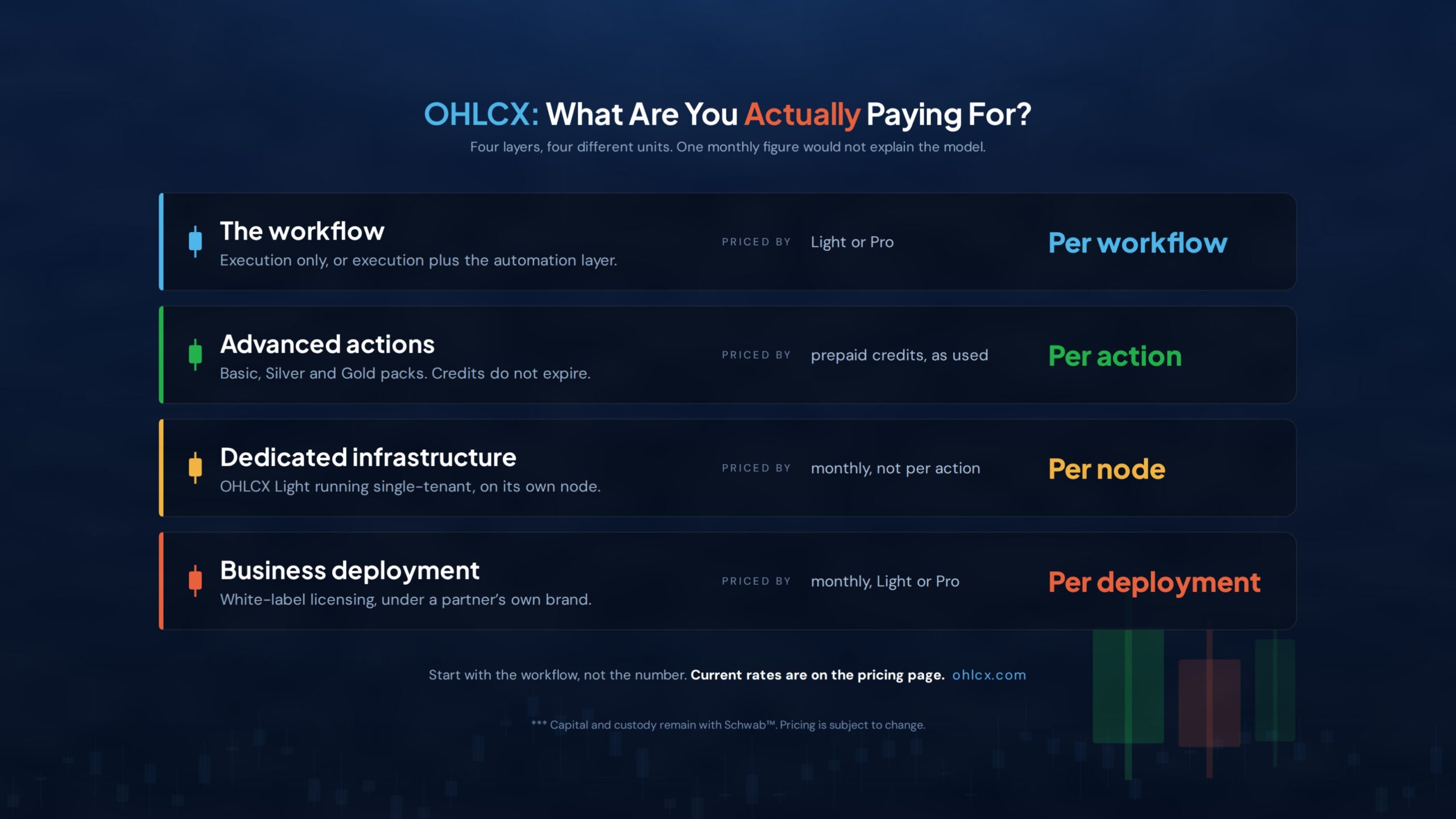
Those are different workflows, so a single headline price does not tell the whole story. A more useful way to evaluate trading platform pricing is to understand what the cost is actually tied to: platform access, advanced trading activity, automation, dedicated infrastructure, or a different deployment model for a business.
OHLCX separates those needs rather than treating every customer as though they use the platform the same way. Light and Pro define the type of workflow, prepaid credits meter advanced actions, Dedicated Trading Nodes price isolated infrastructure separately, and white-label licensing gives businesses another way to deploy the technology.
Understanding those layers makes it easier to decide which parts of OHLCX actually fit the way you trade.
Start with the workflow, not the price
Before comparing credit packs or monthly infrastructure costs, it helps to understand what you need the platform to do.
OHLCX Light is centered on broker-connected execution. Traders can work with structured order entry, positions, charts, options, advanced exit flows, risk visibility, keyboard controls, and other execution tools through a linked Schwab™ account.
For someone who manages their own setups and wants a more structured way to move from an idea into a live order, that execution layer may be the main requirement.
OHLCX Pro adds the broader automation and intelligence layer, including Strategy Builder, Signals, the Analysis Feed, and additional AI-supported platform context.
The distinction is less about one plan simply having “more” and more about how the trader expects to work. A trader who primarily wants to manage entries, exits, and positions does not necessarily need the same workflow as someone building rule-based strategies and using more of the platform’s automation.
That is the first pricing decision to make.
How does usage-based pricing fit?
Some OHLCX activity is metered through prepaid credits rather than a fixed monthly fee for those advanced actions.
Credits are purchased through Stripe in Basic, Silver, and Gold packs. Traders can see their current balance, purchase history, and usage through the billing dashboard, and purchased credits do not expire.
That means part of the cost moves with activity.
At current Gold pricing, one credit costs $0.10. One advanced TRIMMER order uses one credit, so that action costs $0.10 at the Gold rate.
The same logic applies more broadly to credit-consuming activity. A trader using more advanced orders or automation will consume more credits than someone using those capabilities less frequently.
That does not make usage-based pricing automatically better than a subscription. It simply means the cost behaves differently. Instead of paying the same fixed amount for advanced actions regardless of activity, usage follows the actions being performed.
For a trader trying to estimate cost, that creates a practical question: how much of my normal workflow actually uses the features that consume credits?
Platform access and usage are different parts of the model
It also helps to separate the trading environment itself from the activity happening within it.
OHLCX connects through the trader’s existing Schwab™ account. There is no requirement to move funds into OHLCX or open a separate brokerage account with the platform. Capital and custody remain with Schwab™ while OHLCX provides the broker-connected execution layer around that account.
Credits meter specific advanced trading and automation actions within that environment.
That distinction matters because credit usage is not the entire relationship with the platform. It is one part of the pricing model tied to particular kinds of activity.
A trader evaluating OHLCX should therefore think about two things separately: which workflow fits the way they trade, and how often they expect to use the advanced actions within that workflow.
How can you estimate your own OHLCX usage?
For an individual trader, estimating cost starts with the workflow you expect to use regularly.
If your trading is centered on broker-connected execution, order management, exits, positions, and other hands-on execution tools, Light is the execution-focused path.
If your workflow also depends on Strategy Builder, Signals, automated market analysis, and broader automation capabilities, Pro adds that layer.
From there, usage becomes easier to think about. Look at the advanced actions that are already part of how you trade and estimate how frequently you expect to use them. Credit packs can then be evaluated against actual activity instead of treating OHLCX like a flat monthly subscription.
The current OHLCX pricing page gives traders the latest credit rates, plan details, and billing information, including the features currently available across Light and Pro.
Because credits are prepaid and do not expire, unused credits remain available rather than resetting at the end of a billing period.
That gives traders a more concrete way to connect platform cost with how often they actually use advanced execution and automation.
When does dedicated infrastructure enter the picture?
Not every pricing decision is tied to trade activity.
Some customers want an isolated environment for running the platform. Dedicated Trading Nodes address that requirement by giving customers a single-tenant environment rather than the standard shared-platform infrastructure.
Dedicated Trading Nodes currently start at $499 per month.
That monthly cost is tied to the infrastructure model, not to whether the trader happens to place one more advanced order during the month. Comparing a Dedicated Node directly with the cost of a credit therefore does not tell you much because the two charges represent different things.
For traders considering a Dedicated Node, the relevant question is whether isolated infrastructure is actually part of the requirement. If it is not, the standard platform model may already fit the workflow. If it is, infrastructure becomes another part of the pricing decision alongside usage.
Readers who want to understand the operational difference can go deeper in Dedicated Trading Nodes: When Execution Infrastructure Becomes Part of the Workflow.
White-label pricing solves a different problem
White-label licensing moves the pricing conversation beyond the individual trader.
A fintech company, RIA, broker network, or other business may want to deploy OHLCX technology under its own brand rather than send users into the standard OHLCX environment.
OHLCX currently offers white-label licensing starting at $2,500 per month for Light and $5,500 per month for Pro. Current pricing details and any additional infrastructure or third-party costs are published on the OHLCX pricing page.
For a business, the decision is no longer only about which trading tools one user needs. Branding, deployment, integration, infrastructure, and the broader technology relationship become part of the evaluation.
Businesses considering that model can review OHLCX partnership and licensing options or explore Enterprise deployments when the requirements extend beyond the standard Dedicated Node or White-Label paths.
That is a different buying decision from an individual trader deciding how often they expect to use an advanced order.
Compare what you are paying for before comparing the price
OHLCX pricing covers several different needs, and they are easier to understand when they are separated.
For an individual trader, the decision usually starts with the workflow: Light for the execution-focused environment or Pro when automation and intelligence are part of how the platform will be used. Credit consumption then reflects advanced activity within that workflow.
Dedicated Nodes answer an infrastructure question. White-label and Enterprise options answer deployment questions for businesses and larger teams.
Those costs should not be treated as interchangeable because they are paying for different things.
That is also why the most useful pricing question is not simply, “How much does OHLCX cost?”
A better question is, “Which parts of OHLCX fit the way I actually trade or plan to deploy the platform, and which parts of that cost will change with my usage?”
Once that is clear, the pricing is much easier to evaluate.
Read the official pricing announcement
OHLCX recently published additional details about pricing across Light, Pro, prepaid credits, Dedicated Trading Nodes, and white-label licensing.
The official OHLCX pricing announcement covers the pricing model, credit-based usage, the current Gold credit example, Dedicated Node pricing, white-label rates, and how broker-connected access works with an existing Schwab™ account.
For the latest rates and the full breakdown of plans, credit packs, Dedicated Nodes, and licensing options, visit the OHLCX pricing page.
Pricing described in this article reflects published pricing at the time of writing and is subject to change.
Leave a Reply