Active traders do not need another source of generic market commentary.
They already have charts, news, scanners, alerts, watchlists, social feeds, and more opinions than they could reasonably process during a trading session. Adding AI to that mix only helps if it reduces some of the work required to understand what is already happening.
The more useful question is not whether AI can produce another market opinion. It is whether it can help a trader understand their own positions, strategies, signals, and market context without taking over the decision.
That is the role OHLCX is giving AI inside its broker-connected trading environment.
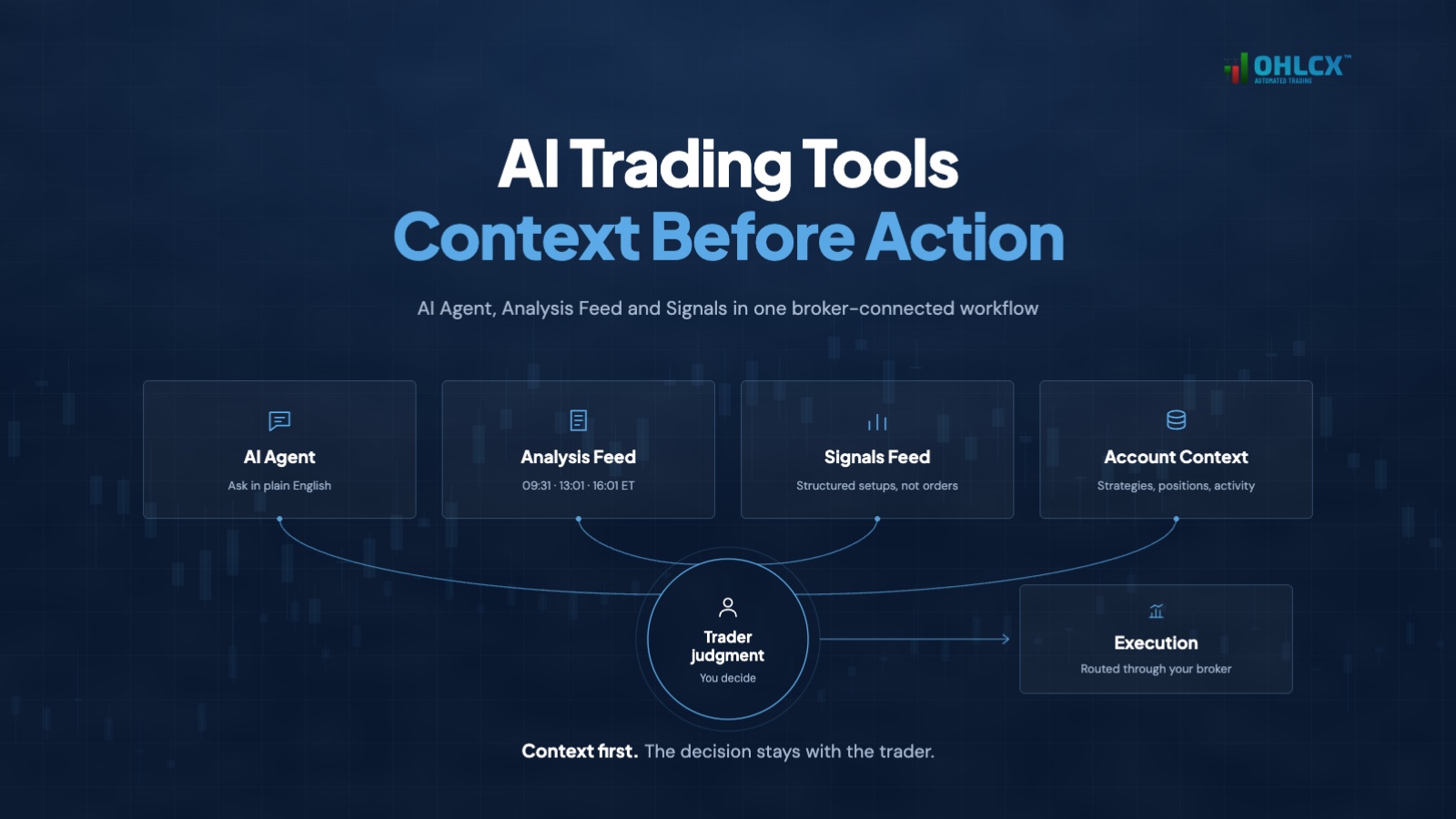
The OHLCX AI Agent gives traders a way to ask plain-English questions using context from the platform. Alongside it, the automated Analysis Feed runs scheduled market scans throughout the session, creating another layer of context that traders can review, question, or ignore before deciding what to do next. Neither is there to make the trade.
What should an AI trading assistant actually know?
A generic question usually produces a generic answer, and for a trader, that becomes a problem quickly.
A position does not exist in isolation. There may already be other exposure in the account, a strategy running against the same symbol, a recent signal, a predefined exit flow, or an analysis briefing that changes how the setup should be reviewed. The more relevant context an AI assistant can work from, the less the trader has to reconstruct manually before asking a useful question.
When a trader is signed in, the OHLCX AI Agent can reference their strategies, brokerage accounts, signals, recent activity, analysis briefings, and news. That gives the conversation a starting point inside the trader’s actual workflow rather than forcing the trader to explain that environment from scratch every time.
A trader might ask:
- What signals have appeared recently, and how do they relate to my strategies?
- Summarize what is happening across my current account and strategy activity.
- Explain the exit flow attached to this setup.
- Walk me through an analysis briefing before I decide whether it matters.
- Explain how a signal relates to a strategy I already have deployed.
The value is not that AI suddenly knows what the trader should do. It is that the trader can spend less time gathering pieces of information and more time deciding whether those pieces change the plan.
For users who are not signed in, a separate support mode works differently. It answers from the OHLCX knowledge base without requiring account data, giving traders a way to ask how the platform, order flows, and features work before connecting an account.
The two modes serve different purposes. One helps explain the platform when personal context is not needed. The other can work with information already available inside the trader’s OHLCX environment.
Market analysis does not have to mean more noise
AI is only one side of the workflow. Market analysis creates its own challenge for active traders because there is almost always something new to look at.
A scanner can keep scanning. Indicators continue to change. News keeps arriving. A trader can spend the entire session consuming information without necessarily getting closer to a better decision.
The OHLCX Analysis Feed takes a scheduled approach instead. Automated market scans run three times during each weekday session, at 09:31, 13:01, and 16:01 ET. Each briefing combines a candlestick chart with directional bias, key price levels, take-profit and stop-loss context, and written analysis built from technical information such as pivot levels, trend bias, and indicator readings.
The cadence creates three defined points for review rather than another continuous stream demanding attention. A trader can look at the market near the beginning of the session, return to it around midday, and review another scan after the cash session closes.
The briefing is there as a second opinion, not a command. A directional bias is not an instruction to enter, and a price level is not a reason to risk capital by itself. Automated analysis can surface something worth examining without deciding that it belongs in the account.
What happens when the analysis raises a question?
This is where putting the AI Agent and Analysis Feed in the same environment becomes more useful than treating them as separate features.
A trader does not have to accept a briefing at face value. They can ask the AI Agent to summarize it, explain the context behind it, or challenge what the briefing is showing before deciding whether the information changes anything.
That creates a more deliberate path from analysis to action. Instead of treating automated analysis as the beginning of an automatic trade, the trader can use it as a starting point for review.
A bullish bias, for example, may conflict with the trader’s own thesis. A technically interesting setup may add exposure the account does not need. A signal may make sense under one strategy and be irrelevant to another.
The software can help surface those relationships and make them easier to examine. The trader still has to decide what they mean and whether they justify putting capital at risk.
A signal is not the same as a trade
When an idea moves beyond analysis, OHLCX Pro’s Signals Feed gives it a more structured form. Signals bring symbol, direction, entry, take-profit, and stop-loss information into one dashboard where the trader can review the setup before acting. That creates a useful distinction between the information being surfaced and the decision to turn it into an order.
Analysis provides context. A signal gives a potential setup more structure. Execution is the point where capital is actually put at risk. Those stages can connect without becoming interchangeable.
For traders using mapped strategies and automation, configured signals can move further into the execution workflow after the platform validates the required account permissions and credit balance. Traders who prefer to review everything manually can leave the signal exactly where it is until they decide whether an order should exist.
Automation can reduce repeated steps, but it does not remove the need for judgment.
AI can make the workflow easier to question
One of the more useful roles for AI in trading may be much less dramatic than asking it to find the next trade.It can make a complicated trading environment easier to interrogate.
A trader may want to understand why a signal appeared, which strategy it is connected to, how an exit flow works, what changed between two analysis briefings, or what information is already available before another order is considered.
Those questions do not require AI to predict what happens next. They require the platform to help the trader understand what is already in front of them.
That is also why OHLCX keeps the AI Agent close to the rest of the trading workflow. The goal is not to create a separate chatbot that happens to talk about markets. The Agent sits alongside strategies, signals, account activity, analysis, and execution tools so the trader can work with those parts of the platform in plain English.
Keep intelligence and authority separate
There is a meaningful difference between software that can explain a trading environment and software that is allowed to act in it.Within OHLCX, those roles remain separate. The AI Agent can provide context. The Analysis Feed can surface market observations. The Signals Feed can organize an idea into a structured setup. Rule-based automation can carry out conditions a trader has already defined.
The AI Agent and Analysis Feed do not independently place trades or change the account. That boundary matters because more capable trading technology does not make risk disappear. It does not make an analysis correct, turn a signal into a suitable trade, or decide how much capital should be committed.
Trading decisions, capital allocation, and risk decisions remain with the user. For active traders, that may be the more useful way to think about AI: not as something that removes judgment, but as another tool for bringing relevant context closer to the point where judgment is required.
Read the official announcement
OHLCX introduced the in-app AI Agent alongside expanded automated market analysis as part of its growing broker-connected trading environment.
The official OHLCX AI Agent and automated market analysis announcement includes the full release details, product availability, Analysis Feed schedule, Signals Feed integration, and developer access through the OHLCX REST API and MCP Server.
To explore how the Agent works in the platform, visit the OHLCX AI Agent. Traders can also learn more about the broader OHLCX automation workflow.
Leave a Reply