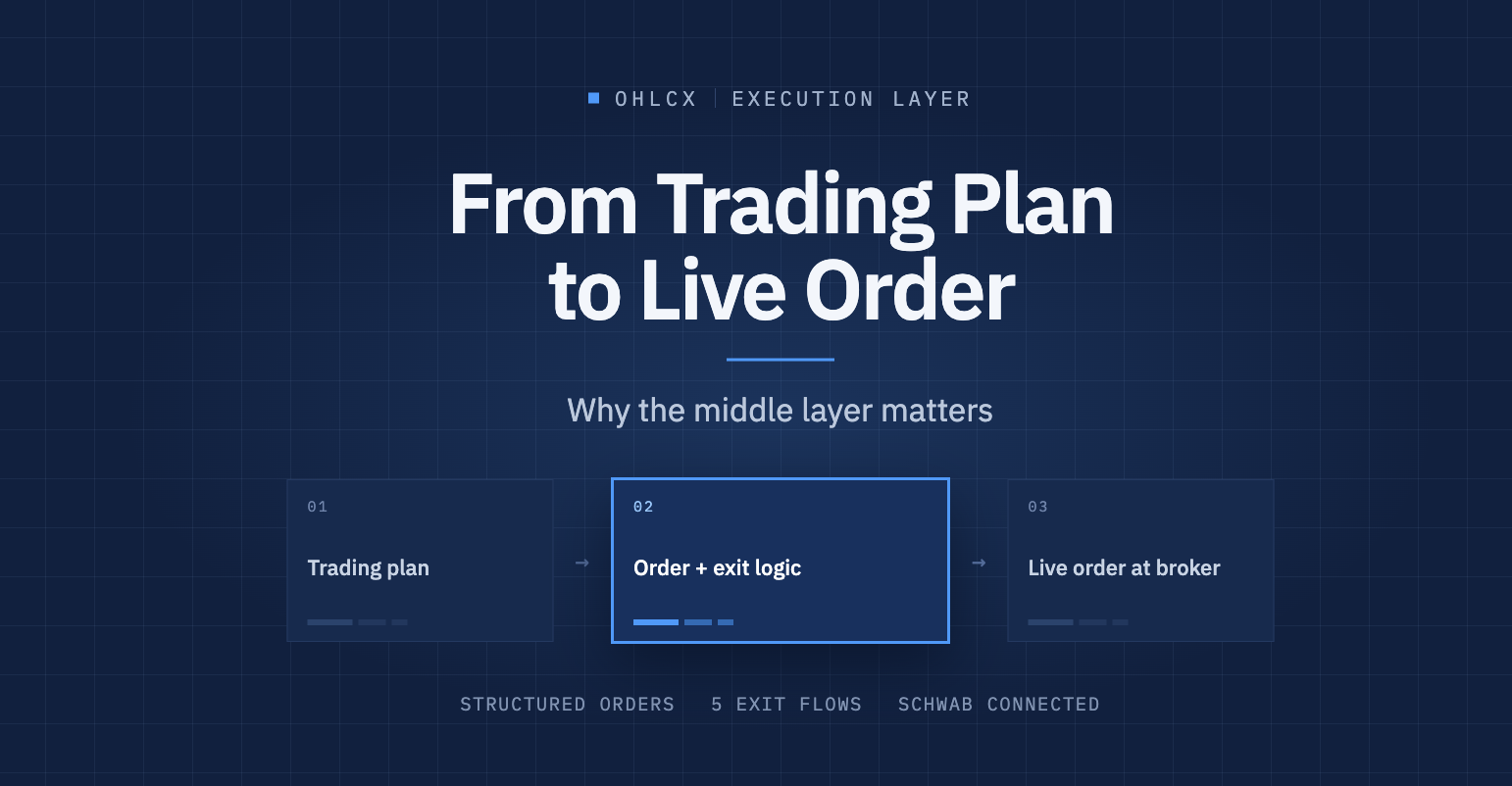
A trader can have a clear setup and still lose pieces of the plan on the way to the broker.
The idea gets reviewed in one place. Position size is checked somewhere else. The order is built at the broker. Stops and targets may be added after the fill. Alerts, analysis, or automation may live in another tool entirely.
None of those steps is necessarily a problem on its own. The problem is the handoff.
Every time part of the plan has to be rebuilt, there is another opportunity for the order that goes live to look different from the trade that was originally intended.
OHLCX is a broker-connected execution platform built around that middle layer between the trading plan and live execution. A recent OHLCX platform milestone brings execution, no-code automation, market analysis, an in-app AI Agent, and dedicated infrastructure together in the same environment.
The platform has grown. The underlying idea has not: the trader defines the plan, and the technology helps carry that plan into executable order logic.
What belongs in the middle layer?
A trading plan is more than an entry price. There is position size to decide, an order type to choose, risk to review, exits to define, and sometimes conditions or schedules that determine whether an order should be active at all.
Those decisions eventually have to become something the broker can execute.
OHLCX connects through a trader’s own Schwab account and routes live orders through Schwab. Capital and custody remain with Schwab, while trading decisions stay with the user.
The execution workflow gives the trader a place to structure the order before it goes live. That includes market, limit, and stop orders along with five exit-flow types, from standard brackets and trailing stops to staged exits through TRIMMER.
Order management and trade management meet here. The entry needs to reach the broker, but the position also needs a plan for what happens next.
For a trader who already knows how a position should be managed, defining that logic earlier can reduce the amount that has to be rebuilt once the market is moving.
The stop is not waiting in the trader’s head. The partial-exit plan does not have to be recreated after entry. More of the original intent can travel with the order from the start.
That is what the middle layer is supposed to do.
Where does automation fit?
Automation can remove repeated manual steps. It cannot decide what a trader actually wants.
OHLCX Pro adds a no-code Strategy Builder for defining trading conditions, sizing, schedules, and exits as structured rules. The trader decides what those rules should be and how much automation belongs in the workflow.
A rule such as “enter when these conditions are met” still requires the trader to decide which conditions matter. Position sizing still requires a risk decision. An automated exit still needs a reason for being there.
The useful part of trading automation comes after those choices have been made.
Instead of rebuilding the same sequence each time a setup appears, the trader can define the logic ahead of time and let the platform carry out the configured steps when those conditions are met.
The platform handles the rule. The trader remains responsible for the reasoning behind it.
Analysis can inform the decision without making it
OHLCX Pro also brings more market context into the same trading workflow.
The unified Signals Feed surfaces structured trade context. The automated Analysis Feed scans the market and provides analysis during pre-market, the active session, and post-market periods. The in-app AI Agent can answer trading and platform questions using context from the trader’s own account and strategies.
Those tools can help a trader review what is happening without turning analysis into an instruction to trade.
A signal can be worth reviewing and still not belong in the account. Market analysis can change how a trader sees current conditions without changing the amount of risk they are willing to take. An AI Agent can make information easier to work with without becoming the decision-maker.
That boundary matters as more intelligence enters trading platforms.
More analysis does not automatically mean a trader should do more. Sometimes the useful outcome of better information is deciding not to send the order.
OHLCX remains execution technology, not a recommendation engine. The final decision stays with the trader.
Why keep execution at the center?
Research can identify a setup. Analysis can provide context. Automation can carry defined rules.
Eventually, the trade still has to become an order.
That is where position size becomes actual exposure. The stop and target become live instructions. A staged exit becomes something the platform may need to manage while price is moving.
Execution is where the plan stops being theoretical.
Keeping the execution layer connected to the tools around it makes the workflow easier to follow. A trader can review the account, work with analysis, define rules, structure the order, and choose exits without treating every step as a separate system.
Risk visibility belongs there too.
Before another order goes live, the trader should be able to see what is already deployed and decide whether adding more exposure still fits the plan. The platform can make that information visible. It cannot decide how much risk the trader should accept.
That separation is important. Better execution technology can make a trading process more structured. It cannot make the underlying decision for the trader.
Dedicated infrastructure solves a different part of the workflow
The same idea extends beyond what appears on the screen.
For traders who want the OHLCX execution environment separated from other customer workloads, Dedicated Trading Nodes run the full OHLCX Light platform in a single-tenant cloud environment.
Dedicated infrastructure does not make a setup better or change how the market behaves. It gives the broker-connected trading environment its own runtime for customers who want that level of separation.
Brokerage control still stays with the trader. Trading decisions still stay with the trader. The Node changes the infrastructure around the workflow, not who is responsible for the trade.
OHLCX also makes platform capabilities available to developers through its REST API and MCP tools, giving technical users another way to work with the execution environment.
One platform should not mean one decision-maker
Bringing trade execution, automation, market analysis, AI, and infrastructure together can make the workflow more connected.
It should not blur responsibility.
OHLCX does not decide which trade belongs in the account, how much capital a trader should risk, or whether a strategy will work. It is not a broker, investment adviser, custodian, or substitute for trader judgment.
The trader still owns the plan.
What changes is how much of that plan can be expressed, reviewed, and carried through one broker-connected environment before and after an order goes live.
That is the significance of this platform milestone.
OHLCX has expanded beyond the execution ticket, but execution remains the anchor. Automation follows user-defined rules. Analysis provides context. AI supports the workflow. Dedicated infrastructure provides another way to run it.
The pieces have expanded, but the responsibility has not moved.
Read the official platform milestone announcement
The official OHLCX platform milestone announcement covers the release details behind this expansion, including broker-connected execution, OHLCX Pro automation, the Signals and Analysis feeds, the in-app AI Agent, Dedicated Trading Nodes, and developer access through REST API and MCP tools.
It also covers where the platform stands today and the areas OHLCX plans to continue expanding.
Leave a Reply