Execution is not only the order a trader sends. It is also the environment that order moves through before, during, and after it reaches the broker.
For active traders, that environment matters. The order ticket, account connection, market data, position view, exit logic, background workers, and activity history all sit between the trading plan and the live order. When those pieces are scattered, shared, or difficult to review, the execution workflow becomes harder to trust.
That is the practical reason dedicated infrastructure matters.
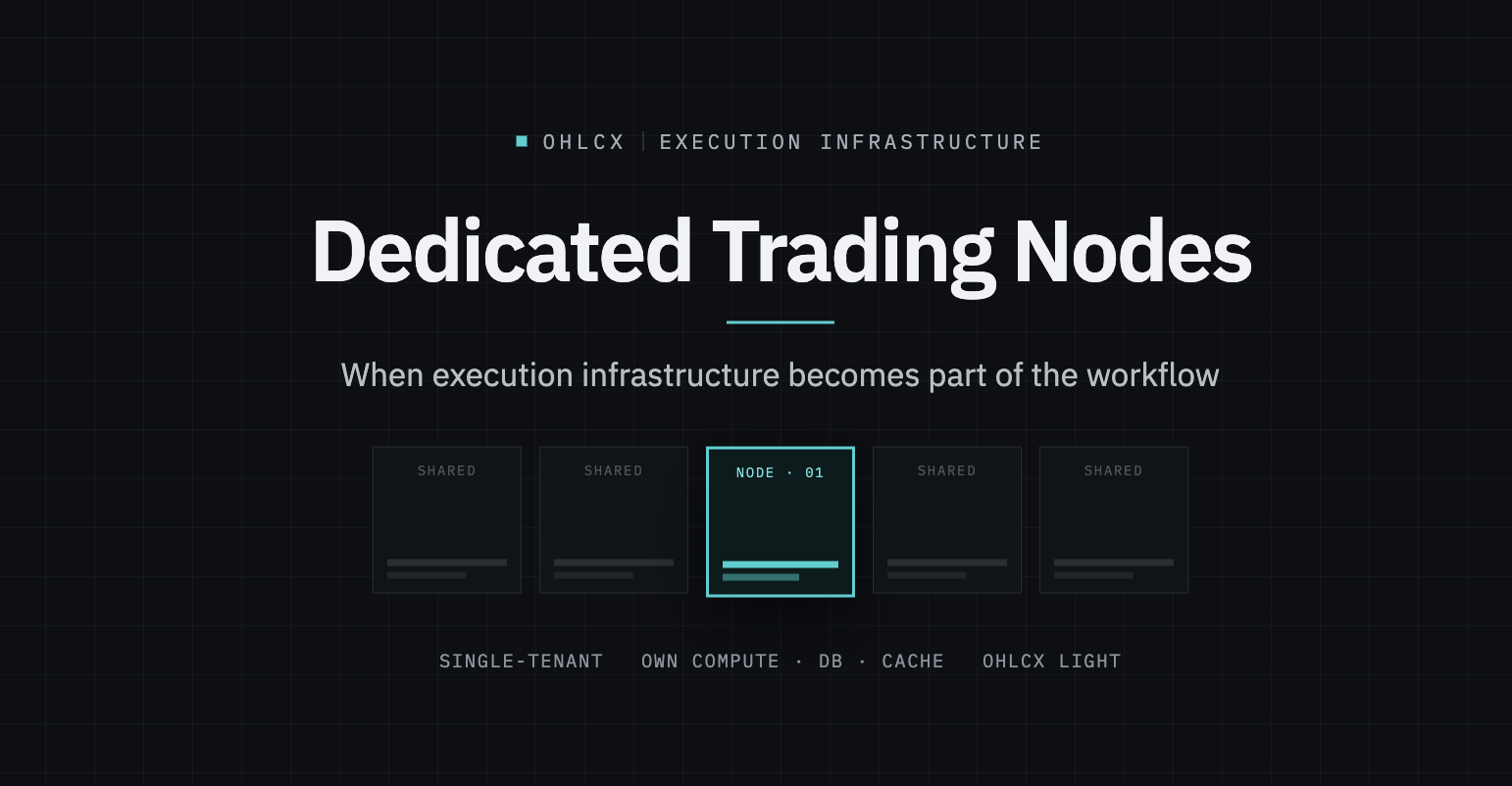
A Dedicated Trading Node gives a trader a single-tenant cloud environment for running the OHLCX Light platform. Instead of sharing the same application resources with other customers, the trader’s Node runs on its own AWS instance with its own compute, database, and cache. OHLCX manages the underlying infrastructure, while the trader remains responsible for the brokerage account, API authorization, trading decisions, and risk.
That distinction is important. Dedicated infrastructure does not make the trade better by itself. It does not choose entries, predict exits, improve fills, or replace trader judgment. It gives the execution workflow its own environment, so the platform, connection, records, and configured trading tools are easier to separate from everyone else’s workload.
For traders who already think in terms of order logic, exits, risk visibility, and repeatable workflows, that separation can matter.
What is a Dedicated Trading Node?
A Dedicated Trading Node is an isolated cloud environment provisioned for one customer.
Each Node runs the full OHLCX Light application. The trader can use the same core platform environment for orders, positions, portfolio information, P&L, charts, market data, risk visibility, keyboard-driven execution, and exit workflows.
The difference is the infrastructure model. With a Dedicated Trading Node, the application runs on its own AWS instance with its own compute, database, and cache. No other OHLCX customer workload runs on those resources. The Node is still managed by OHLCX, including health monitoring, background services, and application maintenance, but the environment itself is provisioned specifically for that customer.
That makes the Node different from simply having a separate login or workspace. A login separates access. A Dedicated Trading Node separates the runtime environment.
Why infrastructure belongs in the execution conversation
Trading platforms are often judged by the visible workflow: the chart, the ticket, the watchlist, the account panel, the exit tools, and the speed of moving from decision to order.
Those pieces matter. But they are not the whole workflow. Behind the visible screen are the systems that keep the platform usable: account connectivity, application services, background processes, databases, cache layers, health checks, activity logs, and the infrastructure that keeps those pieces running. When the trader is trying to manage live orders or review execution history, those systems are no longer “back office.” They are part of the trading environment.
This does not mean every active trader needs dedicated infrastructure. Many traders can work effectively on a standard platform environment. But some traders want more separation, more configurability, and a clearer operating boundary around the platform they use to manage order execution.
That is where a Dedicated Trading Node fit in. The value is not mystery or complexity. The value is cleaner separation: one customer, one Node, one cloud environment running OHLCX Light.
What traders can configure during provisioning
A Dedicated Trading Node is not meant to be a generic shared workspace with a different label.
During provisioning, customers can configure key infrastructure details, including instance size and AWS region. They can also optionally set a custom subdomain. Once the Node is active, the dashboard gives visibility into configuration, health status, Schwab API connectivity, and activity history.
The Node also includes controls to start, stop, synchronize, or terminate the environment.
That matters because active traders do not only need access. They need to know whether the environment is healthy, whether the brokerage connection is active, and what has happened inside the system over time.
The Node dashboard makes those operational details part of the workflow rather than a hidden support conversation.
Brokerage connectivity stays under the trader’s control
Dedicated Trading Nodes connect through the customer’s own approved Schwab Developer API application and authorization.
That means the trader configures their API credentials inside their Dedicated Node and authorizes their own Schwab brokerage account connection. Brokerage access remains under the customer’s own account and control.
This is a core part of the model. OHLCX is not a broker, custodian, investment adviser, or recommendation engine. It does not manage customer funds or make trading decisions for the user. Capital allocation, trade selection, and risk decisions remain with the trader.
The Dedicated Node gives the trader an isolated environment for running OHLCX Light. It does not change who controls the brokerage account.
Execution tools still need trader-defined intent
A dedicated environment is useful only if the trading workflow inside it is clear. OHLCX Light centers on structured order entry and exit management. In addition to market, limit, and stop orders, OHLCX Light supports OCO, TSP, TRIM, and TRIMMER for linked exits, triggered brackets, trailing stops, and staged partial exits.
These tools are designed to help traders define more of the position-management plan before the order goes live.
That matters because many execution errors do not begin with the broker connection. They begin with unclear intent. A trader enters the position, then rebuilds the stop, target, or partial-exit logic while the position is already moving. Under pressure, small decisions can turn into inconsistent execution.
Structured exits help reduce that improvisation. The trader can define the order logic earlier, review it in the ticket, and carry the plan into position management with fewer disconnected steps.
Where TRIMMER fits
TRIMMER is OHLCX’s configurable adaptive staged exit engine. The idea is straightforward: traders define how they want to scale out of a position, and TRIMMER carries those rules through the position-management process as configured. It does not predict market direction. It does not choose the trade. It does not decide whether a position should be entered or exited.
That keeps the responsibility where it belongs. The trader defines the plan. The platform helps structure the execution logic. The Node gives that workflow its own environment.
For traders who use staged exits, this distinction matters. A partial-exit plan is only useful if it can be built before stress arrives and reviewed after the order is live. TRIMMER supports that kind of predefined structure without turning the platform into a recommendation engine.
Dedicated infrastructure does not replace risk discipline
Dedicated infrastructure can make the execution environment cleaner. It does not make a trader disciplined by default.
A trader still has to decide whether the setup belongs in the account, whether the position size is appropriate, whether the stop and target make sense, whether partial exits fit the thesis, and whether the account can absorb the trade.
Risk visibility remains part of the workflow because infrastructure and discipline solve different problems. The Node can give the platform its own compute, database, cache, health status, and activity history. OHLCX Light can give the trader order tools, exits, positions, market data, and risk visibility in one environment. But the trader still owns the decision.
That is the point of execution-first technology. It does not remove judgment. It gives judgment a clearer place to become order logic.
Dedicated Trading Nodes and OHLCX Light
Dedicated Trading Nodes are offered alongside the standard OHLCX Light platform. Every Dedicated Trading Node runs the full OHLCX Light application. The difference is not a reduced or separate product. It is the same OHLCX Light platform running in a single-tenant environment provisioned for the customer.
For some traders, the standard OHLCX Light platform may be the right fit. For others, especially those who want an isolated cloud environment with configurable infrastructure, a Dedicated Trading Node may be the more appropriate model. The decision comes down to how the trader wants to run the execution workflow.
If the priority is a standard platform experience, OHLCX Light provides that path. If the priority is an isolated environment with its own resources, configurable provisioning, Node health visibility, and customer-managed Schwab API connectivity, Dedicated Trading Nodes provide that option.
Read the official announcement
OHLCX has opened early access to Dedicated Trading Nodes for active traders. The official press release includes the launch details, infrastructure model, brokerage connectivity approach, early access pricing, setup-fee waiver, and provisioning information. Or view the setup walkthrough or provision a Dedicated Trading Node.
Keep the execution environment deliberate
A trading plan does not become real until it reaches the ticket. The ticket does not operate alone. It depends on the environment around it: the account connection, the order workflow, the exit tools, the data shown to the trader, the logs that preserve what happened, and the infrastructure that keeps the platform running. Dedicated Trading Nodes are built for traders who want that environment separated and provisioned around their own use of OHLCX Light.
The benefit is not that the Node makes decisions. The benefit is that the trader can work in an isolated execution environment, connect through their own Schwab API access, define order and exit logic inside OHLCX Light, and keep the workflow more deliberate from setup through review.
Leave a Reply