A trading platform can give a trader more control over orders, exits, automation, and account visibility without becoming the broker that holds the account. When another platform connects to a brokerage account, though, the interface can make the relationship feel like one system even when several different roles are involved behind the scenes.
Someone authenticates the trader. Someone holds the cash and securities. A technology layer may help build and manage the order, while the broker receives that order and handles the brokerage side of execution. Understanding where those responsibilities sit is useful before live capital is involved.
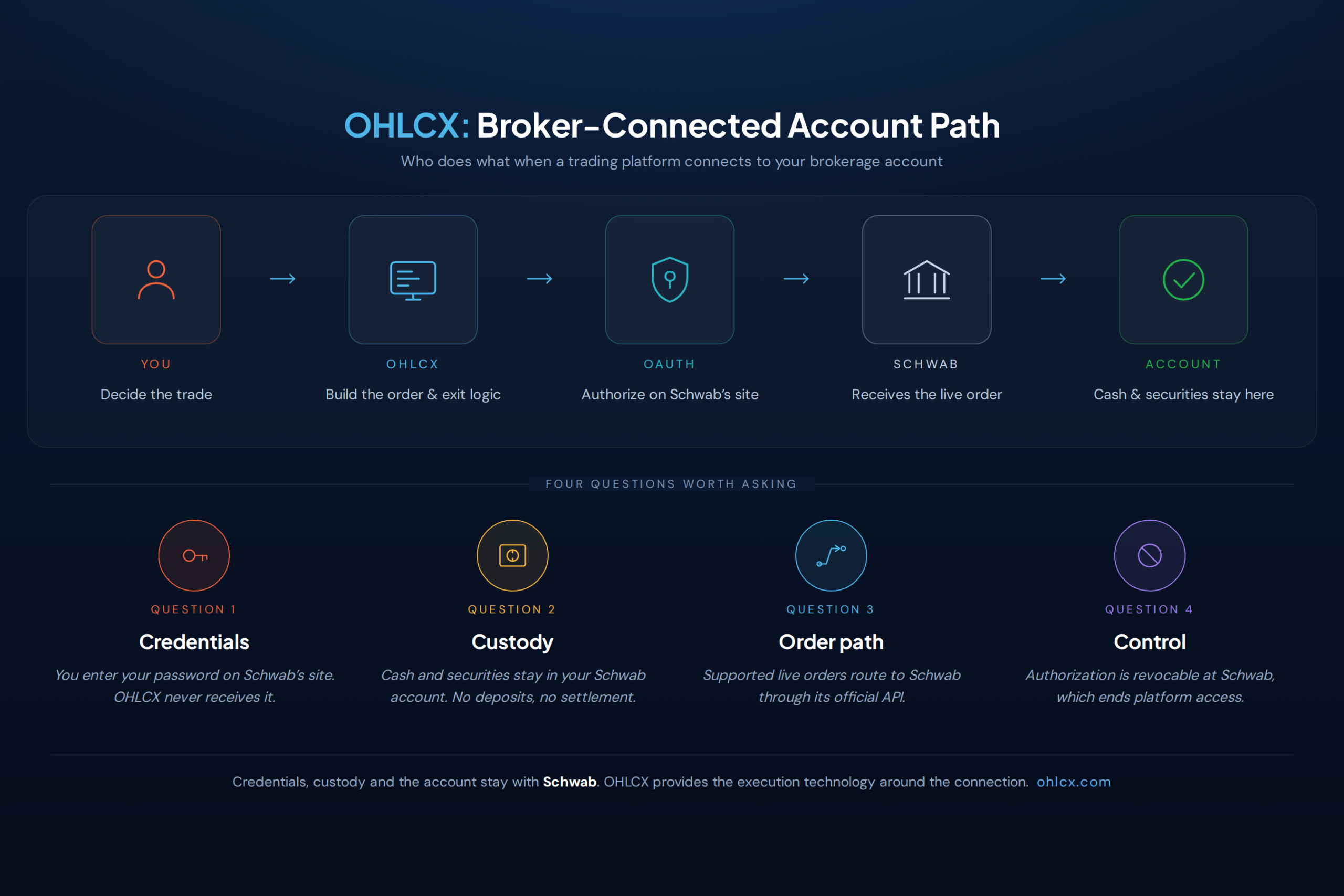
For traders evaluating any broker-connected trading platform, four questions are worth asking: Who receives my brokerage credentials? Where do my assets stay? How does my order reach the broker? And who controls the connection?
OHLCX provides one example of how those roles can stay separate. The platform connects to Schwab through its official API, traders authenticate directly with Schwab, and supported live orders route to the trader’s own Schwab brokerage account. OHLCX provides the execution technology around that connection, while the account and capital remain with Schwab.
Who actually receives your brokerage credentials?
Connecting a platform to a brokerage account does not necessarily mean giving that platform the username and password used to access the broker. With OAuth, authentication and authorization can remain separate from the trading interface itself.
With OHLCX, a trader authorizes the connection on Schwab’s website. Schwab handles the login and provides token-based access that allows OHLCX to interact with the connected account. OHLCX does not receive or store the trader’s Schwab username or password.
This is different from approaches that depend on storing brokerage credentials, scraping information from a broker website, or automating a browser session. For the trader, the practical question is simple: when I enter my brokerage password, who am I actually giving it to? In the OHLCX workflow, authentication happens with Schwab.
We cover the mechanics and day-to-day implications of that connection in more detail in Schwab OAuth: What Secure Connectivity Changes for Traders. Here, the important distinction is between authenticating with the broker and authorizing another platform to work with the account.
Where do the cash and securities stay?
Account access and asset custody are not the same thing. A connected platform may be able to display balances, positions, working orders, or other account information without holding any of those assets itself.
With OHLCX, capital and custody remain with Schwab. OHLCX does not accept deposits, hold customer funds, or handle settlement. Once the connection is authorized, OHLCX can work with live account data such as positions, balances, and orders, but the brokerage account itself stays at Schwab.
That distinction matters because a different trading interface does not necessarily mean a different brokerage relationship.
The OHLCX platform provides tools around order management, positions, risk visibility, exit logic, and optional automation. Schwab continues to hold the account and customer assets, so the trader gains another way to work with the account without changing where the capital is held.
How does an order move from the platform to the broker?
A connected trading workflow has several layers. At a high level, the path can be thought of as:
Trading decision → order and execution workflow → broker connection → brokerage account
The first part belongs to the trader. The trader decides whether a setup belongs in the account, how large it should be, and what risk they are willing to accept.
OHLCX can then help turn that decision into structured order logic. The trader may choose an order type, define position size, attach an exit flow, or use rules that were previously configured for automation.
When a supported live order is submitted through OHLCX, it routes to the trader’s connected Schwab account through Schwab’s official API. OHLCX provides the order-management and execution workflow used to create and submit the instruction, while Schwab receives the brokerage order.
What happens after the broker accepts that order is a separate part of the execution process. We discuss that downstream layer in Dark Pools and Retail Routes: What You Can and Cannot Control.
Understanding where one layer ends and another begins also makes trade review more useful. An incorrectly configured order, an interrupted broker connection, and an unexpected execution outcome are different issues even if they eventually appear to the trader through the same workspace.
Who controls the connection?
Broker-connected access should also be removable. With Schwab OAuth, the connection is based on authorization rather than shared login credentials, and the trader can revoke that authorization through Schwab to terminate OHLCX access.
That gives the account owner a control point at the broker rather than leaving access dependent on whether another platform possesses the brokerage password.
The same principle applies when a trader works with more than one account. OHLCX can work with connected account information and support account-specific strategy deployment, but the underlying brokerage authorization remains tied to the customer’s Schwab account access.
For traders evaluating connected technology, this is worth checking before the account is linked. If you no longer want an application to access the brokerage account, there should be a clear way to end that connection.
What should the technology layer actually add?
If the broker already holds the account and receives the live order, another trading platform needs to add something useful between the trader’s decision and the brokerage ticket.
For OHLCX, that role is the execution workflow. The platform gives traders an environment for structuring orders, viewing positions and account information, managing exit logic, reviewing risk, and using optional rule-based automation while remaining connected to the existing Schwab account.
A trader can use that layer to define more of the order before it reaches the broker. For a manual trade, that might mean setting the size, order type, stop, target, or staged exit before submitting the ticket. For an automated strategy, it may mean allowing previously configured conditions to produce a structured order when the trader has enabled live routing.
Those functions change how the trader works with the account, but they do not turn OHLCX into the broker or transfer custody of the assets. OHLCX sits between the trading plan and the brokerage account as execution technology, while the brokerage relationship remains with Schwab.
Live access should leave something to review
Once a platform can interact with a live brokerage account, traders should also be able to review what happened. OHLCX records order actions as part of the platform’s audit trail, providing a history around the execution workflow that can help a trader understand what action was taken and when.
That becomes more useful as workflows become more complex. A trader may be working manually, managing several accounts, or running configured automation. When an order or position needs to be reviewed later, a record of platform activity provides another part of the execution story.
OHLCX also includes paper-trading and sandbox capabilities that can be used to rehearse strategies and exit flows without live capital before deploying them to a live account. Paper trading cannot reproduce every condition of live execution, but it can help answer a basic question first: does the workflow behave the way the trader expects it to?
For a broker-connected platform, both sides matter. Traders should understand how the live connection works and have a way to test the workflow they intend to run through it.
Broker-connected should make the relationship clearer
A connected trading platform should make it easier, not harder, to understand who is responsible for what.
The trader should know who handles authentication, where the account and assets remain, how an order moves from the platform to the broker, and how access can be removed. Those are not background technical details once live capital is involved.
OHLCX is designed as the execution layer around an existing Schwab brokerage account. Traders authenticate through Schwab, capital remains at Schwab, and supported live orders route through Schwab’s official API. OHLCX provides the order-management, execution, risk, and automation tools around that connection, while trading decisions remain with the user.
Understanding those boundaries makes it easier to evaluate what the technology is adding and what responsibility still belongs elsewhere.
Read the official announcement
OHLCX recently published additional details about the broker-connected execution model behind the platform, including Schwab API routing, OAuth authorization, credential handling, account access, audit history, and paper-trading capabilities.
The official OHLCX Schwab broker-connectivity announcement includes the full release details and additional information about the platform architecture.
To learn more about OHLCX execution and brokerage connectivity, visit the OHLCX platform overview.
Leave a Reply