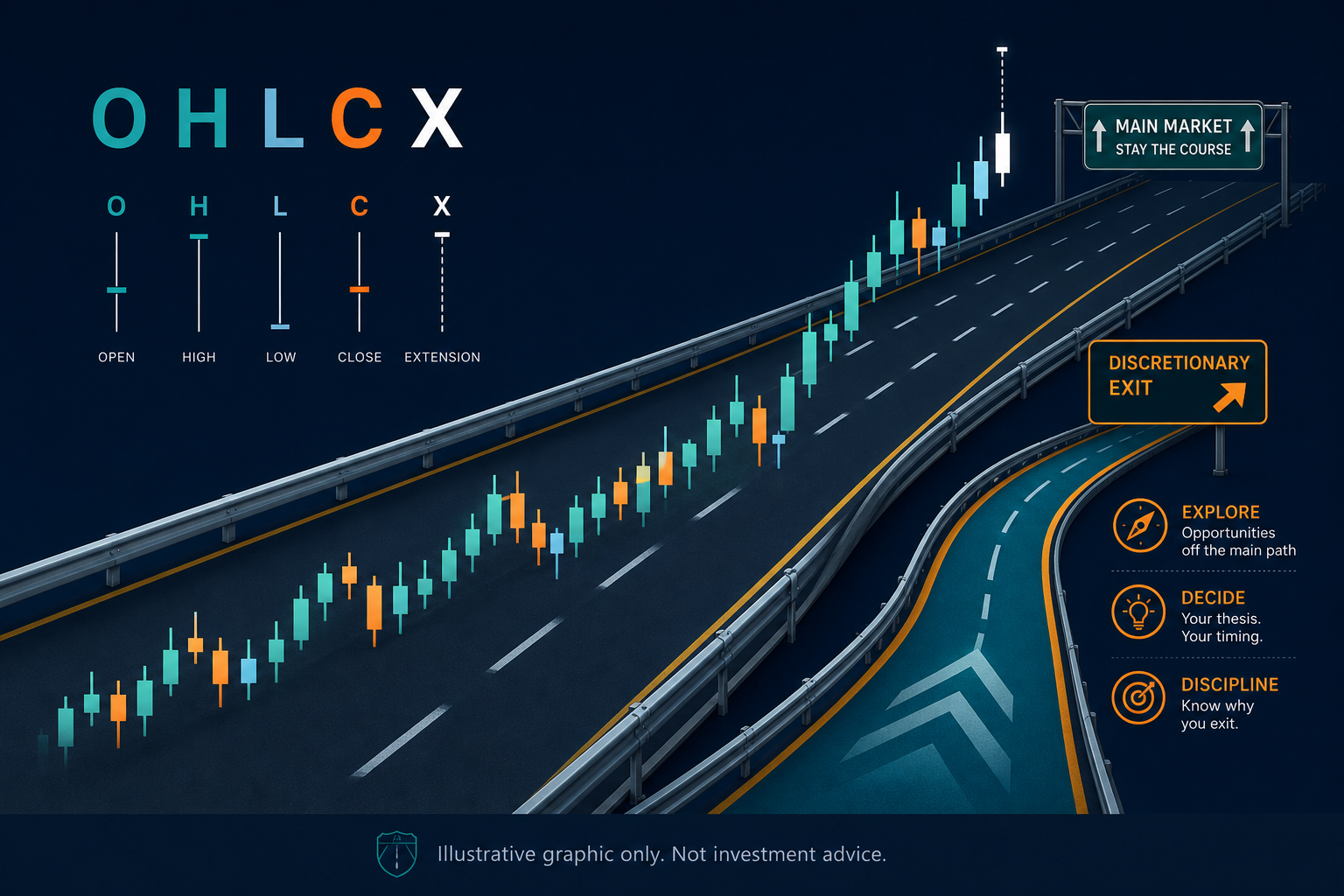
Every trader uses discretion. The question is where that discretion belongs.
Some decisions can reasonably change as the market develops: whether a setup still looks valid, whether the entry needs more patience, whether the catalyst still matters, or whether the trade is worth taking at all. Other decisions should not be renegotiated in the middle of a live order: max loss, position size, portfolio exposure, liquidity limits, cooling-off rules, and what happens when order state becomes unclear.
That is the difference between a playbook and a judgment call. The playbook defines the rules that protect the account. Discretion operates inside those rules. When the two get mixed together, traders can start calling rule breaks “nuance,” especially when the trade is moving fast or conviction is high.
The cost usually shows up in familiar places: a position that is too large for the account, a stop moved beyond the original risk budget, a second trade that doubles the same exposure, or an exit decision made after liquidity has already deteriorated.
The goal is not to remove judgment from trading. The goal is to protect the parts of the process that should not depend on mood, pressure, or the last candle.
What belongs in the playbook, and what belongs to judgment?
A useful trading playbook separates fixed rules from flexible decisions.
Fixed rules are the parts of the process that should not change during the trade: maximum dollar risk, maximum position size, portfolio heat, liquidity requirements, exit structure, cooling-off triggers, and unclear-order-state procedures.
Flexible decisions are the choices that happen inside those boundaries: whether to take the setup, whether to wait for a cleaner entry, whether the catalyst still matters, and whether the tape supports the idea.
That distinction matters because traders rarely break rules in obvious language. They do not usually say, “I am ignoring my max loss.” They say the setup is different. They do not say, “I am adding correlated exposure at the wrong time.” They say the second name is cleaner.
Clean language protects the process. If a rule is fixed, call it fixed. If a decision is discretionary, define where the discretion starts and stops. If a “temporary exception” lasts for months, it is not temporary anymore. It is an undocumented rule.
Which trading rules should stay rigid?
Rigid rules belong where the cost of improvisation can change the account-level outcome faster than better interpretation can help. That usually means capital, exposure, liquidity, and operational clarity.
A short list should stay firm:
- Per-trade and portfolio risk caps: Maximum dollar risk, maximum position size, and portfolio heat limits should not change because conviction gets louder.
- Daily loss and cooling-off rules: After a defined loss or a cluster of ticket violations, the playbook should decide whether new risk is still allowed.
- Liquidity and spread limits: If the market is too wide or thin for the planned size, discretion should not talk the trade into being. A setup can still be valid while the available liquidity makes the ticket unattractive.
- Halt, gap, and unclear-order-state procedures: When the live state becomes uncertain, the next step should already be written.
- Defensive actions: Flattening, reducing, or verifying existing exposure should remain available even when new initiation is blocked.
These rules are not there because the trader lacks skill. They are there because skill degrades under pressure, and the market does not care whether the violation felt reasonable at the time.
Rigid does not mean thoughtless. It means the thinking happened before the moment became emotional.
Where does discretion still belong?
Discretion still has an important role. It belongs in selection, timing, and interpretation.
A trader can decide not to take a valid setup because the context looks weak. A trader can wait for a cleaner entry inside a preset risk limit. A trader can choose between allowed order structures based on liquidity, timing, or event risk. That discretion can improve the trade by avoiding a poor fill, waiting for cleaner participation, or passing when the reward no longer justifies the risk.
That is real judgment. It is also bounded judgment.
What discretion cannot do is rewrite the account’s risk rules mid-send. It cannot redefine max loss because the trade “needs room.” It cannot remove a planned exit because the tape looks like it might turn. It cannot add size after the account has already reached its exposure limit.
That is not discretion. That is a rule break with better vocabulary.
When should discretion be refused?
Discretion should be refused when the environment makes good judgment harder and the cost of being wrong larger.
That includes max portfolio heat, repeated ticket-quality violations, poor liquidity, unclear borrow conditions for shorts, halt reopenings, major macro prints, or any period after a cooling-off trigger has fired. In those windows, the playbook should allow defensive management of existing risk, but it should prevent fresh interpretation from becoming fresh exposure.
The rule does not have to be dramatic. It can be simple: no new risk, verify working orders, reduce if needed, and review later. The important part is that the decision is made before the trader is emotionally invested in the next click.
Conviction is not enough when bandwidth, liquidity, or account heat has already failed the test.
Automation needs the same boundary
Automation does not remove the playbook problem. It makes the boundary more important.
Stable, repeatable steps can be good candidates for rule-based automation: recurring setup conditions, structured ticket preparation, default size rules, or predefined exit logic. But automation should not be treated as permission to skip review where review is still required.
The cleanest rule is this: automate the repeatable workflow, not the excuse to avoid judgment. If market conditions shift, liquidity changes, a halt occurs, or exposure breaches the playbook’s limits, the workflow should return to manual review.
Strategy Builder can support no-code, rule-based automation using conditions the trader defines. The trader remains responsible for deciding when those conditions still belong in production.
Automation should make a sound rule easier to repeat. It should not make a questionable rule easier to scale.
Change the rule, but not mid-trade
Rigid does not mean permanent. A rule can be wrong, stale, or too narrow. But changing a rule should be a review process, not a live-session negotiation.
If a max size rule no longer fits the account, revise it after review. If a halt procedure is too slow, test a better one at smaller size. If an exit template creates repeated cancel-replace errors, adjust the template and monitor whether ticket quality improves.
What should not happen is a live override with no record and no follow-up. An override can make money and still be procedurally wrong. A rule can lose money and still be correct. Those are separate questions, and they need to be reviewed separately.
Rigidity without feedback becomes superstition. Discretion without review becomes drift.
How OHLCX supports fixed rules and discretionary decisions
OHLCX is not a substitute for trader judgment, and it does not decide which rules should be rigid. The trader owns the playbook.
What OHLCX can support is the execution layer where those rules are easier to carry into the actual ticket. Structured order entry helps turn a planned response into order logic instead of a set of loose intentions. Exits like OCO, OTOCO, TSP, TRIM, and TRIMMER can be selected before the order goes live, so exit policy is not left for a more emotional moment after the fill.
Persistent defaults and keyboard shortcuts can help reduce the need to rebuild the same order structure under pressure. Risk Gauge visibility gives the trader a clearer reference point for exposure before adding risk. Order history and timestamps provide a record for later review, which the trader can compare against the playbook to see whether the ticket followed the plan or whether discretion crossed into rule-breaking.
That matters because the financial damage often happens in the gap between the rule the trader thought they were following and the order they actually sent.
For traders using Strategy Builder, rule-based automation can support clearly defined workflows where the trader sets the conditions. The same boundary still applies: automation belongs in the repeatable layer, while human judgment belongs at defined gates.
OHLCX helps traders turn a plan into executable order logic. It does not decide whether the trade belongs in the account.
Keep the rules clear so discretion can do its job
Discretion and playbooks are not enemies. They fail when they are asked to do each other’s work.
Use fixed rules for survival: size, heat, liquidity, cooling-off triggers, and defensive actions when order state becomes unclear. Use discretion for selection, timing, and interpretation inside those boundaries. Then review the exceptions honestly, because the most expensive rules are usually the ones traders bend without naming.
Request access to OHLCX to see how structured order entry, visible risk context, and user-defined workflows can help keep the fixed rules clear while the trading decision stays with you.
Leave a Reply