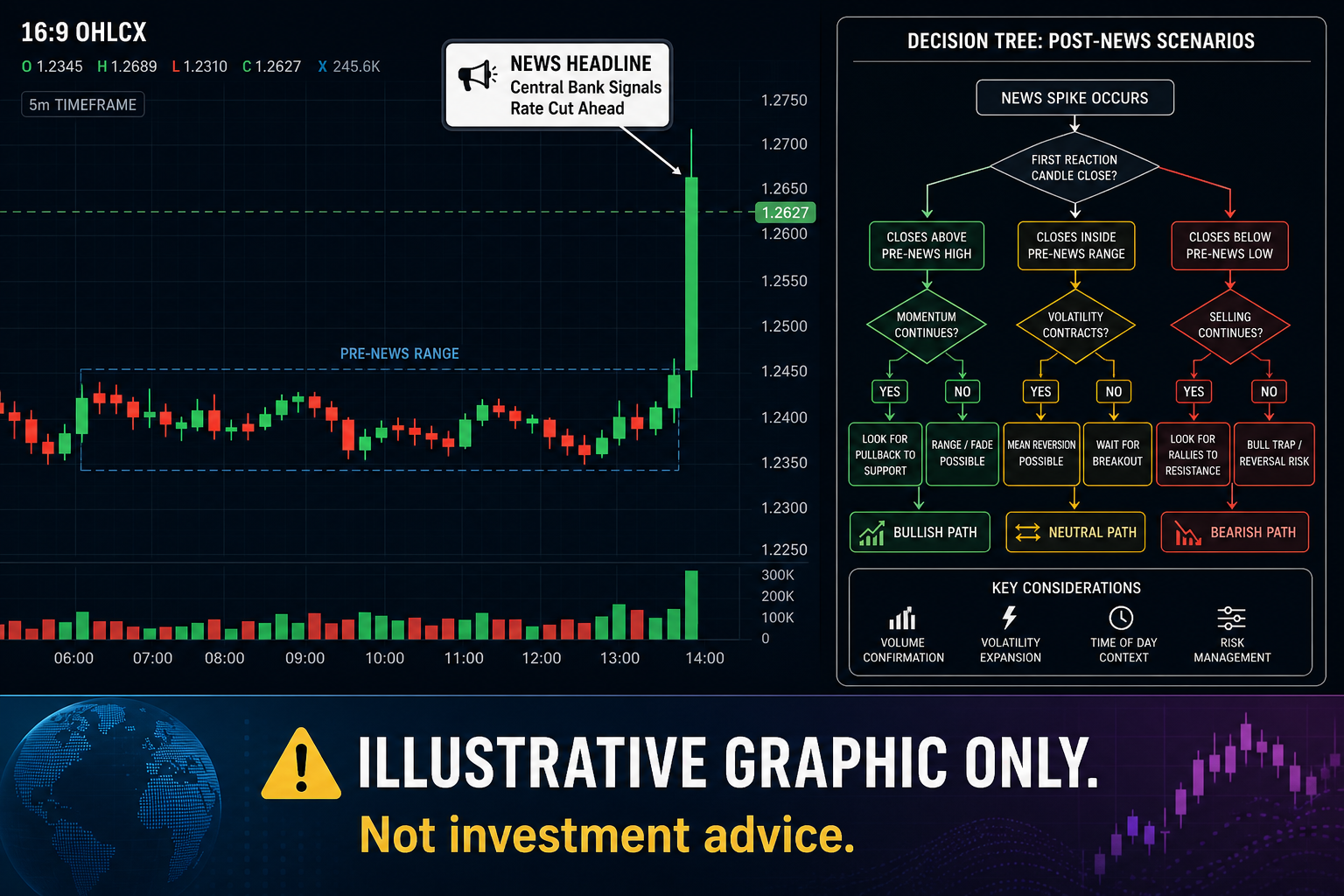
Headlines are built to interrupt. A wire hits, social feeds react, spreads move, and the trader feels pressure to do something before the full picture is clear.
That pressure is not a reason to abandon the plan. Most news should not create a new trade, change the risk budget, widen the stop, or justify adding exposure. At most, news should trigger a rule the trader already wrote: reduce, flatten, cancel stale orders, pause new risk, or do nothing.
That distinction matters. Research from Barber and Odean found that individual investors are often pulled toward “attention-grabbing stocks,” including stocks in the news, high-volume names, and stocks with extreme one-day moves. Attention is not the same thing as edge. A loud stock is not automatically a better trade.
Schwab’s trading education puts the old rule plainly: “Plan your trade and trade your plan.” A trade plan defines what to trade, how much to trade, when to enter, and when to exit before the order is placed.
That is the point of this blog. News can matter, but it should not take over the ticket. If a headline changes anything, it should change only what the plan already said was allowed to change.
A headline is not a trading signal by itself
A headline can be important without being actionable. It can explain why price is moving, but that does not mean the trader has an executable edge.
Some headlines confirm an existing plan. Some invalidate it. Some create nothing except wider spreads, thinner books, and worse fills. The obligation is not to participate. The obligation is to follow the process that existed before the market became harder to read.
A headline should earn the right to affect execution. It does that only if it touches one of the plan’s defined conditions: invalidation, liquidity, exposure, time-in-force, or risk limits.
If it does not touch one of those, it belongs in research, not in the order ticket.
What can news change, and what should it never change?
News can change whether the original trade thesis is still valid. It can make liquidity unacceptable. It can turn a working order stale. It can make correlated exposure more dangerous than it looked five minutes earlier.
Those are real execution issues. They deserve attention.
But news should not rewrite the account’s risk rules in real time. It should not turn a planned loss into an undefined loss. It should not justify adding size after the book has already reached its exposure limit. It should not turn a missing exit into “I’ll manage it manually.” It should not make a trader treat a worse spread like the cost of staying informed.
A simple hierarchy helps:
- If the headline violates invalidation, manage risk first. Follow the exit plan, reduce, or flatten before debating whether the story might reverse.
- If the headline supports the idea but liquidity breaks down, wait or size down. A correct read can still become a poor ticket if the available market is unattractive.
- If the headline is unclear, protect existing risk before looking for new risk. Ambiguity is not a reason to add exposure.
The headline does not get to invent a new plan. It can only test whether the existing plan still applies.
Check the live account before the story
When a headline hits while risk is already on, start with the live account, not the article.
Before reading another reaction thread or analyst comment, check working orders, filled quantities, related exits, time-in-force, and current exposure. The reason is practical: the headline can change urgency, but the order state tells you what risk is actually live.
If an entry filled but the related exit is not where expected, that matters first. If a limit order is still working after the original signal expired, that matters first. If several positions share the same macro driver, the headline may be a portfolio event rather than a single-name event.
Interpretation can wait long enough for that check. Execution hygiene comes first because it defines the problem the trader is actually solving.
Use news to trigger rules, not invent them
A news rule does not need to predict the headline. It needs to define what happens if a category of headline touches the trade.
That can be simple. A macro headline may trigger an exposure review across rate-sensitive names. A single-stock headline may trigger a check of related options positions before any new order is considered. A halt reopening may trigger observe-and-reduce rules unless the trader already has a specific reopen plan.
This keeps the trader from writing live prose under pressure. The question is not, “What do I feel like doing now?” The question is, “Did this headline trigger the rule I already defined?”
That is also why planned exits matter. If the exit logic is already selected before the order goes live, the trader is not trying to build the entire response after the headline arrives.
Watch liquidity before acting on a correct read
A headline can be directionally useful and still produce a bad trade.
During news windows, spreads can widen, depth can thin, and fills can become less predictable. That changes the ticket even if the idea is right. A trader who ignores liquidity because the headline feels urgent can turn a valid thesis into an unattractive execution.
This is especially important with options, thinner equities, and fast-moving names where the last price may not represent what can actually be filled. The plan should say when spread, depth, or volatility makes a trade no longer worth taking.
Refusing a trade because the market is not offering a clean ticket is not hesitation. It is part of execution discipline.
Watch the portfolio, not just the symbol
News often moves drivers, not just tickers. A rate headline, dollar move, credit headline, sector shock, or policy surprise can affect several positions at once.
That is where a clean single-name setup can become part of a crowded book without looking dangerous on its own. Before adding risk after a headline, check whether the account already has similar exposure through another ticker, ETF, option position, or macro proxy.
The issue is not only whether the new trade looks valid by itself. The issue is whether the portfolio can tolerate another position tied to the same driver.
This matters most when several alerts fire together. Multiple signals can look like confirmation when they are really the same trade repeated across different instruments.
When facts are unclear, reduce complexity
Some headlines arrive incomplete. Some are corrected. Some are interpreted differently by different sources. When material facts are still moving, the plan should narrow, not widen.
That does not mean the trader is frozen. Defensive action may still make sense: reduce exposure, verify working orders, cancel stale orders, or follow an existing exit plan.
What deserves a higher bar is fresh initiation. Opening new risk based on unclear facts often adds complexity at the worst possible time. A stale order, a partial fill, a widening spread, and a correlated position can turn one headline into several avoidable problems.
When the facts are unclear, the cleaner move is usually to make the account easier to understand before making it larger.
How OHLCX supports plan-first execution
OHLCX does not interpret headlines, predict news impact, or decide whether a trade should be taken. The trading decision stays with the user.
What OHLCX can support is the execution layer that should already be in place before news hits. Structured order entry helps the trader turn a planned response into order logic. Exits like OCO, OTOCO, TSP, TRIM, and TRIMMER can be selected before the order goes live, so exit logic is not left as a separate follow-up task after the fill.
Risk Gauge visibility gives the trader a clearer reference point for exposure when checking whether a headline has turned a single position into broader portfolio heat. Persistent defaults and keyboard shortcuts can help reduce the need to rebuild the same ticket structure under pressure. Order history and timestamps provide a record the trader can review against the headline timeline, including what was sent, filled, canceled, or left working.
For traders using Strategy Builder, rule-based automation can support clearly defined workflows using conditions the trader defines. The same guardrail applies: automation should support the prepared workflow, while unclear headlines and changing facts should return the decision to manual review.
OHLCX helps traders keep the execution path deliberate. It does not make news less volatile, and it does not replace the need to decide whether the plan still applies.
Let the plan answer before the headline does
News should not be ignored blindly. It should be filtered through the plan.
If the headline violates invalidation, manage risk. If it makes liquidity unacceptable, wait or size down. If it changes portfolio heat, check exposure before adding anything. If the facts are unclear, reduce complexity rather than expanding it.
That is the difference between being informed and being pulled around by information.
Request access to OHLCX to see how structured order entry, visible risk context, predefined exits, and reviewable order history can support execution when the market gets loud.
Leave a Reply