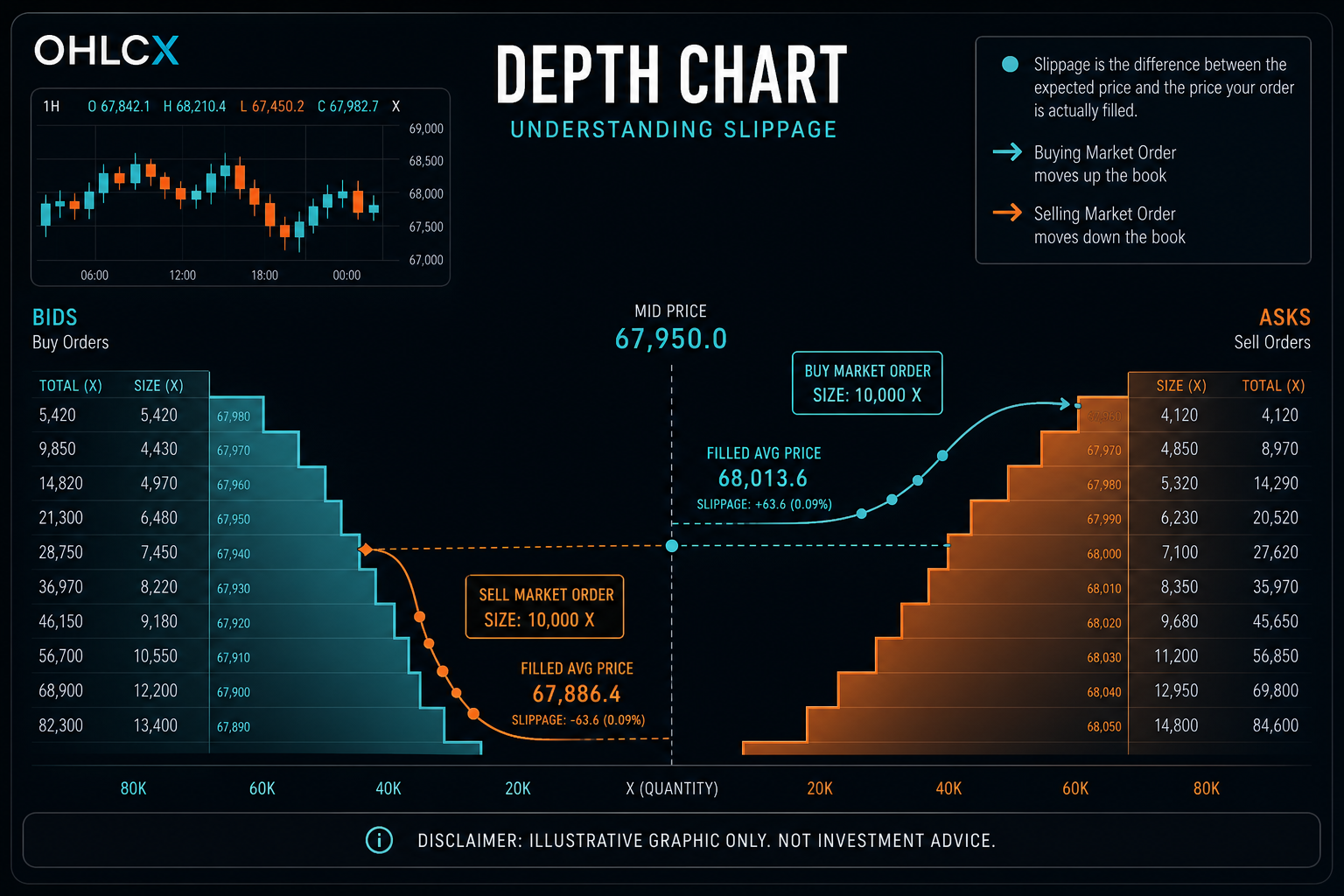
Perfect fills are easy to plan around. The order fills at the expected price. The whole position fills at once. The stop, target, and partial exits line up cleanly. The trader knows the size, the average price, and the exit path before anything has to be adjusted.
Live trading is not always that clean.
An order can fill away from the expected price. It can fill in pieces. A fast market can move through a planned level. A thin options contract can fill part of the order and leave the rest working.
None of that means the trade idea was wrong, but it does mean the live trade may no longer match the original plan. That is the point traders need to respect: slippage and partial fills change the trade.
They can change size, average price, risk, reward, attached exits, and what the trader should do next. A strong workflow plans for that before the order goes live and verifies it after the fill.
OHLCX supports that workflow by giving traders a Schwab-connected place to build structured orders, attach exit logic before send, check risk, review live positions, and use optional rule-based automation. It does not guarantee fills or remove market risk. It helps the trader work from a clearer execution path when the market does not fill the order exactly as expected.
What changes when a fill is not perfect?
A fill changes more than the entry price.
If the order fills worse than expected, the stop may now represent more risk. The target may offer less reward. The trade may no longer have the same reward-to-risk profile the trader accepted before sending.
If the order only partially fills, the position size is different from the intended size. The remaining order may still be working. Attached exits may need to be checked against the filled quantity. If the trade includes staged exits, the trader needs to know whether those exits still make sense for the position that actually exists.
The chart may look almost the same, but the trade is not the same.
That is why slippage and partial fills should not be treated as minor details. They can change what is live, what is protected, and what still needs attention.
Why do partial fills need a second look?
A partial fill creates a new state.
The trader may have intended to enter 500 shares, but only 200 filled. Or the trader may have intended to buy 10 contracts, but only 4 filled. That changes the position, the remaining order, and the exit plan.
The immediate question is not just, “Did I get filled?” It is, “What position do I actually have now, and does the rest of the plan still match it?”
After a partial fill, the trader should verify:
- How much filled and what quantity remains open
- The average fill price and whether slippage changed the planned risk
- Whether the stop, target, or staged exits still match the live size
- Whether any OCO or OTOCO logic activated as expected
- Whether the remaining order should stay open, be adjusted, or be canceled
- Whether Risk Gauge visibility still fits the account state
This matters because assuming the full plan is active can create silent risk. The trader may think a position is fully protected when the live account says something different.
OHLCX helps here by keeping orders, positions, exit flows, and risk visibility closer to the live execution workflow. The trader still has to check the state. The platform gives them a more structured place to do it.
Plan the exit around the fill you may get
Exit planning should not assume the entry will be perfect.
Before sending an order, the trader should know what happens if the entry slips, only partially fills, or fills in pieces. The exit plan should still make sense for the position that actually gets created.
For example, if a trader planned a tight stop because the entry was supposed to be near a specific level, a worse fill may make that stop too wide for the intended risk. If the trader planned staged exits around a 10-contract position but only 4 contracts fill, the original exit structure may need to be simplified.
This is where structured order entry matters. In OHLCX, traders can choose exit flows before the order goes live. OCO can connect a target and stop. OTOCO can stage the bracket after entry. TRIM can support fixed partial exits. TRIMMER can support staged exits based on rules the trader defines. TSP can support trailing protection when that fits the setup.
The platform does not decide which exit is right. The trader does.
The value is that the exit plan can be part of the order workflow before the fill, instead of being rebuilt manually after the market has already moved.
Check liquidity before choosing the order path
Some market conditions make slippage and partial fills more likely.
Fast opens, closing windows, earnings reactions, macro headlines, low-volume names, wide spreads, and thin options contracts can all make the fill path less predictable. A trade can be valid and still require a different order approach because the market is not offering clean liquidity.
Before sending the order, the trader should have a basic read on liquidity. A wider-than-normal spread, thin Level 2 depth, a major news window, or a low-volume options contract can all change how the order should be handled. The question is not only whether the setup is valid. It is whether the market is offering enough liquidity for the intended size and exit plan.
OHLCX’s Asset Detail view can support this check by keeping chart context, options data, Level 2 depth, technical indicators, instrument details, and the order ticket closer together. More data does not guarantee a better fill, but it can help the trader choose the order path with better context.
Market, limit, and staged orders each solve different problems
Order type is a tradeoff.
A market order prioritizes completion. It may make sense when getting out matters more than the exact price, but it can expose the trader to worse fills in fast or thin markets.
A limit order prioritizes price. It can protect the trader from paying more or selling lower than intended, but it may leave the order unfilled or partially filled.
A staged approach can reduce the burden of trying to complete the full size at once, but it also creates more to manage. More clips mean more fills to track, more remaining size to verify, and more chances for the exit plan to drift if the trader is not paying attention.
There is no universal answer. The trader has to decide which tradeoff fits the setup, liquidity, urgency, and risk tolerance.
OHLCX can support that decision by making the order path, exit flow, and risk view more visible before send. It cannot manufacture liquidity, guarantee execution quality, or remove the need to choose the right order approach.
How should automation handle imperfect fills?
Automation should be planned around live execution, not ideal execution.
If a trader uses Strategy Builder or another repeatable order workflow, the rules should account for what happens when fills are partial, delayed, or worse than expected. A strategy that assumes full fills every time may behave cleanly in theory but require more review in live conditions.
This does not mean automation is the problem. It means automation should operate inside clear boundaries. The trader should know whether a partially filled entry leaves the remainder working, when the workflow should be paused, and whether slippage changes the setup enough to stop the trade.
OHLCX automation is optional and rule-based. The trader defines the rules, decides whether to use automation, and remains responsible for the setup, risk, and order path. When automation is used, the workflow still needs to be explainable: what rule fired, what order was created, what filled, and what happened next.
Track slippage without making review complicated
Slippage review does not need to become a research project.
A simple review can be enough. The trader can track the symbol, order type, expected price, actual average fill, time of day, spread condition, whether the order filled fully or partially, and any notes about news, liquidity, reconnects, or distractions.
Over time, patterns can become useful. Maybe slippage is worse near the open. Maybe certain options contracts rarely fill cleanly. Maybe market orders are being used in conditions where limits would better match the plan. Maybe staged exits work well for one setup but create too much management burden for another.
OHLCX’s order history, timestamps, and audit trail can support this review by making it easier to understand what order was created, what happened next, and how the live execution path unfolded.
The goal is not to judge every imperfect fill as a mistake. The goal is to separate normal market friction from process problems the trader can improve.
When should the plan change?
A trader should know ahead of time what kind of execution problem requires a change.
The plan may say that if the spread widens beyond a certain point, the order waits. If only part of the entry fills, the trader may cancel the remainder instead of chasing. If slippage pushes the entry too far from the intended level, the trader may skip the trade. If a partial fill leaves the position too small for the original staged exit plan, the exit logic may need to be simplified.
These decisions are easier to make before the candle is moving.
Without a rule, the trader may improvise in the worst moment. That can lead to widening stops, chasing fills, adding size without updating risk, or keeping a leftover position that no longer matches the original setup.
A clear rule does not remove discretion. It gives discretion a boundary.
Plan for the trade that actually fills
Slippage and partial fills are not rare exceptions. They are part of live execution.
A strong trading workflow does not assume every order will fill perfectly. It gives the trader a way to check liquidity, choose the order path, attach exits, verify fills, and review the difference between the intended trade and the live result.
OHLCX supports that workflow by helping traders work from structured order entry, exit flows, risk visibility, order history, and optional rule-based automation in one Schwab-connected execution layer.
The trader still owns the plan. The market still controls the fill.
The work is making sure the plan can survive the fill the trader actually gets, not only the fill the trader wanted.
To see how OHLCX supports structured execution workflows, request access through the OHLCX platform page.
Leave a Reply