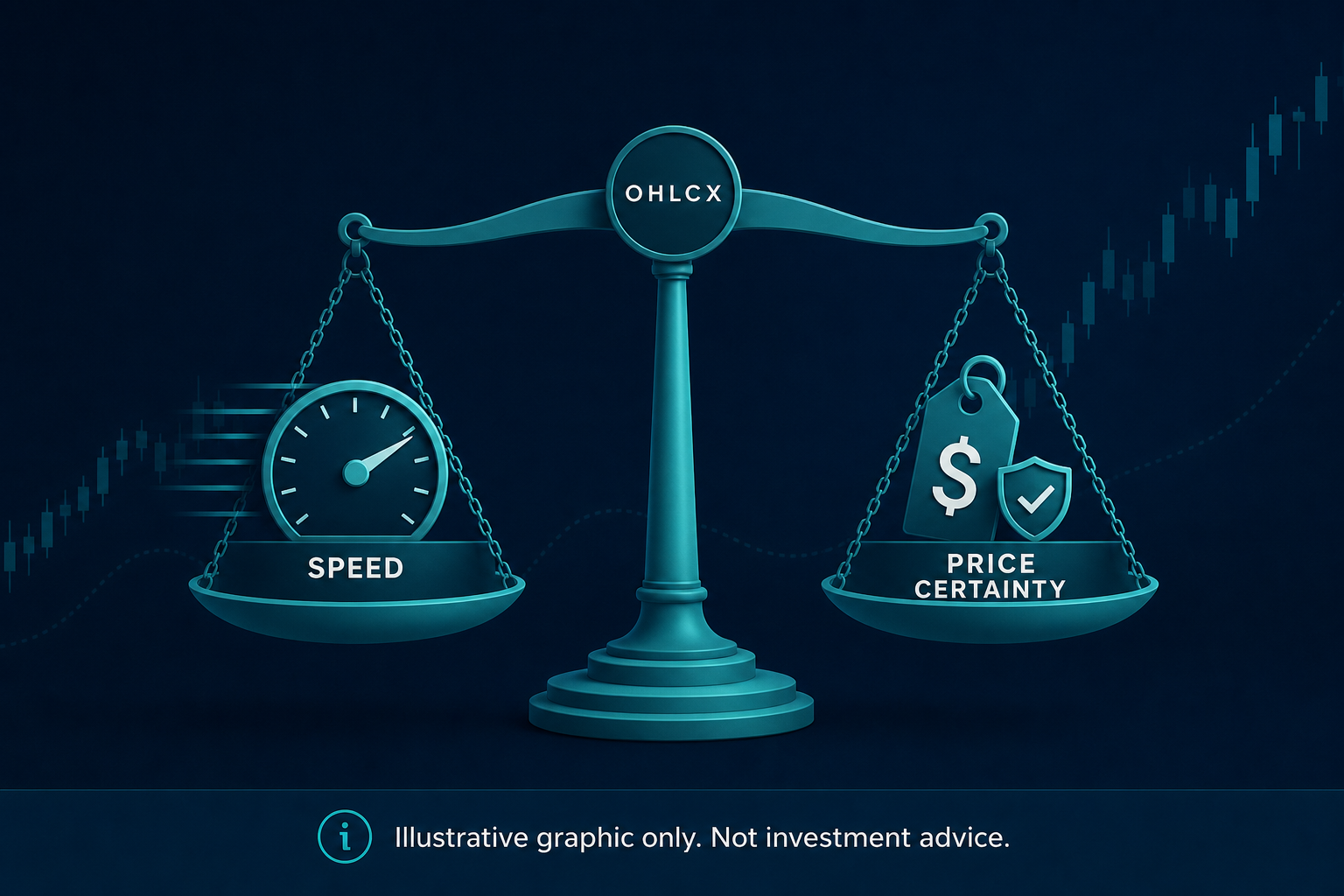
Every order sends a message. A market order says completion matters most. The trader wants the order filled now, even if the final price is not exactly what they hoped for.
A limit order says price control matters most. The trader is willing to miss the fill, or wait longer for it, instead of accepting any available price.
Neither choice is automatically smarter. The right choice depends on the setup, liquidity, urgency, spread, position size, and what happens if the order only partially fills.
That is why fast markets make order type decisions harder. Spreads can widen. Depth can disappear. Price can move through a planned level before the trader finishes editing the ticket. In those moments, loyalty to one order style can become its own risk.
OHLCX supports this decision by making the order path more explicit before the trade goes live. Traders can connect through Schwab, build structured orders, choose exit flows, review risk, use expiry controls when appropriate, and use optional rule-based automation while keeping the final trading decision in their hands.
What is the real difference between market and limit orders?
The difference is priority. A market order prioritizes completion. The trader is accepting uncertainty around price in exchange for a higher chance that the order is filled quickly.
A limit order prioritizes price. The trader is setting a boundary around what they are willing to pay or accept, while accepting the risk that the order may not fill.
That tradeoff matters because execution is part of risk. A market order may get the trader out quickly, but at a worse price than expected. A limit order may protect price, but leave the trader unfilled or partially filled while the market keeps moving.
The question is not, “Which order type is best?” The better question is, “What matters more for this trade right now: completion or price control?” That answer should be clear before the order is sent.
Choose the bad outcome you can accept
A useful way to choose order type is to ask which bad outcome the trade can tolerate. With a market order, the bad outcome is a worse-than-expected fill. With a limit order, the bad outcome is no fill, a late fill, or a partial fill. With staged or hybrid execution, the bad outcome is more complexity: more fills to track, more remaining size to reconcile, and more chances for the exit plan to drift.
That does not make one path better than the others. It makes the tradeoff clearer.
If missing the trade is acceptable but paying up is not, a limit order may fit the setup. If staying in the position is more dangerous than accepting slippage, a market order may be the cleaner choice. If the trader needs completion but only within a defined price boundary, a marketable limit may be the better middle ground. Order type is not just a preference. It is a decision about which execution risk the trader is willing to carry.
When should a trader consider a market order?
A market order may make sense when delay is more dangerous than price uncertainty.
That can happen when a thesis is broken, an exit is urgent, liquidity is changing quickly, or the trader needs to reduce exposure before a catalyst. In those cases, waiting for a perfect price may create more risk than accepting a worse fill. This does not make market orders careless. It makes them blunt. Sometimes that bluntness is appropriate.
The danger is using a market order for the wrong reason. If the trader is using it because they are impatient, chasing, or trying to avoid the discipline of a planned entry, the order type becomes an emotional shortcut. Over time, repeated market entries in thin or fast conditions can create slippage that the trader does not fully see until reviewing fills later.
A market order should be a conscious choice. The trader should know why completion matters more than price control and what amount of slippage would make the trade unacceptable.
When does a limit order make more sense?
A limit order may make sense when price matters more than immediate completion. That can be true for entries where the setup only works near a specific level. It can also be true in wider spreads, thinner options contracts, or situations where the trader is willing to miss the trade rather than accept a poor fill.
A limit order can create discipline because it makes the price boundary explicit. The trader is not saying, “Get me in at any cost.” They are saying, “This trade only belongs at this price or better.”
But limit orders create their own risk. The order may not fill. It may partially fill. It may sit longer than intended. If the trader starts chasing the price with repeated cancel-and-replace edits, the limit order may become a market order in disguise.
A limit order also needs a time decision. If the setup depends on a specific moment, leaving the order working after that moment passes can create leftover order risk. The trader should know whether the order is meant to work briefly, remain active for the session, or expire if the market moves away.
This is where OHLCX’s expiry order time limit can support the workflow. It gives the trader another way to define how long the order should stay active, instead of letting an old limit continue working after the trade thesis has changed. Price control is useful only if the order’s timing still matches the setup.
Where do marketable limits fit?
In fast markets, the practical middle ground is often a marketable limit. A marketable limit still prioritizes completion, but not at any price. For a buy order, the trader may place a limit at or above the current ask. For a sell order, the trader may place a limit at or below the current bid. The order can behave with urgency, but the limit acts as the worst acceptable execution price.
That does not guarantee a fill. It also does not remove slippage risk. The market can move before the order reaches the book, or the available size may not be enough for the full order.
The benefit is that the trader has named the boundary. Instead of saying “fill me anywhere,” the order says, “fill me only within this defined price range.” For traders who need to act quickly but still want a price guardrail, that distinction matters.
What changes in fast markets?
Fast markets compress the decision. A trader may start with a clear order preference, then watch price move, spreads widen, and liquidity shift in seconds. That pressure can turn an order decision into an emotional reaction.
This is especially common near the open, close, earnings reactions, macro prints, Fed-related headlines, or sudden news events. The trade may still be valid, but the execution path is no longer the same as it was a few minutes ago.
Before sending the order, the trader should have a basic read on the conditions. If the spread is wider than normal, Level 2 depth is thin, or the contract does not show enough liquidity for the intended size, the order type deserves another look. A market order may complete quickly but with more slippage. A limit order may protect price but leave the trader stranded with no fill or a partial fill. A marketable limit may provide urgency with a defined worst acceptable price, but it can still miss if the market moves too quickly.
OHLCX’s Asset Detail view can help support this check by keeping chart context, options data, Level 2 depth, technical indicators, instrument details, and the order ticket closer together. That does not guarantee a better fill. It gives the trader more context before choosing how to send.
Use the order type that matches the trade priority
A useful order decision starts with the priority.
- Use market execution when completion matters more than price control. This may apply to urgent exits, broken theses, or moments when staying in the position creates more risk than accepting slippage.
- Use limit execution when price control matters more than completion. This may apply to planned entries, wide spreads, thin contracts, or setups that only work at a defined price.
- Use marketable limits when urgency needs a price boundary. This may apply when the trader wants faster execution but still wants to define the worst acceptable fill.
- Use staged execution when size and liquidity need more care. Breaking an order into pieces can reduce pressure on the book, but it also creates more fills to track and more room for the exit plan to drift.
- Use hybrid approaches only when the rules are clear. A marketable limit, staged clip, escalation rule, or expiry time limit should be defined before the trader is reacting mid-candle.
The point is not to memorize a universal rule. The point is to make sure the order type matches the actual trade priority.
OHLCX supports that by keeping the order path, exit flow, expiry behavior, and risk view inside the execution workflow. The platform cannot manufacture liquidity or guarantee execution quality. It can help make the chosen priority easier to review before the order goes live.
How do exits affect the order type decision?
The entry order is only one part of the trade. If the trader uses attached exits, the order type decision should also consider what happens after the fill. A market order that fills worse than expected may change the distance to the stop, the quality of the target, or the number of contracts that make sense for a staged exit. A limit order that only partially fills may leave the trader with an exit structure built for a larger position.
This is why exit logic should be reviewed before send and verified after fill. In OHLCX, traders can choose exit flows before the order goes live. OCO can connect a target and stop. OTOCO can stage the bracket after entry. TRIM can support fixed partial exits. TRIMMER can support staged exits based on rules the trader defines. TSP can support trailing protection when that fits the setup.
The trader still decides which exit belongs with the trade. OHLCX gives that decision a structured place in the order workflow.
What should traders verify after the order is filled?
The order type decision is not finished once the order is submitted. After the fill, the trader needs to confirm whether the execution matched the intended priority. If the trader used a market order, did the urgency justify the actual fill price? If the trader used a limit order, did the order fill fully, partially, expire, or remain open? If a staged approach was used, does the remaining size still match the exit plan?
This is where the review should be practical. The trader should compare the intended order path with what actually happened: order type, expected price, average fill, fill status, remaining quantity, attached exits, expiry behavior, and account risk after execution.
OHLCX’s order history, timestamps, and audit trail can support that review by making it easier to understand what order was created, what happened next, and how the live execution path unfolded. The goal is not to second-guess every fill. It is to learn whether the order type matched the trade priority.
How should Strategy Builder handle order type choices?
Automation should not blur the priority behind the order. If a trader uses Strategy Builder or another repeatable workflow, the order type should reflect the same decision a trader would make manually. Does the setup require completion, or does it require a strict price boundary? Should the order expire if it does not fill within the intended window? What happens if the order only partially fills? When should the workflow wait, pause, or stop?
A repeatable workflow can reduce manual rebuilding, but it should not hide the execution tradeoff. A strategy that uses limits should have a plan for non-fills, partial fills, and expiry. A strategy that uses more urgent execution should have clear risk boundaries for slippage and market conditions.
OHLCX automation is optional and rule-based. The trader defines the rules, chooses whether to use automation, and remains responsible for the setup, risk, and order path. When automation is used, the workflow still needs to be explainable: what rule fired, what order was created, what filled, what expired, and what happened next.
When limits become market orders with extra steps
There is a common pattern traders should watch for. A trader places a limit order, does not get filled, cancels, moves the limit, misses again, cancels, moves again, and eventually gets filled at a price close to where a market order would have landed anyway.
Technically, the trader used limits. Practically, they may have been chasing. That is not always wrong, but it should be honest. If the trader is repeatedly moving limits because completion matters, then completion may have been the true priority all along. In that case, the plan should name that priority instead of disguising it as price discipline.
The opposite can happen too. A trader uses a market order because they want speed, then regrets the fill because the trade only made sense at a tighter price. That is a sign the order type did not match the trade.
The fix is not to worship one order style. The fix is to decide what the trade needs before the market pressures the trader into improvising.
Make execution priority part of the plan
Market orders and limit orders are not personality types. They are tools. A market order can be the right tool when completion matters more than price. A limit order can be the right tool when price matters more than completion. A marketable limit can be the right tool when urgency needs a defined worst acceptable price. A staged or hybrid approach can make sense when size, liquidity, or urgency sits somewhere between those poles.
The risk comes from choosing the order type after emotion has already taken over. A strong execution workflow makes the priority visible before the order goes live. It connects the order type to the setup, the liquidity, the exit plan, the expiry behavior, and the account risk.
OHLCX supports that workflow by helping traders work from structured order entry, exit flows, risk visibility, order history, expiry order time limits, and optional rule-based automation in one Schwab-connected execution layer.
The trader still owns the decision. The market still controls the fill. The work is choosing the order path that matches the trade, not the adrenaline of the moment. To see how OHLCX supports structured execution workflows, request access through the OHLCX platform page.
Leave a Reply