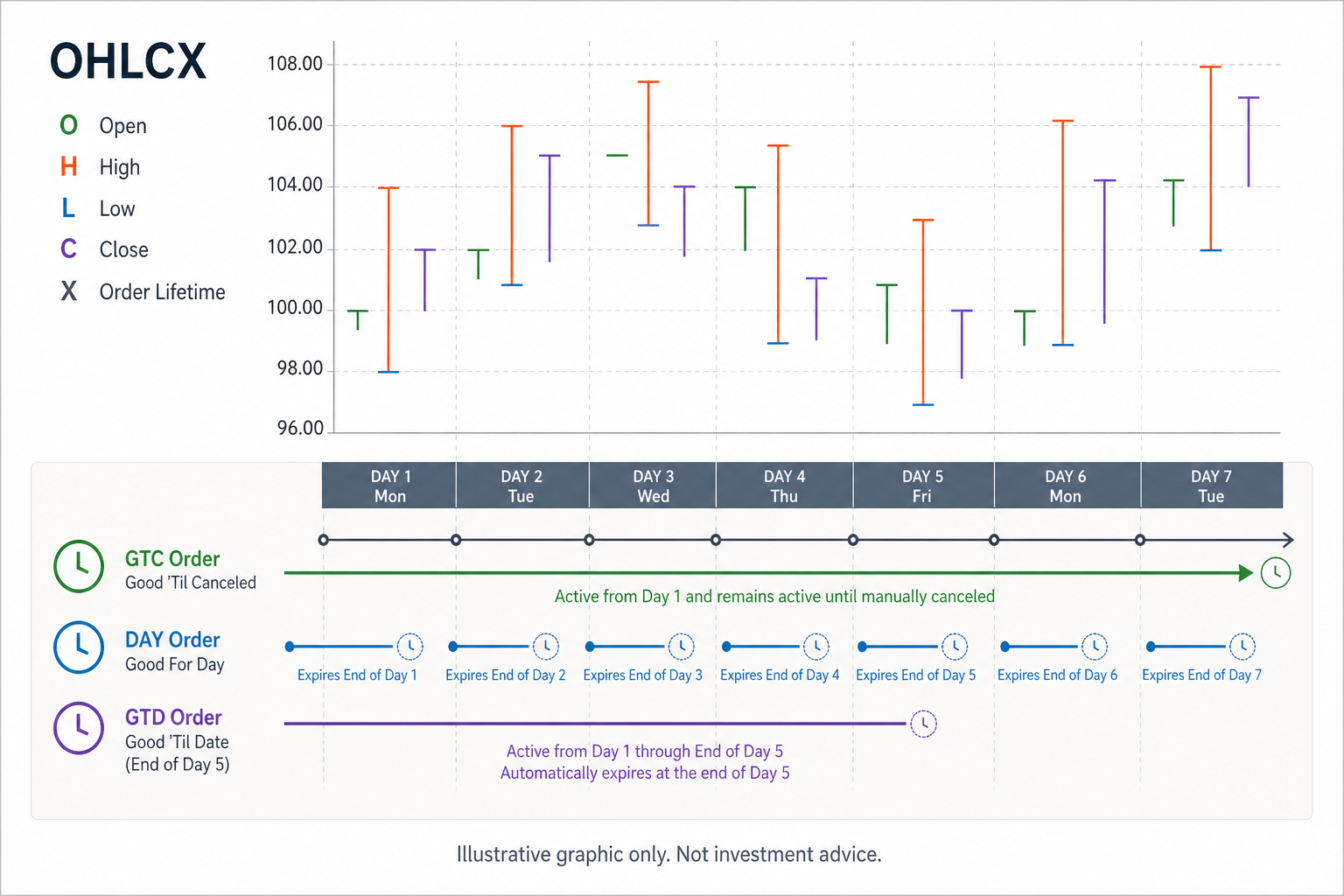
Time-in-force can look like a small ticket setting, but it has a direct impact on risk. Often shortened to TIF, time-in-force tells the broker how long an order should remain active before it expires or is canceled.
That matters because markets do not pause after an order is placed. A limit order that made sense at 10:05 may not make sense after a macro headline, a partial fill, a new position, or a change in portfolio heat. An order that expires too soon can create the opposite problem if the trader assumes protection is still working when it is not.
Time-in-force belongs in the same conversation as order type, position size, exits, and risk. It defines how long an instruction stays live, which means it also defines how long that instruction can keep affecting the account. When timing no longer matches intent, a working order can become residual risk.
OHLCX supports this part of the workflow by giving traders a Schwab-connected place to build structured orders, choose exit flows, use expiry order time limits where appropriate, review risk, and track what happened after an order was created. It does not decide how long an order should work. The trader still owns that decision.
Why does time-in-force matter beyond DAY and GTC?
Time-in-force matters because an order can remain active while the trader’s thesis, exposure, or market context changes.
A DAY order generally works during the trading day and expires if it is not filled by the end of the session. A GTC order, or good-till-canceled order, can remain live beyond the session until it fills, is canceled, or reaches the broker’s expiration rules. An order with a specific expiry window can help keep the instruction tied to the trade thesis, but only if the trader chooses that window deliberately.
The real question is not only, “Which TIF label should I choose?” The better question is, “How long does this order still represent my intent?”
That answer depends on the trade. A breakout entry near the open may have a short shelf life. A slower mean-reversion setup may allow more patience. A protective exit may need to stay active longer than an entry idea. A limit order placed before earnings may need a different time policy than one placed during a quiet midday market.
When the time setting does not match the thesis, the account can drift away from the trader’s mental model. The trader may have an order working after the reason for the trade has changed, or they may believe an order is still protecting a position after it has expired or been canceled. Both situations are dangerous because the account state and the trader’s intent no longer match.
What does residual risk look like?
Residual risk is the risk left behind when old instructions, open positions, and current intent no longer line up.
It can show up as a forgotten entry order that fills after the trader has moved on. It can show up as a working limit order that adds exposure after the account is already crowded. It can also show up after a partial fill, when the trader has one position size in mind but the live account has another.
Exits can create residual risk too. A trader may believe a stop, target, or staged exit is still doing its job when the order state says something different. That does not always come from carelessness. It often comes from the normal mess of active trading: fast markets, alerts, multiple positions, reconnects, cancel-replace edits, and fatigue.
OHLCX can help by keeping orders, positions, exit flows, Risk Gauge visibility, and order history closer to the live execution workflow. But no platform can make an old order current again. The trader still has to decide whether each working instruction belongs in the account now.
Choosing time-in-force for entries
Entries should use time-in-force based on how long the trade idea remains valid.
Some entries are short-lived by nature. If the setup depends on a specific price reaction, opening range, liquidity window, or headline response, the order should not quietly survive long after that context is gone. In that case, a shorter time setting or expiry order time limit can help keep the order from turning into a stale instruction.
Other entries may tolerate more time. A trader using patient limits around a slower setup may be comfortable letting the order work longer, but that patience still needs a rule. If the order does not fill, does the trader wait, adjust, cancel, or skip? If it partially fills, does the trader keep the remainder open or simplify the plan?
The risk with entries is not only that the order fails to fill. The risk is that it fills later, under conditions the trader would not have accepted if building the ticket from scratch. That is why a limit order should carry both a price boundary and a time boundary. Price says where the trade belongs. Time-in-force says how long that statement remains true.
Choosing time-in-force for exits
Exits need a different kind of attention because a missed entry and an expired exit do not carry the same consequence. An entry that never fills may simply mean the trader missed the trade. An exit that is not live when the trader thinks it is can leave real exposure unmanaged.
That does not mean every exit should use the same time setting. A protective stop, profit target, trailing stop, OCO bracket, staged TRIM flow, TRIMMER setup, or TSP-style exit may each have a different role in the plan. The important point is that the trader should know whether the exit instruction is live, what position size it applies to, and whether its time behavior still matches the trade.
After partial fills, this becomes even more important. The position may be smaller than planned. The remaining order may still be working. The exit plan may need to be checked against the live size rather than the original intended size.
In OHLCX, exits can be selected before the order goes live. That helps make exit policy part of the order workflow, not a separate task after the fill. But time behavior still matters. If an exit, bracket, or staged plan depends on order duration, the trader should confirm that duration before relying on it.
What should traders check before leaving an order working?
A good time-in-force decision should make the order’s shelf life clear before it is left live. The trader should know whether the instruction still matches the thesis, what happens if it does not fill, and what should happen if it only partially fills.
For orders that may remain active beyond the immediate moment, it helps to check:
- How long this order still matches the trade thesis
- What happens if the order does not fill in that window
- What happens if it partially fills
- Whether the time setting matches the order’s role: entry, exit, stop, target, or staged logic
- Whether the order could add exposure after account risk changes
- Whether a reconnect, red banner, or order-state issue should trigger a sweep
- Whether Risk Gauge visibility still supports taking or keeping the exposure
This does not need to become a ritual for every small order. It is most useful when an order is being left to work, when markets are moving quickly, when automation is involved, or when the trader is stepping away from the screen. The point is simple: do not leave an order live unless the trader still wants that instruction to exist.
How OHLCX expiry order time limits help
An expiry order time limit can help prevent an order from outliving the reason it was placed.
This is especially useful when the trade idea has a short window. A trader may want an entry to work only during a specific liquidity period, around a planned setup, or before a known market event. If the order does not fill by then, the trader may prefer for it to expire instead of becoming leftover exposure.
That does not make expiry settings a substitute for review. They are a control, not a complete risk system. The trader still needs to confirm what filled, what expired, what remains open, and whether the plan still fits the account.
In OHLCX, expiry behavior can sit closer to the rest of the execution workflow: order type, exit flow, risk review, and live order visibility. That matters because time-in-force should not be treated as an afterthought once the rest of the ticket is built. It is part of the order logic.
How should Strategy Builder handle time-in-force?
Automation can multiply time-in-force mistakes if defaults are not intentional. A manual trader may forget one resting order, but a repeatable template can create the same timing problem across multiple symbols or accounts if the rules are not clear.
That is why Strategy Builder workflows should define not only entry conditions, sizing, and exits, but also what happens when an order does not fill within the intended window. If a strategy uses limits, it needs a non-fill policy. If it uses staged entries, it needs a partial-fill policy. If it carries instructions across sessions, the trader should know why that is acceptable and when those instructions should be swept or reviewed.
OHLCX automation is optional and rule-based. The trader defines the rules and remains responsible for the setup, risk, and order path. When automation is used, the workflow should still be explainable: what rule fired, what order was created, how long it was allowed to work, what filled, what expired, and what happened next.
When should traders audit working orders?
Order audits do not need to be constant. They need to happen at the moments when account state is most likely to drift from intent.
A sweep is especially useful after a reconnect, after a partial-fill sequence, after a burst of automation, before major economic releases, before earnings clusters, near the close, and before long weekends or market holidays. Those are the moments when old instructions can become misaligned with current exposure.
Long weekends deserve special attention. A trader may mentally move on from a thesis while a working order remains. By the time the market reopens, the setup may no longer be valid, the account may have changed, or new information may have made the old instruction stale.
The same applies after travel or time away from the desk. A reconnect should not be treated as proof that every working order still makes sense. It should trigger an order sweep.
OHLCX order history, timestamps, positions, and live order views can support that process by making it easier to see what is still working and what already happened. The decision still belongs to the trader.
Keep time-in-force tied to intent
Time-in-force is how a trader puts a clock on intent. Without that clock, a ticket can keep representing an old idea, and the live account may still be following instructions the trader no longer believes in.
A strong execution workflow keeps time-in-force connected to the setup, order type, exit plan, account risk, and automation rules. It also creates a habit of reviewing working orders when conditions change.
OHLCX supports that workflow by helping traders work from structured order entry, expiry order time limits, exit flows, risk visibility, order history, and optional rule-based automation in one Schwab-connected execution layer.
The trader still owns the plan. The market still controls the fill. Time-in-force helps define how long the instruction should remain valid between those two realities.
To see how OHLCX supports structured execution workflows, request access through the OHLCX platform page.
Leave a Reply