Most active traders are not short on inputs. They have charts, scans, alerts, watchlists, and conviction about where price may go. The breakdown usually happens later, in the handoff from analysis to execution.
A setup can be clear, but the order form still has to translate it into entry, position size, stop, exit logic, and risk. If those pieces are vague before the order is sent, the trade can change quickly. A sound idea can become a rushed fill, a loose stop, or a partial exit that has to be corrected after the fact.
Indicators can help shape context, confirm timing, or filter setups. But they do not structure the order. They do not define the risk. They do not decide how the position should be managed once it is live.
OHLCX is built around that layer. It does not tell traders what to trade. It helps traders express their own plan as structured order logic, so the move from signal to order is more deliberate.
What changes when execution comes first?
Execution-first workflow changes where the discipline starts. Instead of treating the order form as the last step, the trader treats it as part of the plan. The setup has to translate into specific decisions before the trade is live.
That does not make the process rigid. It makes the trade clearer. If the setup looks good but the position size does not fit the risk plan, the order should not be forced. If the entry makes sense but the exit plan is vague, the trade is not finished. If the trader cannot explain what should happen after a partial exit, there is still a gap in the workflow.
Execution-first workflow forces that gap into view before the trade has to be managed under pressure.
How do you know when a signal is enough?
A useful test: two traders with the same idea should produce materially similar risk and brackets, not similar chart screenshots.
If two traders look at the same setup and one places a bracket while the other places a market order, the difference is not only the analysis. It is the workflow.
A trader has enough signal when another input does not change the order in a way they could actually fill at their size and speed. If a new indicator changes the entry, stop, target, or size, it belongs in the process. If it only makes the chart feel more convincing, it may be delaying the decision.
A better question is not only, “Do I have enough confirmation?” It is, “Can this setup become a clear order?”
If the answer is no, the issue may not be the signal. It may be the execution workflow.
Standardize the handoff from idea to order
Rework is the tax on unclear handoffs.
A trader enters first and builds the bracket later. The stop is placed after the fill. The partial exit is decided only once price starts moving. Size changes because the market moved while the order was still being built.
Each of those moments creates room for drift. A slightly larger position, a slightly wider stop, or a delayed partial exit can change the risk profile of the trade. The chart may be the same, but the trade is not.
Reduce rework by standardizing how ideas become orders:
- Define the entry trigger and invalidation level before submitting the order.
- Decide whether profit and stop need to be paired with OCO logic up front.
- Predefine partial exit logic if the plan includes scaling out.
- Log the intended maximum position before scaling in.
That is where structured order entry matters. The order form is not treated as an administrative step. It becomes the place where the plan is made executable.
Exits before the order, not during the trade
Execution-first workflow means exits are decided before the order is sent, not improvised when price moves.
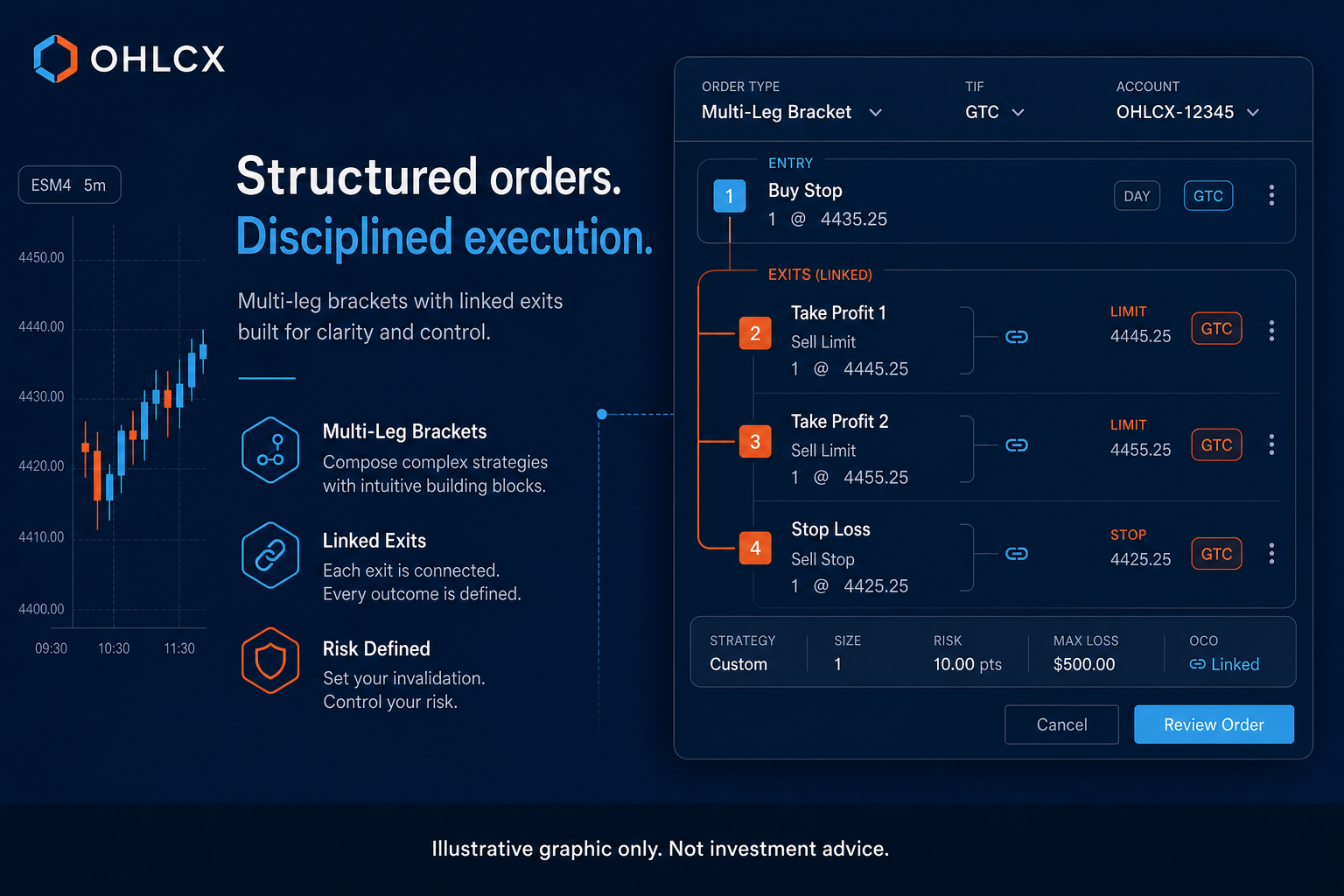
That changes how the trader thinks about exit flows. OCO logic pairs target and stop so they exist as one structure. OTOCO stages a bracket that activates on fill. TSP supports trailing stop logic when protection should follow favorable price movement.
For partial exits, TRIM and TRIMMER let the trader define staged exit logic ahead of time so the partial plan is part of the order, not a manual task to handle later.
The trader still defines the plan. These flows do not predict direction or replace judgment. They make sure the order reflects what the trader already decided.
When native tools encourage more analysis instead of better execution
Native tools are not “bad.” They are generic.
That matters because a generic order form can push traders to solve execution problems with more analysis. Another indicator gets added. Another confirmation gets checked. Another chart stays open. But the actual issue may be that the order path is not structured enough to carry the plan cleanly.
The broker can place the order. The question is whether the workflow helps the trader stay consistent from signal to execution.
OHLCX is designed to sit in that middle layer. It connects through Schwab and gives traders a focused workspace for structured orders, exits, partials, risk visibility, and optional automation.
The Risk Gauge supports that workflow by keeping exposure visible while the trader is building and managing orders. That matters because execution is not only about entering a trade. It is also about understanding what that trade does to the rest of the account.
Capital and custody remain with Schwab. OHLCX is not the broker. It is execution technology that helps traders structure the order workflow around their own rules.
Automation supports execution, not analysis
Execution-first workflow does not mean every step has to be manual. It means automation should serve the order path.
For traders running similar setups across many sessions, manual rebuilding of the same brackets and exit logic is where consistency breaks down. In OHLCX Pro, Strategy Builder supports a visual, no-code path for turning a recurring setup into a repeatable order workflow.
The point is not to remove the trader from the decision. The point is to keep the order form aligned with the plan when speed matters.
Live execution also exposes assumptions that paper trading can hide. Partial liquidity, latency, and the time it takes to react under pressure all matter once real orders are involved. Automation that assumes ideal fills is different from automation that operates against real conditions.
In execution-first workflow, automation belongs in the order path, not in the analysis layer.
Build the workflow before adding more indicators
Another indicator stack rarely fixes inconsistent order forms, unclear exits, or risk that only becomes obvious after the trade is already live.
Execution-first workflow puts more attention on the handoff between idea and order. The setup still matters. The signal still matters. But the trade is only as strong as the workflow that carries it into execution.
Indicators describe the setup. Execution decides the trade. OHLCX is built for that second part: the handoff from idea to order, structured before the trade goes live.
To see the workflow in action, request a walkthrough through the OHLCX platform page.
Leave a Reply