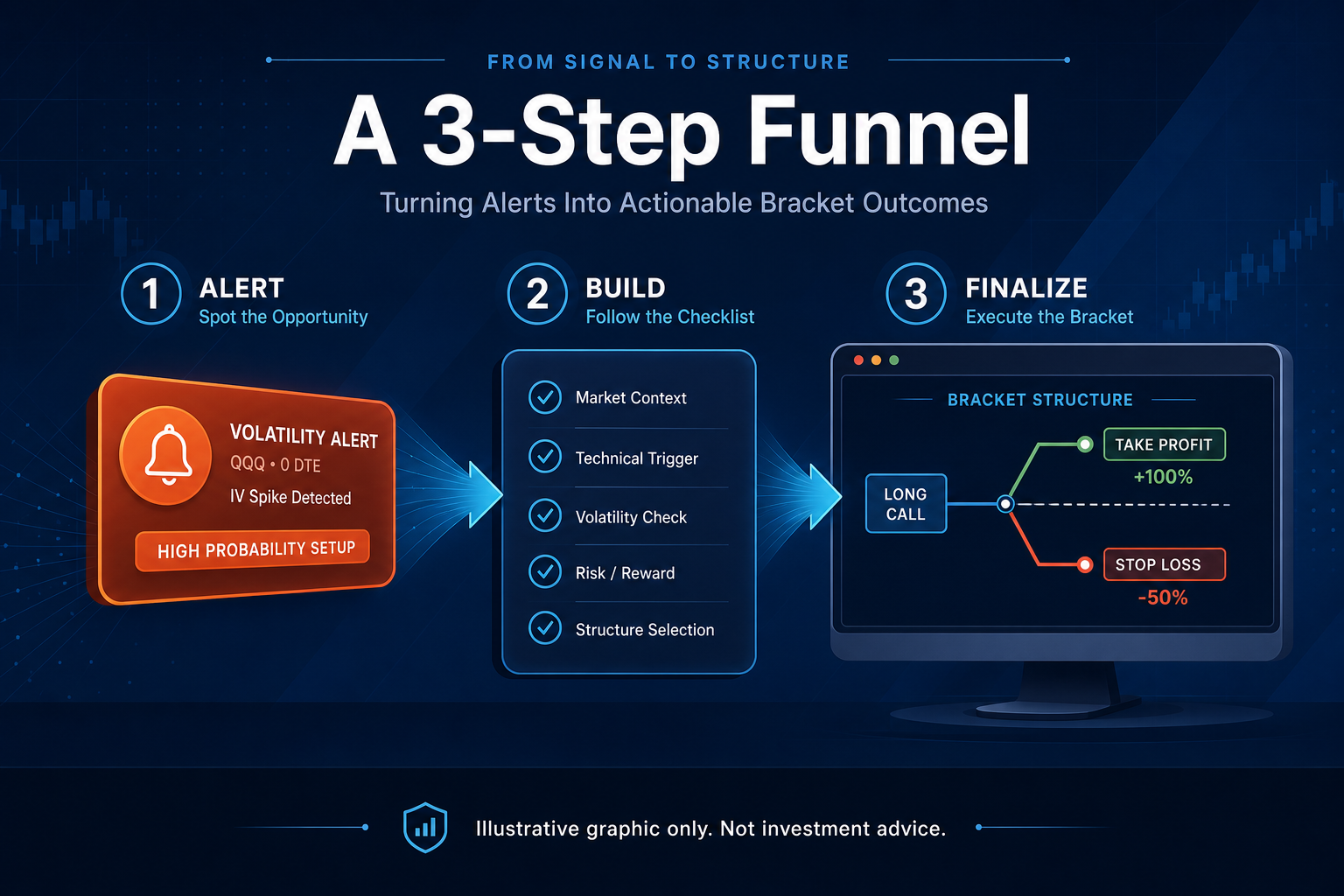
A clean signal does not produce a clean order on its own.
Once a trader accepts the setup, the next risk is translation. The idea still has to become an executable order with the right entry, size, stop logic, exit plan, and account-level risk. If those pieces are rebuilt after price starts moving, the trader may end up sending an order with different risk than the setup originally justified.
That is where rework costs traders. Rework shows up when a bracket has to be rebuilt, position size changes on the fly, or a mental stop has to be reconciled with what is actually live in the broker account. It creates more chances for the order to drift away from the plan before or after execution.
OHLCX is built for the handoff from signal to live order. It gives traders a structured way to move from decision to order form, with execution logic, risk visibility, and optional automation supporting the process without replacing the trader’s judgment.
What has to survive the handoff?
The signal is only the start. Before it becomes a live order, the important parts of the plan have to carry through to the order form.
That includes the direction of the trade, the entry area, the size, the invalidation point, and the exit logic. It also includes whether the trade should be managed as one position, scaled into over time, or reduced in stages if it starts working.
This does not need to become a long thesis. It needs to be clear enough that the ticket does not depend on memory once price starts moving.
If the position size does not fit the risk plan, the order is not ready. If the stop is still vague, the order is not ready. If the exit plan only exists as “I’ll manage it when it moves,” the trade is still carrying rework.
Reduce rework before the order is live
The best time to reduce rework is before the order goes live. A common mistake is to place the entry first and clean up the rest later. The bracket gets built after the fill. The stop gets added when the trader has time. The partial exit is handled manually if the trade starts working.
That approach may work once in a while, but it is not repeatable. It leaves too much of the trade dependent on speed, attention, and emotional control at the exact moment those things are easiest to lose.
A cleaner workflow defines the order path before the entry is sent. That includes whether the target and stop should be paired, how a bracket should activate on fill, where partial exits belong, and how protective logic should follow favorable price movement.
The OCO, OTOCO, TRIM, TRIMMER, and TSP flows in OHLCX make those decisions part of the order workflow instead of reactions after the fill. The trader still defines the plan. The platform helps the ticket reflect that plan before the trade is live.
Repeatable setups need repeatable order paths
Some setups repeat often enough that the order workflow should become familiar. A trader may have a continuation setup, a pullback setup, or a reversal setup with a clear failure point. The names matter less than the structure. If the same type of trade keeps coming back, the trader should not have to rebuild the order process from scratch every time.
That is where Strategy Builder and no-code automation templates fit into the process. They are useful when a trader already understands the setup and wants a more consistent way to move from signal to order.
The goal is not to automate judgment. It is to reduce the manual reconstruction between decision and execution. When recurring steps are structured, the trader can spend more attention on whether the setup still fits the market, not whether the stop, bracket, or partial logic was remembered correctly.
Automation should prevent omissions. It should not override the person responsible for the trade.
Check account risk before the order goes live
No order exists in isolation. A trade can look clean on its own and still change the account in a way the trader did not intend. It may add exposure to the same theme, increase concentration, or push risk beyond the level that made the signal worth taking.
That is why account risk should be checked before the order is sent, not only after the position is open.
OHLCX’s Risk Gauge supports that part of the workflow by keeping exposure visible while the trader is building and managing orders. The point is simple: the trader should understand what the order does to the account before it becomes live risk.
This is where signal quality and execution quality separate. A strong setup can still become a poor order if it adds too much heat, overlaps with existing exposure, or forces a later resize that should have been avoided up front.
Measure whether the workflow is improving
A cleaner workflow should show up in how orders are handled. Traders can watch a few practical signals:
- How often brackets are canceled and rebuilt
- How often size changes after the original plan
- How long it takes to move from accepted signal to a live order with risk logic attached
- How often manual overrides are used
- Whether slippage improves or stabilizes across similar setups
These signals show whether the path from signal to order is getting cleaner. If rework stays high, the issue may not be the signal. It may be the workflow around the signal.
The review should be practical. If the same kind of setup keeps creating the same kind of order repair, that is not just a trading note. It is a workflow problem.
Make the signal executable
A signal only matters if the trader can turn it into an order that reflects the plan.
The path from idea to live order is where rework costs traders the most, and where structure can help the most. The goal is not to make trading mechanical. The goal is to make the order path clear enough that judgment, risk, and execution stay aligned.
OHLCX is built for that path. Capital and custody stay with Schwab. The trader’s rules stay with the trader. OHLCX is the execution layer in between.
To see the workflow in action, request a walkthrough through the OHLCX platform page.
Leave a Reply