Multi-step entries are easy to plan and harder to manage once the market is moving.
A trader may be scaling into a position, preparing a conditional hedge, setting staged targets, or waiting for a specific entry before attaching protection. The logic may be clear before the trade starts, but each extra step creates another place where the workflow can break.
That is where OTOCO and contingent order logic can help.
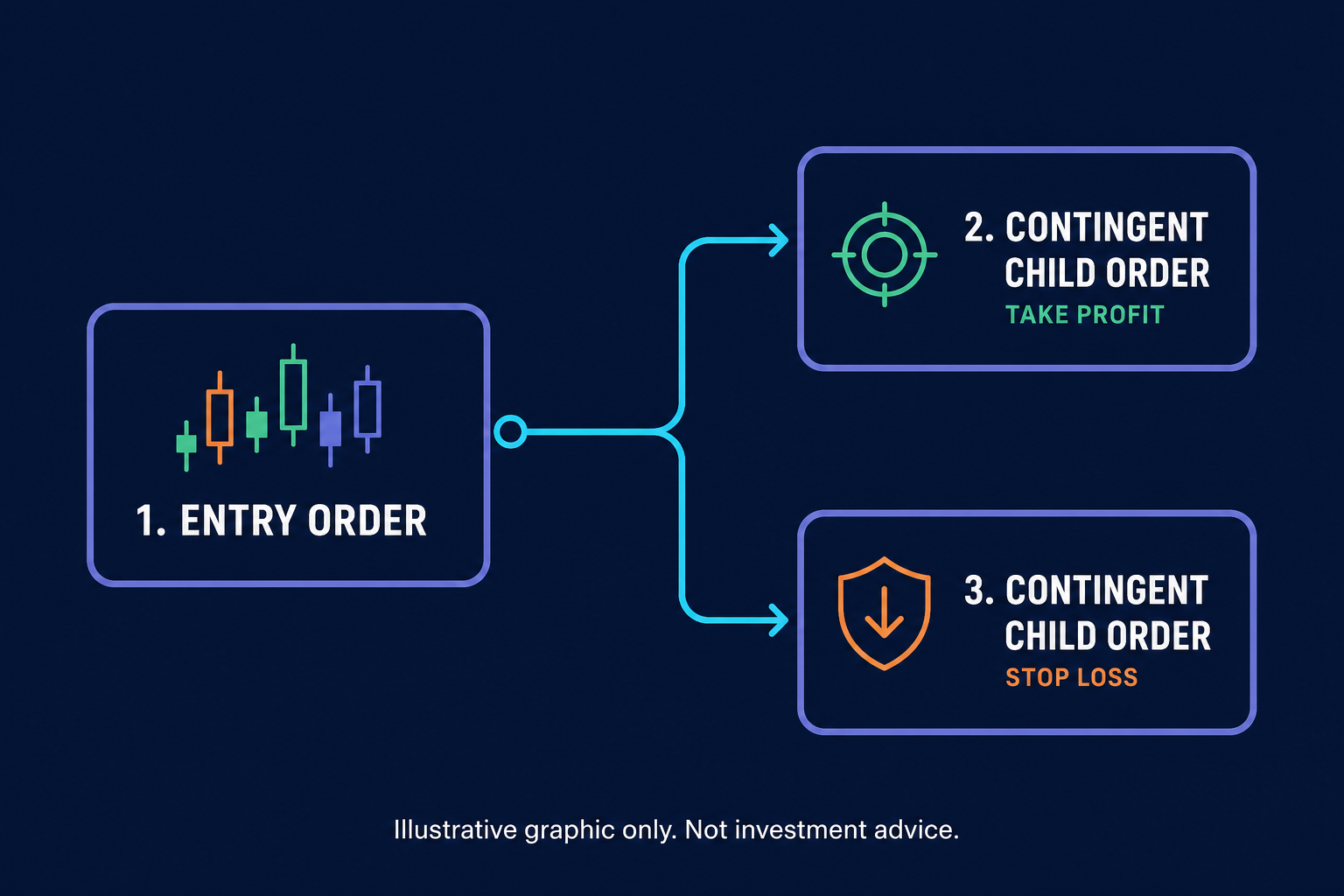
OTOCO stands for one triggers one cancels other. In practice, the entry order acts as the parent. Once that parent order fills, it triggers an OCO bracket, usually made up of a profit-taking order and a protective stop. If one child order fills, the other is canceled.
The value is not that OTOCO improves the trade idea. The value is that the order chain can be prepared before the trade is live.
For OHLCX users, OTOCO fits into a broader structured order entry workflow. It helps traders define the entry, attached exit logic, and risk controls ahead of time while keeping the final trading decision with the user.
Why contingent logic matters beyond simple brackets
Simple brackets work well when the trade is straightforward: enter the position, attach a target, attach a stop, and let one exit cancel the other.
Multi-step trading is different.
A trader may want the first entry to trigger protection, a later fill to adjust the remaining size, or a partial exit to change how the rest of the position is managed. That is not just a bracket. It is a sequence.
Contingent logic exists because active traders often think in steps:
- If the entry fills, activate the protective orders.
- If the first target fills, manage the remaining position.
- If the stop fills, cancel the profit target.
- If only part of the entry fills, confirm the attached exit quantity.
- If market conditions change, pause or adjust the chain.
This kind of multi-step contingent order design can reduce the need to rebuild the same logic manually after each fill.
It also makes the trade easier to review. After the trade, the question becomes clearer: did the order chain reflect the plan, or did the plan itself need work?
multi-step contingent order design
What problem does OTOCO solve?
OTOCO solves a timing and follow-through problem.
Without contingent logic, a trader may place an entry order, wait for the fill, then manually add the target and stop afterward. That can work in a slow market with one position open.
It becomes harder when the trader is managing options contracts, multiple tickers, scale-ins, fast-moving price action, or several setups at once. A small delay after the entry fill can leave the position without the intended protection.
OTOCO helps by connecting the steps before the trade is live:
- The trader defines the entry.
- The trader defines the target and stop.
- The entry order is sent.
- If the entry fills, the OCO bracket activates.
- If the target fills, the stop is canceled.
- If the stop fills, the target is canceled.
This keeps the trade structure connected from the start.
The trader still has to decide whether the setup is valid, where the stop belongs, where the target belongs, and how much size to use. OTOCO does not replace that judgment. It helps carry the defined plan into execution.
How should OTOCO chains be sequenced?
A good OTOCO chain should be simple enough to explain under pressure.
The first step is the parent order. That is the entry condition. The next step is the child order structure that activates only if the parent fills. In most cases, that means an OCO bracket with a profit target and a stop.
The trader should sequence the chain based on the economic purpose of each step.
For example:
- Parent order: enter the trade only if the price reaches the planned entry.
- Child target: take profit at the planned level.
- Child stop: exit if the trade reaches the invalidation level.
- Review step: verify size, order status, and remaining exposure after a fill.
This sounds basic, but it matters. If the trader cannot explain what each leg is supposed to do, the chain is too unclear.
Partial fills make sequencing even more important. If the parent order fills only halfway, the trader needs to know whether the child orders adjust to the actual filled quantity or whether they need to be reviewed manually. The target and stop should match the position that exists, not the position the trader expected to have.
Before sending an OTOCO order, the trader should know:
- What triggers the child orders?
- What happens if the parent order partially fills?
- What quantity should the bracket cover?
- What order state should be verified after the fill?
- What needs to be canceled if the setup changes?
That is the difference between a useful order chain and a confusing one.
Where complexity becomes counterproductive
Contingent logic is helpful until the order chain becomes harder to manage than the trade itself.
A parent entry with an attached OCO bracket is easy to understand. A long chain with multiple adjustments, partial exits, conditional hedges, and shifting templates can become difficult to monitor during live trading.
This is especially true around earnings, macro prints, halts, and other event windows. Those conditions can stress contingent orders because price may move discontinuously, spreads may widen, and liquidity can change faster than the original levels assumed.
In those environments, the cleaner choice may be to simplify the chain, reduce size, widen the review process, or avoid automation unless the risk limits are already clear.
OTOCO can organize execution, but it cannot make an event-driven market orderly. The trader still needs to decide whether the order structure fits the conditions.
How OTOCO works with OCO, TSP, and TRIM
OTOCO and OCO are closely related, but they are not the same.
OCO connects two exit orders so that one cancels the other. OTOCO adds the entry step before that bracket. The parent entry fills first, then the OCO bracket activates.
That distinction matters because OTOCO is about sequence. OCO is about paired exits.
Other exit flows may be more appropriate depending on the trade plan.
TSP can help when the trader wants a trailing stop to adjust as price moves favorably.
TRIM can help when the trader wants staged exits instead of one full exit.
TRIMMER can help when the trader wants a more adaptive staged exit workflow where the remaining position is managed according to the configured structure.
A simple breakout may only need OTOCO. A runner may need a trailing stop. A multi-contract options trade may need staged exits. A scale-in may require more deliberate sequencing before each new leg is added.
The point is not to choose the most advanced order type. The point is to match the order logic to the trade.
Risk Gauge portfolio limits still matter
A clean OTOCO chain on one symbol does not automatically make the full account clean.
A trader may have several positions with brackets attached, but still carry too much exposure to the same sector, index, volatility event, or directional theme. Each individual order can look structured while the total book becomes too concentrated.
This is where Risk Gauge portfolio limits matter.
Before adding another contingent order, the trader should review whether the new trade fits the account’s current exposure. The question is not only, “Does this trade have a stop?” It is also, “What happens to my portfolio if this order fills?”
A filled contingent order can increase exposure quickly. If several related chains trigger around the same time, the account can become more directional than intended.
For active traders, portfolio-level review should happen before the chain is armed, not only after the position is live.
Where Strategy Builder fits
For repeatable setups, OTOCO logic can connect naturally to Strategy Builder.
The benefit of no-code automation is that traders can define repeatable workflows without rebuilding every step manually. That can be useful when a trader has a known setup, a defined entry condition, and a consistent exit structure.
But automation changes the type of error.
Manual errors often happen through clicks, timing, or missed follow-through. Automated errors happen through stale templates, outdated assumptions, or configuration that no longer matches the market.
That is why new chains should be treated carefully. The trader should test the workflow, review partial-fill behavior, confirm exit quantities, and make sure the order chain behaves as expected before using meaningful size.
Automation can reduce repeated manual work. It should not remove the trader’s responsibility to understand the chain.
Testing OTOCO before using size
Traders should test contingent workflows before relying on them with meaningful capital.
That can mean starting with small size, using a paper trading account where available, or testing one setup at a time before adding more complex logic.
The goal is not to prove the trade idea is profitable. The goal is to confirm that the order chain is understandable, repeatable, and easy to verify.
A practical test should answer:
- Did the parent order trigger the child bracket as expected?
- Were the target and stop created with the correct quantity?
- Did one exit cancel the other when filled?
- What happened after a partial fill?
- Was the live order state easy to verify?
- Did the chain reduce manual steps without creating confusion?
After fast markets, traders should also check for stale child orders that no longer match the live thesis. Resting orders should not survive just because they were part of an old chain.
Using OTOCO inside a disciplined workflow
OTOCO is useful when the trader has a defined entry and wants the exit bracket prepared before the position is live.
It is less useful when the trader is still undecided about the target, stop, position size, or trade thesis. In that case, the problem is not the order type. The plan needs more work before it becomes an order.
OHLCX supports OTOCO as part of a structured execution workflow built around entry, exit logic, risk visibility, and optional automation. The purpose is to help traders turn their own rules into executable order logic while keeping the broker connection and final decision in the trader’s hands.
For active traders, OTOCO can make multi-step entries more deliberate. It connects the parent order to the protective bracket, keeps the sequence clearer, and helps reduce the gap between the planned setup and the live order state.
Request access to evaluate OHLCX contingent workflows, or explore the platform to see how OTOCO, OCO, TSP, TRIM, and TRIMMER fit into an execution-first trading process.
Leave a Reply