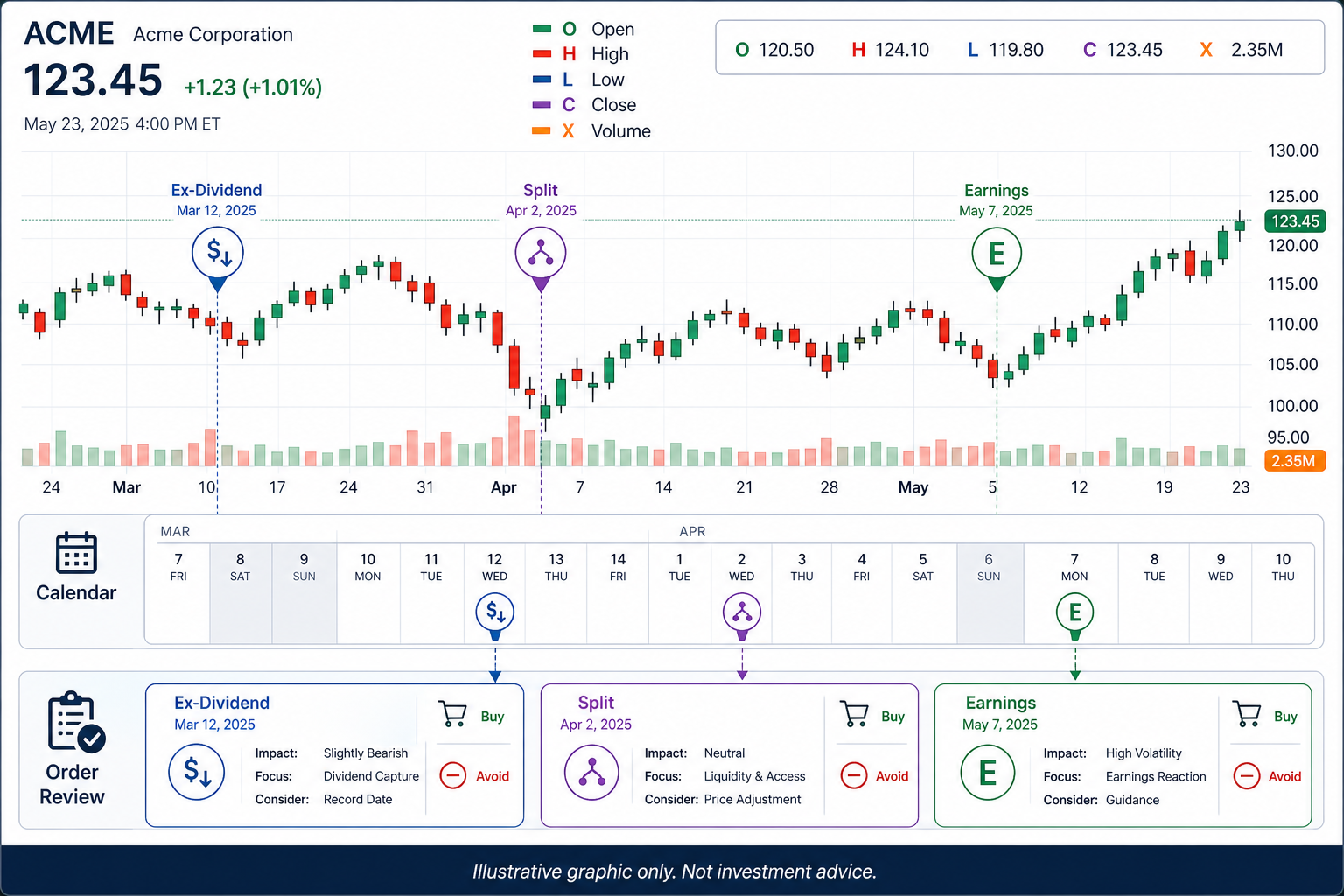
Corporate actions can change the mechanics of a position without changing the trader’s original opinion.
A dividend can affect the stock’s price behavior around the ex-dividend date. A split can change the share count and price reference behind every chart, alert, and working order. A spin-off can leave the trader with a new position that was not part of the original trade plan. An options adjustment can make an old contract look unfamiliar even though it still represents the economic terms of the prior position.
None of that automatically creates alpha, but it does create execution work.
The mistake is treating corporate actions as background noise until the account statement, chart, or order ticket looks wrong. Active traders need a cleaner process. Before adding risk, trimming size, or rebuilding brackets after a corporate action, the trader should confirm what changed, what still reflects the original plan, and what needs to be reset.
OHLCX supports that process by giving traders a Schwab-connected place to review positions, structure orders, choose exit flows, monitor Risk Gauge visibility, and reconstruct what happened through order history. It does not interpret corporate actions or provide tax guidance. It can help keep the trading workflow organized when the position’s terms, references, or exposure need another look.
Why do corporate actions matter to execution?
Corporate actions matter because they can change the reference points a trader uses to make decisions.
A stop level placed before a split may not be meaningful if the chart, order, or trader’s notes were not adjusted correctly. A hedge sized against the parent company may no longer fit after a spin-off. A dividend date may explain a price adjustment that a trader might otherwise mistake for weakness or strength.
The issue is not whether the trader understands the headline. It is whether the ticket, bracket, hedge, and account view still match the position that actually exists.
Execution plans depend on accurate inputs: share count, average price, working orders, option contract terms, cash impact, and portfolio exposure. When any of those inputs change, the next trade should begin with reconciliation rather than reaction.
Dividends are cash-flow events, not free return
Dividends can be useful, but they are not bonus money detached from market mechanics.
Around an ex-dividend date, the stock’s price may reflect the dividend leaving the company. That does not mean every price move on the ex-date is purely mechanical, but traders should not misread a predictable distribution adjustment as a new signal by default.
For long stock holders, the dividend may be part of the intended carry. For short sellers, dividend obligations can affect the cost of holding the position. For options traders, dividends may influence early exercise considerations, particularly around deep in-the-money calls near expiration.
Tax treatment can also matter, especially for traders thinking about qualified dividend rules or holding periods. That belongs in the planning layer and should be reviewed with appropriate tax guidance. It should not override trade invalidation or account risk.
The execution question is simple: does the position still deserve to remain open after the dividend mechanics, expected cash flow, and remaining risk are understood?
What should traders check around dividend dates?
Dividend dates should be treated as calendar inputs, not last-minute reminders.
Before carrying a position through an ex-dividend date, the trader should confirm:
- Whether the dividend is part of the thesis or just a scheduling detail
- How the ex-date may affect price references, alerts, and chart interpretation
- Whether a short position carries dividend-related obligations
- Whether options positions could be affected by exercise or assignment behavior
- Whether the position is part of a broader dividend-heavy basket
- Whether tax or holding-period considerations are relevant but subordinate to risk
This review does not need to be complicated. It needs to happen before the trader starts explaining away price movement that was already on the calendar.
Risk Gauge visibility can help when several dividend-sensitive positions sit in the same account. A dividend payer may look manageable by itself, but a basket of similar names can create more exposure to the same rate, sector, or defensive-yield theme than the trader intended.
Splits change references, not the trade thesis
A stock split changes the number of shares and the price per share. It does not, by itself, change the business value of the position.
That sounds basic, but splits can still distort behavior. A lower post-split price may feel cheaper even when the economics are unchanged. Retail participation may shift. Liquidity and spreads may look different for a period of time. Old chart levels can also become misleading if the trader is comparing adjusted and unadjusted references without realizing it.
The practical issue is ticket hygiene. Working orders, alerts, stop levels, target references, and position size should be reviewed after the split adjustment is reflected in the account.
A trader who owned 50 shares before a split may own a different number afterward, with the same economic exposure in adjusted terms. The account may be fine, but the trader’s mental model may not be. That gap is where mistakes happen.
Spin-offs and reorganizations need a deeper check
Spin-offs, mergers, rights offerings, and tender offers can create more complicated execution problems than ordinary dividends or splits.
A spin-off may leave the trader holding a parent company and a new child company. The original thesis may apply to one, both, or neither after the separation. A merger or tender offer can create a different risk profile, with spreads reflecting timing, approval risk, financing risk, or deal uncertainty. Rights offerings may require action by a deadline and can behave differently across brokers and account types.
These events are not just chart adjustments. They can change what the trader owns.
After a reorganization, the trader should confirm the live position, cash components, fractional-share treatment, option deliverables if applicable, and whether any working orders still make sense. If the position no longer expresses the original thesis cleanly, the exit plan should be rewritten rather than patched.
OHLCX order history and live position visibility can support that review, but the trader still needs to confirm corporate-action details through broker records and official company or exchange materials.
Options require special attention after adjustments
Corporate actions can affect options contracts in ways that are easy to miss.
After certain splits, special dividends, mergers, or spin-offs, listed options may be adjusted. Strike prices, deliverables, contract multipliers, symbols, or settlement terms can change depending on the action. The option may still represent the adjusted economic exposure, but it may not look like a standard contract in the chain.
That matters for exits. A trader who relies on muscle memory may select the wrong contract, misunderstand the deliverable, or compare an adjusted option to the wrong unadjusted reference. Liquidity can also change after an adjustment, especially if the contract becomes less standard.
Before trading around an adjusted options position, the trader should verify the contract terms, the current bid-ask spread, the deliverable, and the exit path. If the position was part of a hedge, the hedge ratio may need to be reviewed.
OHLCX’s Asset Detail view, options chain, Greeks, and order ticket can help bring the relevant inputs closer together. The platform can make the review easier to perform, but the trader still has to understand what the adjusted contract represents before sending another order.
Corporate actions can change portfolio heat
A corporate action may look like a single-position event, but the portfolio effect can be broader.
Several dividend payers may cluster around the same calendar window. A split in a high-profile name may influence related retail flow or sector attention. A spin-off can create exposure to a smaller, less liquid company that behaves differently from the parent. A special dividend or merger can change option behavior and hedging assumptions.
The point is not to overstate every corporate action as a major risk event. Most are manageable. The danger is ignoring the combined effect across a portfolio.
If several positions are affected by corporate events in the same week, the trader should review whether exposure, liquidity, and working orders still fit the account. Risk Gauge visibility can help keep that broader view in front of the trader before new orders are added.
How should Strategy Builder handle corporate-action windows?
A repeatable workflow should not ignore known corporate-action dates.
If a trader uses Strategy Builder, the workflow should account for events that can change price references, option terms, dividend behavior, or position structure. That might mean pausing new entries before a corporate action, requiring manual review after an adjustment, setting expiry order time limits for orders that are valid only before the event, or creating a separate workflow for post-action conditions.
The goal is not to automate judgment away. It is to keep a stale template from operating as if nothing changed.
For example, a strategy that uses fixed price levels should be reviewed after a split. A workflow tied to option Greeks should be checked after an option adjustment. A recurring dividend-related setup should not continue if the dividend was special, suspended, changed, or no longer part of the thesis.
OHLCX automation is optional and rule-based. The trader defines the rules and remains responsible for deciding whether they still fit after the corporate action.
Reconcile before placing new risk
The first step after a corporate action should be reconciliation.
The trader should confirm the current share count, average price, cash components, working orders, alerts, brackets, option terms, hedge ratios, and portfolio exposure before adding or reducing risk. If anything looks inconsistent, the next trade should wait until the account state is clear.
That sounds administrative, but it is execution discipline. A trader cannot manage the position they remember. They can only manage the position that exists after the corporate action has been processed.
OHLCX order history, structured order views, live positions, and Risk Gauge visibility can support that process. If the Schwab account state, broker records, or corporate-action treatment is unclear, the trader should verify the authoritative record before sending a fresh order.
Review what the action changed
A post-action review should separate three questions.
First, did the corporate action change the economic thesis? A split usually does not, while a spin-off, special dividend, merger, or tender offer might. Second, did it change the execution plan? Working orders, stops, hedges, and option contracts may need to be checked even when the thesis remains intact. Third, did it change the portfolio? The position may now carry different liquidity, factor exposure, or operational complexity.
Those answers should be recorded separately. Otherwise, the trader may confuse a mechanical adjustment with a market signal or treat a real thesis change as a clerical detail.
Over time, the review can improve the process. The trader may learn to pause automation around certain events, simplify brackets after reorganizations, or reduce size when adjusted options become harder to exit cleanly.
Treat corporate actions as execution inputs
Dividends, splits, spin-offs, and other corporate actions do not deserve panic, but they do deserve a process.
They can change price references, share counts, option terms, cash flows, tax considerations, hedge relationships, and portfolio exposure. Some changes are mechanical. Others affect the thesis. The trader’s job is to know which is which before placing the next order.
OHLCX supports that workflow through structured order entry, Asset Detail context, options chain and Greeks, OCO and OTOCO logic, TRIM and TRIMMER exits, TSP, Risk Gauge visibility, Strategy Builder, order history, and a Schwab-connected execution workflow.
Explore OHLCX to see how structured tickets and risk visibility can support cleaner post-action reviews. When a corporate action changes the terms of a position, the next edge is not speed. It is knowing exactly what changed before the next ticket goes live.
Leave a Reply