Short selling asks more of the trader than a bearish opinion.
A long trade can be wrong, hit its stop, and leave the trader with a defined loss based on the capital committed. A short trade can move against the trader in a more open-ended way because the stock can keep rising, borrow conditions can change, and the exit may require buying into a market where other short sellers are also trying to cover.
That difference changes the workflow before the order goes live. The trader has to know whether the shares can be borrowed, whether the cost of borrow still leaves enough edge, how much account risk the position creates, and what conditions turn a planned cover into an urgent one.
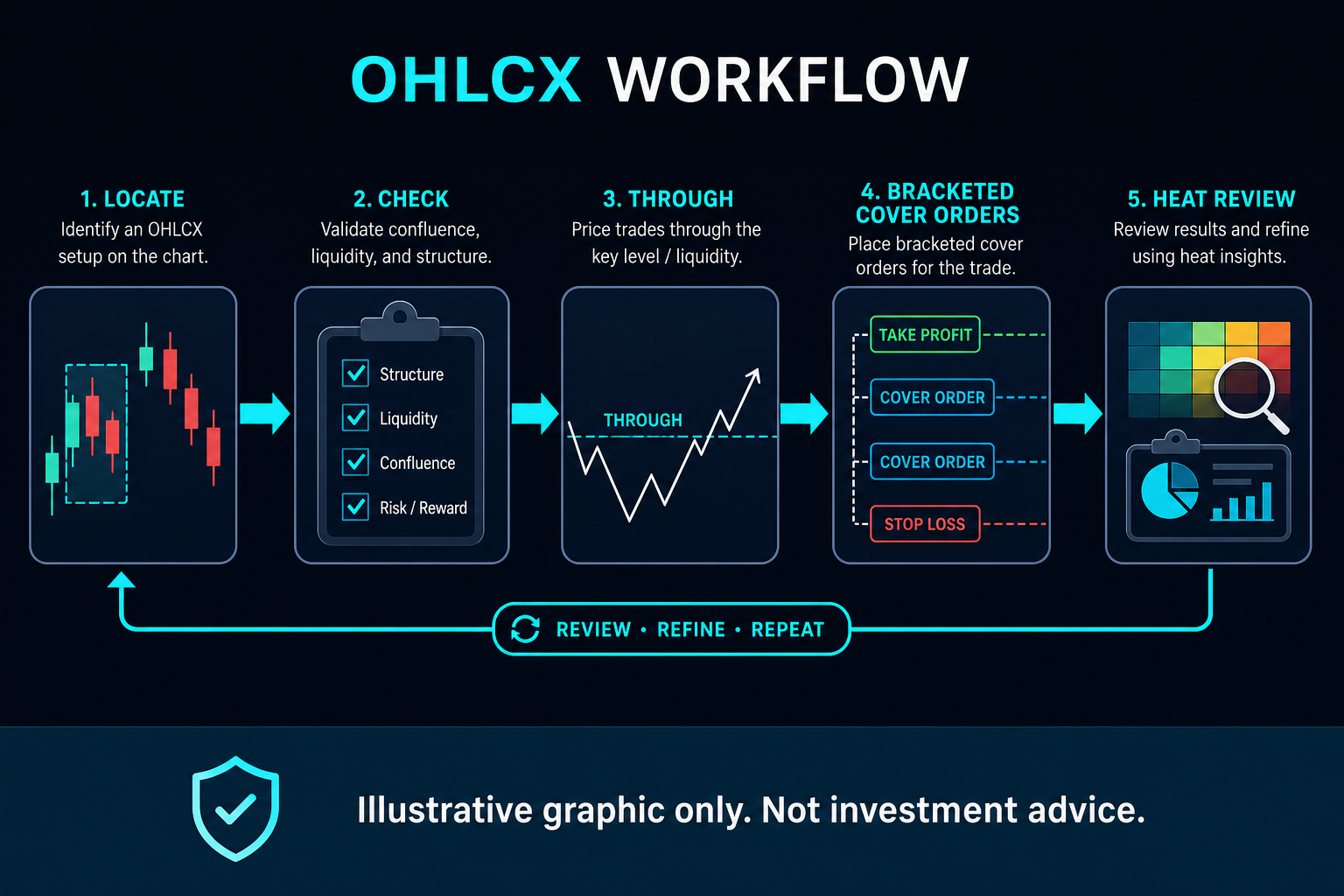
OHLCX can support the execution discipline around that process through structured order entry, Risk Gauge visibility, exit flows, order history, and a Schwab-connected workflow. It does not remove borrow constraints or decide whether a short sale belongs in the account. The trader still needs to confirm availability, margin requirements, borrow cost, and account-specific restrictions through broker records before placing or maintaining the trade.
Why is short selling not just the opposite of going long?
A long position can lose the capital committed to the trade. A short position can theoretically lose more than the initial proceeds because the stock can continue rising.
That asymmetry changes how the trader should think about invalidation. A short stop is not just the mirror image of a long stop. If price rises sharply, the loss grows while liquidity may become more expensive or more crowded. In a heavily shorted or hard-to-borrow name, the pressure to cover can build at the same time other traders are trying to do the same thing.
Shorts also carry operational constraints. The broker must be able to locate shares before the short sale, and the trader may be charged borrow costs while the position remains open. Those costs and conditions can change, especially in less liquid or crowded names.
The bearish thesis may be about price. The short-selling workflow has to account for the mechanics that make the position possible in the first place.
Borrow and locate are trading inputs
Borrow availability should be treated as part of the trade, not as an administrative detail after the idea is already built.
Easy-to-borrow names may feel routine, but they still deserve a basic check before size is added. Hard-to-borrow names require more care because availability, fees, and locate conditions can change the expected return. A trade with a modest expected downside move may not be worth taking if borrow cost absorbs too much of the edge.
That is especially true when the thesis requires holding through earnings, a regulatory event, a dividend date, or a crowded catalyst window. The trader may be correct on direction and still find that the carrying cost, margin impact, or cover path makes the position less attractive than it looked on the chart.
Before entering or scaling a short, the trader should know:
- Whether the stock is easy to borrow or hard to borrow
- Whether borrow cost changes the expected return
- Whether the planned holding period still makes sense after carry is included
- Whether a dividend, catalyst, or crowded short base could change the economics
- What should happen if borrow conditions deteriorate before price confirms the thesis
The goal is not to make every short impossible. It is to avoid entering a trade whose operating assumptions were never checked.
What makes covering different from selling a long?
Covering a short means buying the stock back. When the short is working, that can feel controlled. When the stock starts rising quickly, covering can become urgent because the trader may be competing with other buyers and other short sellers at the same time.
That is the part long-only habits often miss. A long trader selling into weakness may face slippage, but the position is already owned. A short seller covering into strength may be trying to buy back shares while the tape is accelerating higher and available offers are moving away.
The exit plan should include both price triggers and operational triggers. A chart level may still look defensible while the borrow cost, catalyst risk, or liquidity profile has changed enough to alter the trade.
For example, if borrow cost rises meaningfully and the stock has not moved in favor of the short, the trader should already know whether the plan is to keep paying for thesis time, reduce size, or close and revisit later. If price begins rising on heavy volume and offers thin out, the trader should know whether staged covering is still realistic or whether completion matters more than price improvement.
A short exit is not only “buy back when wrong.” It is “cover when the combined price, borrow, liquidity, and account-risk picture no longer supports the position.”
How should shorts be sized?
Shorts should be sized for adverse paths, not only for the intended target.
A stock can gap higher, halt, squeeze, or move through the area where the trader expected to manage the cover. A crowded name can become harder to exit when the same signal that invalidates the short also forces other traders to buy.
Sizing should account for the distance to invalidation, borrow cost, liquidity, catalyst risk, and the trader’s maximum acceptable loss if the cover happens at a worse price than planned. Short interest can be a useful context clue, but it should not be treated as a complete real-time map of crowding. It is a reported snapshot, not a perfect view of who will cover tomorrow.
Risk Gauge visibility can help keep the short in context with the rest of the account. A single short may look manageable, but several high-beta shorts can behave like one crowded risk-on bet if the broader market turns higher.
What changes around catalysts?
Catalysts make short selling harder because they can change both price behavior and borrow conditions.
Earnings, financing news, takeover rumors, regulatory updates, FDA decisions, macro releases, index changes, and ETF flows can all move a short quickly. Small-cap, biotech, and heavily shorted names deserve extra care because gaps and halts can change the cover path before the trader can respond.
If the short thesis is tied to a catalyst, the trader should decide whether the position is meant to survive the event or close before it. If the trade is not meant to carry that event risk, expiry order time limits and pre-event review rules can help prevent stale orders from remaining active after the original setup has passed.
The post-catalyst plan matters too. If the thesis is confirmed, does the trader cover part of the position into weakness, trail the remainder, or hold for a larger move? If the thesis fails, does the trader cover, reduce to a probe size, or wait for liquidity to normalize?
OHLCX’s structured order entry and exit flows can help express that plan before the market is moving. The platform does not remove catalyst risk or borrow risk. It helps make the intended response more deliberate.
How should profit-taking work on shorts?
Profit-taking on a short means covering into weakness. That can be a clean exit when liquidity is available, but it still needs structure.
If the stock falls toward the target, the trader may want to cover part of the position before the move becomes crowded or before liquidity disappears. TRIM or TRIMMER-style staged exits can support partial covers when the trader wants to reduce exposure without closing the entire position at once.
The same caution applies as with long exits: staged exits only work when the market allows them. In thin or fast conditions, a detailed ladder may become less useful than a simpler cover plan. If the bearish thesis is broken, completing the exit may matter more than preserving a carefully staged cover schedule.
After every partial cover, the remaining short should still have a clear invalidation level, an updated exposure amount, and a reason to stay open.
How should protective exits be used?
OCO, OTOCO, and TSP-style logic can help organize short exits, but they should be built around the specific risk of a rising stock.
A protective buy stop can define where the short thesis fails. A target can define where the trader wants to cover into weakness. A trailing plan can help protect open profit if the stock continues lower and then begins to reverse. Those structures can bring discipline to the trade, but they do not guarantee an exact fill during gaps, fast markets, or thin liquidity.
Shorts require special attention to upside acceleration. If price starts rising quickly, the trader may be competing with other shorts who also need to cover. A planned stop can turn into a more urgent liquidity problem when the tape starts moving against the position.
The exit logic should include a hierarchy: when to wait, when to stage covers, and when to prioritize completion. The trader should not be deciding that hierarchy for the first time while the stock is squeezing higher.
How should Strategy Builder handle short setups?
A repeatable short workflow should include more than a bearish signal.
If a trader uses Strategy Builder, the rules should define entry conditions, size, invalidation, profit-taking logic, and the conditions that pause or cancel the setup. For short workflows, the policy should also account for borrow status, hard-to-borrow conditions, catalyst windows, and correlated exposure.
A short workflow may need stricter review rules than a long workflow. New short entries may pause before earnings, during known regulatory events, or when several related names are already short in the account. A recurring setup may also require manual review if borrow cost or liquidity changes materially.
OHLCX automation is optional and rule-based. The trader defines the conditions and remains responsible for whether the short exposure belongs in the account. Automation can help apply a repeatable process, but it should not turn a stale bearish idea into an active short without the required borrow, risk, and event checks.
What should traders verify during the trade?
Short positions should be monitored for more than price.
The trader should review borrow status, borrow cost where visible, margin impact, position size, open orders, partial covers, and whether the trade is approaching a catalyst or dividend date. If the stock is hard to borrow or moving quickly, those checks may need to happen more often.
Order history matters because short decisions can happen quickly under pressure. If a trader covers part of the short, cancels a stop, resets a bracket, or changes size, the review should show what actually happened and when.
OHLCX order history, live position visibility, and structured order views can support that review. The authoritative borrow and margin details still come from broker records and account-specific information, but the trading workflow should make it easier to see whether the exit plan and remaining exposure still match.
What happens when several shorts move together?
A portfolio of shorts can become concentrated faster than it looks.
Shorting four high-beta growth names may feel diversified by ticker, but if the market catches a broad risk-on bid, those positions can move against the trader together. The same can happen across crowded small caps, sector shorts, or names tied to one macro factor.
The danger is not only that several prices rise at once. It is that several covers may need liquidity at the same time.
If multiple shorts begin moving against the book, the trader should decide whether to reduce the weakest name, cover the most crowded position, reduce the most liquid exposure first, or cut the theme. Waiting to evaluate each ticker one by one can be too slow when the shared driver is already moving.
Risk Gauge visibility can help keep account-level exposure in front of the trader. The question is not only whether each individual short still has a thesis. It is whether the combined short book still fits the account.
Review the short after it closes
A short trade should be reviewed for both thesis quality and execution quality.
The trader should ask whether the bearish thesis was valid, whether borrow cost changed the expected return, whether the cover followed the plan, whether partial covers helped or hurt, and whether the position became too urgent before action was taken. If the trade was covered because of operational pressure rather than price invalidation, that should be recorded separately.
A losing short may still be a disciplined exit if the trader covered before the position became unmanageable. A profitable short may still reveal poor process if borrow cost was ignored, the exit was improvised, or the remaining position had no clear protection.
The purpose of review is not to shame the trade. It is to learn whether the short failed because the idea was wrong, the execution plan was incomplete, or the operational assumptions were too optimistic.
Treat short risk as more than price risk
Short selling can be useful, but it has a different failure mode than long exposure.
The trader has to account for price movement, borrow availability, carry cost, margin impact, squeeze dynamics, event risk, and cover urgency. A bearish thesis is only one part of the trade. The workflow has to prove that the position can be entered, held, reduced, and covered under realistic conditions.
OHLCX supports the execution side of that discipline through structured order entry, OCO and OTOCO logic, TSP, TRIM and TRIMMER exits, Risk Gauge visibility, Strategy Builder, order history, and a Schwab-connected workflow.
Request access to OHLCX to evaluate how structured tickets, risk visibility, and order history can support a clearer short-selling process. A short sale is not proven at entry. It is proven when the trader knows how the position will be covered if the tape turns first.
Leave a Reply