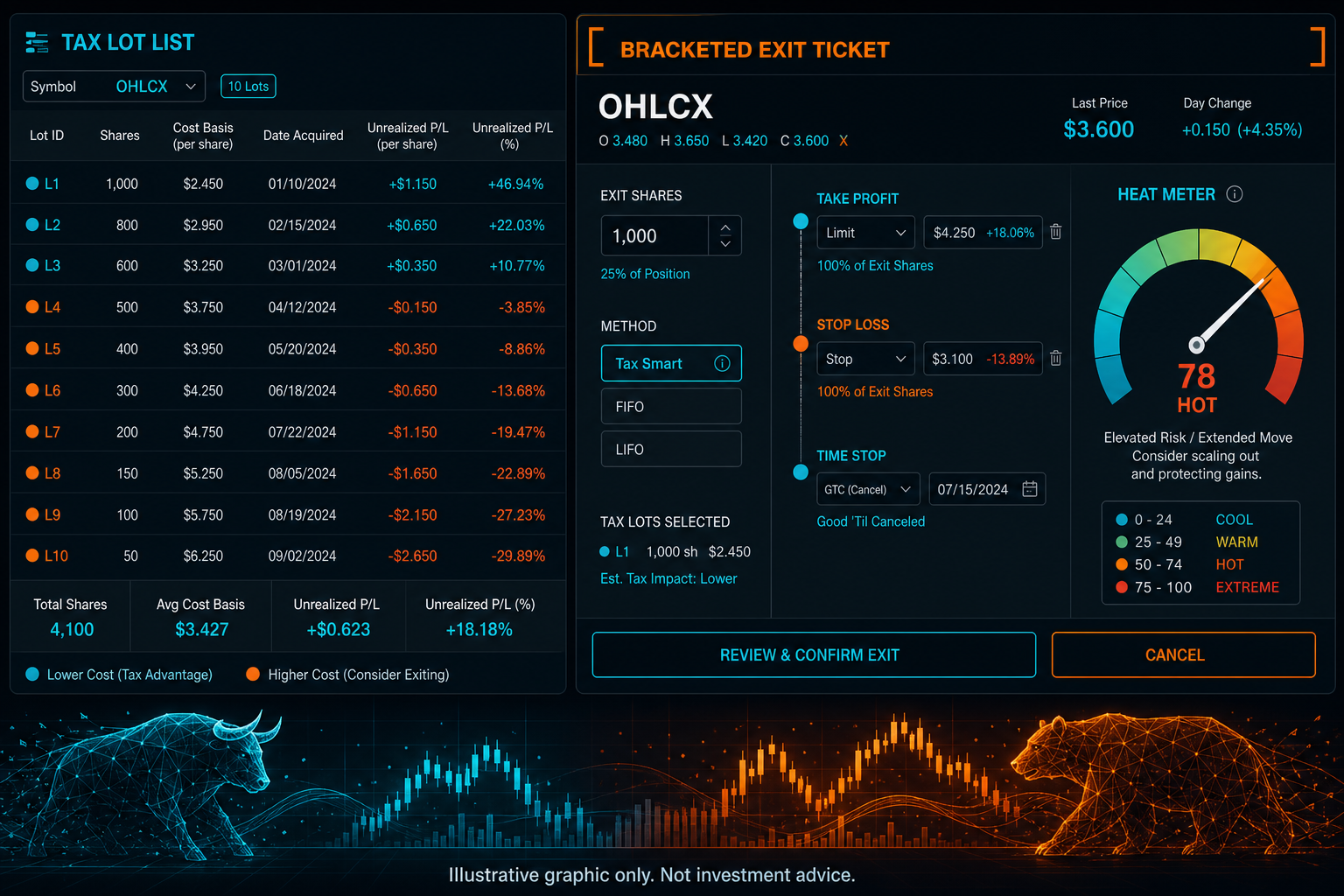
Taxes are real trading costs, and traders are not wrong to pay attention to them. Lot selection, holding period, wash-sale considerations, and realized gain or loss timing can all affect the after-tax result in a taxable brokerage account. Those mechanics matter, but they sit on a different timeline than market risk.
A position can become invalid before the tax outcome becomes convenient.
That is the problem this blog is really about. Traders can keep broken positions because a lot is close to long-term treatment, avoid a necessary trim because they do not want to realize a gain, or hold a losing trade because the loss may be useful later. Each choice may sound reasonable in isolation. Together, they can turn tax awareness into a quiet override of the exit plan.
Market risk shows up immediately. Taxes are reconciled later. When those two timelines collide, the trading plan needs a clear hierarchy: thesis invalidation first, portfolio heat second, tax preference third.
OHLCX supports that kind of risk-first workflow by giving traders a Schwab-connected place to structure orders, review Risk Gauge visibility, choose exit flows, and reconstruct what happened through order history. OHLCX does not provide tax advice or decide which tax lot should be sold. It can help keep the trading decision visible so tax preference does not quietly rewrite the exit.
When should taxes influence an exit?
Taxes can influence an exit when the economic trade is still valid and the tax impact is large enough to matter.
That may include a position approaching a targeted holding period, a planned loss-harvesting window, a year-end gain budget, or a situation where selling one lot instead of another changes the after-tax result without increasing unacceptable market risk. In those cases, tax awareness is a planning overlay. It helps the trader choose between otherwise acceptable actions.
The key phrase is “otherwise acceptable.” A tax preference should shape the timing or lot selection of an exit only when the trade still makes sense from a trading and portfolio standpoint.
If the thesis has failed, if the position has exceeded its planned risk, or if correlated exposure has become too concentrated, the tax argument should not get the final vote. A trade that would be wrong without taxes is still wrong with taxes.
Where tax awareness becomes dangerous
Tax thinking becomes dangerous when it starts changing the risk rule after the fact.
A trader may avoid selling because the gain is short-term. Another may hold a deteriorating position because the loss could be useful in a different tax window. Someone else may widen a stop because one lot is close to a preferred tax outcome. The language sounds practical, but the behavior is often the same: the trader is letting the tax result delay a decision the market has already made.
This is especially common when the trader is trying to preserve both the story and the tax outcome. Selling would realize the gain or loss and force a decision. Holding keeps the narrative alive a little longer.
That is not tax planning. It is risk drift with better vocabulary.
A cleaner rule is simple: taxes can optimize an exit, but they should not redefine invalidation.
What hierarchy should traders use?
A trader needs a written order of operations before tax friction appears.
A practical hierarchy can look like this:
- Thesis invalidation: If the original reason for the trade is no longer valid, exit or reduce according to the risk plan.
- Portfolio heat: If the account is carrying too much exposure to one name, theme, sector, or macro driver, reduce risk before optimizing tax outcome.
- Execution quality: If liquidity, spread, or partial fills make the intended exit unrealistic, adjust the order path without pretending the tax lot changes the market.
- Tax preference: If the trade still belongs in the account and risk is within bounds, choose the lot, timing, or realization path that best fits the tax plan.
This hierarchy does not eliminate judgment. It prevents the wrong layer from making the decision.
Risk Gauge visibility can support the middle part of that review by showing the trader whether the account is already carrying more exposure than intended. If portfolio heat says the position needs to be reduced, tax preference should not quietly veto the reduction.
How do tax lots interact with partial exits?
Partial exits can make tax-lot awareness more complicated because the trader is not simply in or out. A TRIM-style exit may reduce tactical size while leaving a core position open. The tax result can vary depending on which lot is selected, how the broker applies default disposal rules, and whether the trader uses specific identification where available.
That means partial-exit planning should include both trade language and tax-lot language. The trader should know whether the trim is meant to reduce the newest tactical add, take down an older core lot, realize a specific gain or loss, or simply lower account heat regardless of basis.
The tax choice should not disturb the risk purpose of the trim. If the plan is to cut exposure by 30%, the trader should not keep more risk open just because the preferred lot creates an unattractive tax result.
OHLCX’s structured exit flows can help keep the trading intent clear before the order goes live. The trader still needs to confirm tax-lot handling through broker records or a tax professional, but the exit reason should remain visible: reduce heat, protect gains, close invalidated exposure, or simplify the book.
Do tax lots change stop logic?
Tax lots should not change the reason a stop exists.
A stop or protective exit is there because the trade has reached a level or condition where the position should no longer remain open as originally planned. If the trader changes that level only because one lot is close to a preferred tax outcome, the stop has stopped being a risk tool.
There can be legitimate planning choices before the trade reaches invalidation. A trader may reduce a different lot, trim earlier, or plan a substitute exposure with tax guidance. Once the position has reached the level that proves the thesis wrong, the tax lot should not be used to rewrite the exit.
OCO, OTOCO, TSP, TRIM, and TRIMMER workflows can support different exit structures, but the trader still has to define the risk logic behind them. A tax preference should not silently widen a trailing stop, delay a bracket exit, or keep a remainder open after the original reason for holding has disappeared.
What about wash-sale windows?
Wash-sale considerations are real, but they should be handled as part of planning rather than improvised during a stressful exit.
A trader harvesting a loss may need to consider whether buying the same or a substantially identical exposure around the sale affects the expected tax treatment. That is a tax-planning question, and it should be reviewed with current broker records and qualified tax guidance.
From a trading standpoint, the more important rule is that wash-sale concerns should not trap the trader in a position that no longer belongs in the account. If risk needs to be reduced, the trader may need to exit first and solve the replacement-exposure question separately.
This is where planning matters. A trader can decide in advance whether a substitute instrument is acceptable, whether exposure should stay flat during the relevant window, or whether the loss-harvesting idea is not worth the market risk. Those choices are easier to make before price is moving and the trader is trying to protect both the account and the tax outcome at the same time.
How should Strategy Builder handle tax-aware rules?
A repeatable strategy should not allow tax preference to quietly override risk controls.
If a trader uses Strategy Builder, the workflow should be designed around the trading rule first: entry conditions, invalidation, size, exit logic, expiry timing, and portfolio heat limits. Tax-related considerations may sit around that workflow as review points, but they should not automatically keep a broken position alive.
For example, a trader may create a manual review rule before selling a lot with a specific tax consequence. That can be reasonable if the position remains inside the risk plan. It is not reasonable if the review rule becomes a loophole that prevents exits after invalidation.
OHLCX automation is optional and rule-based. The trader defines the rules and remains responsible for the exposure they create. For tax-sensitive workflows, the cleanest approach is to document which rules are risk controls and which are tax preferences so the two are not confused later.
Year-end is when the hierarchy gets tested
Year-end can make tax decisions feel urgent. Traders may want to harvest losses, manage realized gains, or avoid selling a position before a preferred tax date. At the same time, year-end can bring thinner liquidity, crowded tax-motivated flows, holiday schedules, and portfolio rebalancing pressure.
That combination can make weak decisions sound sophisticated.
If a trader holds a deteriorating position only to preserve a tax outcome, the account may absorb market risk that is larger than the tax benefit being protected. If the trader delays a necessary trim because realizing the gain is inconvenient, portfolio heat can build quietly while the calendar becomes the excuse.
A better process is to define the tax plan before the final weeks of the year. Which positions are candidates for tax-aware exits? Which risks override that plan immediately? Which holdings require advisor input before a trade is placed? Which positions should not be touched for tax reasons unless the thesis breaks?
The goal is not to ignore taxes. It is to make sure the calendar does not become the trader.
How should exceptions be documented?
Exceptions should be rare, written, and time-bound.
A useful exception might say: defer selling this lot only if the position remains below a defined exposure limit, the original thesis remains intact, and the review date is no later than a specific day. That creates a contract with the future trader. It does not leave the decision open to mood.
An unhelpful exception sounds more like: wait because the lot is almost long-term, or hold because realizing the loss feels wasteful. Those statements do not define risk, timing, or invalidation. They invite rule shopping.
If exceptions become frequent, the hierarchy is probably wrong. The trader should rewrite the policy instead of justifying each override one by one.
OHLCX order history and timestamps can help review whether exceptions were followed as written or expanded under pressure. That review can be uncomfortable, but it is useful. A tax-aware process should still be auditable as a trading process.
Review after-tax outcomes without rewriting history
After-tax results matter, but they should be reviewed honestly.
A trade may produce a better tax outcome while still being a poor risk decision. Another trade may create a taxable gain while correctly removing exposure from a broken setup. The review should separate those outcomes instead of treating the tax result as proof that the exit was good or bad.
The trader should record the exit reason, the risk condition, the lot method or tax preference considered, and the actual execution result. Over time, that record can show whether tax awareness improved decisions or repeatedly delayed exits that should have happened sooner.
OHLCX order history can support the execution side of that review by showing what actually filled, what remained open, and when decisions were made. Tax records and advisor guidance complete the tax side. The trading review should not rely on memory alone.
Keep taxes in the plan, not in charge
Tax-lot awareness belongs in active trading, but it belongs below risk.
A trader can choose lots thoughtfully, plan around wash-sale considerations, and manage realization timing without letting taxes dictate bad exits. The dividing line is whether the trade still deserves to exist after thesis, heat, liquidity, and execution risk are considered.
OHLCX supports the risk-first side of that process through structured order entry, OCO and OTOCO logic, TRIM and TRIMMER exits, TSP, Risk Gauge visibility, Strategy Builder, order history, and a Schwab-connected execution workflow.
Tax planning should be handled with accurate broker records and qualified tax guidance. Trading discipline still has to answer the market first.
Request access to OHLCX to evaluate how structured tickets, risk visibility, and post-trade order history can support a cleaner separation between tax preference and trade invalidation.
Leave a Reply