Options and equities may share the same ticker, but they do not share the same execution mechanics. Buying shares and buying a call can express a similar directional view, yet the two positions can produce very different results even when the stock moves as expected.
An equity position is primarily exposed to changes in the share price, along with liquidity, gaps, and execution quality. An option is also affected by its strike, expiration, implied volatility, time remaining, and sensitivity to movement in the underlying stock. The trader can be directionally right and still lose because the contract was purchased at an unfavorable price, volatility declined, time decay accelerated, or the spread made the exit more expensive than expected.
That difference should shape the order before it goes live. Equity and option trades require separate assumptions about price, liquidity, timing, and how the position will be closed.
OHLCX supports U.S. equities and options within a Schwab-connected execution workflow. Its Asset Detail view brings chart context, an options chain with Greeks, Level 2 depth, instrument information, and the order ticket closer together. Those tools can make the different inputs easier to review, but the trader still has to decide whether the selected instrument fits the thesis and whether its execution risk is acceptable.
Why does equity-style thinking break in options?
Equity traders often treat the stock price as the main source of truth. If the stock moves above resistance, below support, or through an invalidation level, the position responds directly to that move.
An option contract adds more variables. Delta describes how responsive the option is to movement in the underlying stock, while gamma describes how quickly that delta can change. Theta reflects the effect of time passing, and vega reflects sensitivity to changes in implied volatility.
These variables do not operate independently. Near expiration, gamma may cause an option’s directional exposure to change rapidly as the stock moves. Before an earnings announcement, implied volatility may support a higher option premium. After the event, that volatility can contract sharply even if the stock moves in the expected direction.
The result is a common options-trading frustration: the stock was right, but the trade was not.
That outcome is not necessarily a failure of the directional thesis. It may be a failure to account for the price paid, the contract selected, the time horizon, or the way volatility was expected to change.
Where does equity execution usually fail?
Equity execution often fails through speed, liquidity, and queue position.
In highly traded stocks, spreads may be narrow, but price can still move before an order fills. A passive limit order may sit behind other orders at the same price. A marketable order may complete quickly but experience slippage during a fast move. Gaps and trading halts can also move the next available price beyond the trader’s stop or target.
Less liquid equities introduce wider spreads and thinner depth. Short positions add borrow and locate considerations, particularly when a stock becomes difficult or expensive to borrow.
These risks are meaningful, but the position itself remains relatively direct. If a trader owns 100 shares, a $1 move changes the position value by approximately $100 before fees and other costs. The fill may be poor, but the relationship between the stock and the position is easy to observe.
That transparency is one reason OCO brackets, staged entries, and straightforward invalidation levels often translate cleanly into equity workflows.
How do option orders fail differently?
Option liquidity is divided across multiple strikes and expiration dates. A stock can trade millions of shares while a specific option contract has limited volume, little displayed size, or a wide bid-ask spread.
The midpoint between the bid and ask may look like the contract’s value, but it is not a guaranteed execution price. A trader may need to pay closer to the offer to enter and accept closer to the bid to exit. That spread can consume a meaningful portion of the expected return before the underlying stock has moved.
Option orders also fail through contract selection. A contract may have too little time remaining, too little delta, or too much implied volatility embedded in the premium. A near-expiration contract can become highly sensitive to small stock moves, while a farther-dated contract may respond more slowly but carry a larger absolute premium.
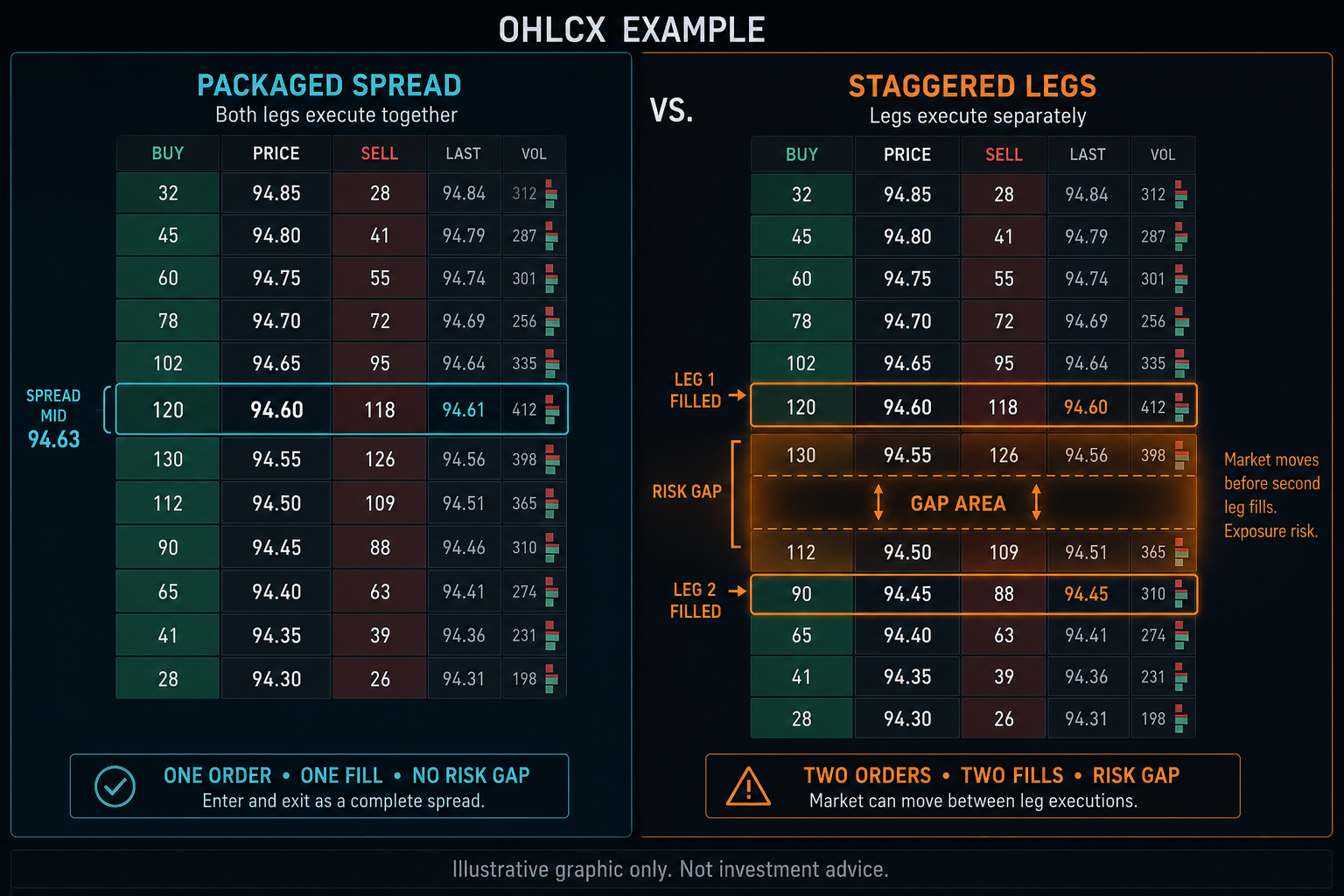
For multi-leg positions, another risk appears: completion. If the trader enters each leg separately, one option may fill while the other remains open. The result can be a position with different directional, volatility, and loss characteristics than the intended spread.
Submitting a strategy as a combined order may reduce the risk of being filled on only one leg, but it does not guarantee completion. If the requested net price is unavailable, the full order may remain unfilled while the market moves.
Why can the stock move correctly while the option loses?
An option’s value reflects more than direction.
Suppose a trader buys a call before an earnings release and the stock rises afterward. The call can still disappoint if the move was smaller than the options market expected, implied volatility falls sharply, or the trader paid a wide spread to enter and exit.
Time can create the same mismatch. A bullish thesis may eventually be correct, but an option can lose value while the stock moves sideways because the contract has less time remaining. Near expiration, waiting for the thesis to work becomes increasingly expensive.
Contract choice therefore belongs inside the execution thesis. The trader should not only ask where the stock may go. The trader should also ask how quickly it needs to move, how much movement is already reflected in the premium, and whether the contract can be exited efficiently.
OHLCX’s options chain and Greeks can provide context for that review before the order is submitted. They help make the contract’s sensitivities more visible, but they do not determine whether the premium is attractive or whether the market thesis will play out in time.
What should be defined before an options order is sent?
An option ticket needs more than a directional entry and a chart-based stop. Before sending the order, the trader should define:
- The stock price or new information that invalidates the thesis
- The selected strike and expiration, and why they fit the expected move
- The maximum acceptable debit, credit, or bid-ask spread
- The role of implied volatility before and after known events
- The point at which time remaining becomes too short for the thesis
- The exit plan if the stock moves correctly but the option does not
- The treatment of partial fills or an incomplete multi-leg position
- The assignment, exercise, or expiration plan if the position remains open late in the contract’s life
This does not require predicting every outcome. It requires recognizing that an options trade can fail through more than one path.
Structured order entry can help keep these decisions attached to the live workflow rather than scattered across notes and browser tabs. OHLCX also allows traders to choose structured exit flows before an order goes live, although the exit logic still needs to fit the specific option contract and its liquidity.
How should market and limit orders be used?
The tradeoff between completion and price control exists in both equities and options, but wide option spreads make the choice more visible.
A market order prioritizes completion and accepts the available price. In a liquid equity, the difference between the quoted and executed price may be small under normal conditions. In a thin option contract, a market order can cross a much wider spread and create immediate slippage.
A limit order establishes the worst acceptable price, but the trader must accept that the order may not fill. Repeatedly adjusting the limit to chase the market can erase the original price discipline one small edit at a time.
For options, the order decision should be based on the specific contract rather than the liquidity of the stock alone. A liquid underlying does not guarantee a liquid strike or expiration.
OHLCX can keep the stock chart, option data, and ticket in the same Asset Detail workflow, helping the trader compare the underlying move with the contract being ordered. The platform supports the order process, while the trader decides whether the spread and available liquidity justify the trade.
What changes near expiration?
Expiration changes the trade even when the chart looks quiet.
As time runs down, gamma can make delta change more rapidly around the strike. A small move in the stock may produce a much larger change in the option’s exposure than it would have earlier in the contract’s life. Time decay also becomes more important, particularly for options that remain out of the money.
Pin risk can arise when the stock trades near a strike at expiration. The trader may face uncertainty around whether a short option will be assigned or whether an apparently closed economic exposure will create a stock position after expiration.
The practical response is not to avoid expiration entirely. It is to decide in advance how late the position is allowed to remain open, whether the trader is prepared for exercise or assignment, and when the remaining execution risk outweighs the value of holding longer.
An expiry order time limit can support a workflow where an order is only valid until a defined point. The trader still needs to verify the position and understand how the broker handles exercise, assignment, and expiring contracts.
What happens when equities and options are managed together?
Stock and options positions can interact in ways that are easy to miss when each ticket is reviewed separately.
A trader may hold shares and use puts for protection, sell calls against the stock, or hedge an option position by adjusting the equity position. If shares are reduced through a staged TRIM or TRIMMER exit, the hedge relationship can change. The remaining option position may protect more or less stock exposure than the trader intended.
Delta also changes as the stock price, implied volatility, and time to expiration change. A hedge that was reasonably aligned at entry may need to be reviewed later even if no new contracts were added.
The rebalance rule should be defined before the position becomes difficult to manage. It may reference a stock price, a delta range, a time threshold, or a change in the original thesis. What matters is that the trigger is clear enough to follow without improvising every adjustment.
Risk Gauge visibility can help keep the account-level effect of the positions in view, but it should not be described as a substitute for options-specific sensitivity analysis. The trader remains responsible for understanding how the stock and option positions work together.
When does automation help?
Automation is most useful when the rules are repeatable and the inputs are clearly defined.
A recurring workflow may specify an acceptable spread, contract duration, entry window, position size, exit threshold, or time-based review. Strategy Builder can help reduce variation in how those user-defined rules are applied across repeated setups.
Automation becomes less useful when the trade depends on a one-time catalyst, a rapidly changing volatility surface, or judgment about whether a displayed option market is genuinely tradable. Those situations may still require a manual review before the order is released.
OHLCX automation is optional and rule-based. It does not decide which option contract is fairly priced or whether a multi-leg position should be entered. The trader defines the conditions and remains responsible for the exposure those rules create.
Review fills, not screenshots
Options reviews should begin with the actual execution, not the chart or the midpoint that was visible before the order filled.
The trader should compare the intended and actual entry price, the spread paid, any partial fills, the underlying move, the change in implied volatility, and the effect of time passing. For multi-leg positions, the review should also confirm whether the intended structure was completed and whether any leg remained open longer than planned.
Equity reviews need the same honesty around slippage, queue position, partial fills, and gaps. The difference is that option performance may need to be separated into several causes rather than explained only by the stock’s direction.
OHLCX order history, timestamps, live positions, and Asset Detail context can support that reconstruction. The purpose is not to explain away a loss with more variables. It is to identify whether the thesis, the contract, or the execution process failed.
Match the workflow to the instrument
Equities and options can express the same opinion, but they place different demands on the trader.
Equity execution centers on stock price, available depth, order priority, gaps, and borrow conditions where relevant. Option execution adds strike and expiration selection, spread width, time decay, volatility changes, shifting Greeks, possible assignment, and multi-leg completion risk.
OHLCX supports both instruments through a Schwab-connected workflow with structured order entry, equity and option data, Greeks, Level 2 depth, Risk Gauge visibility, order history, exit flows, and optional rule-based automation.
Explore OHLCX to see how those elements come together in one execution workflow. The stock can move exactly as expected and the option trade can still disappoint; understanding why is part of choosing the instrument, not something to discover after the fill.
Leave a Reply