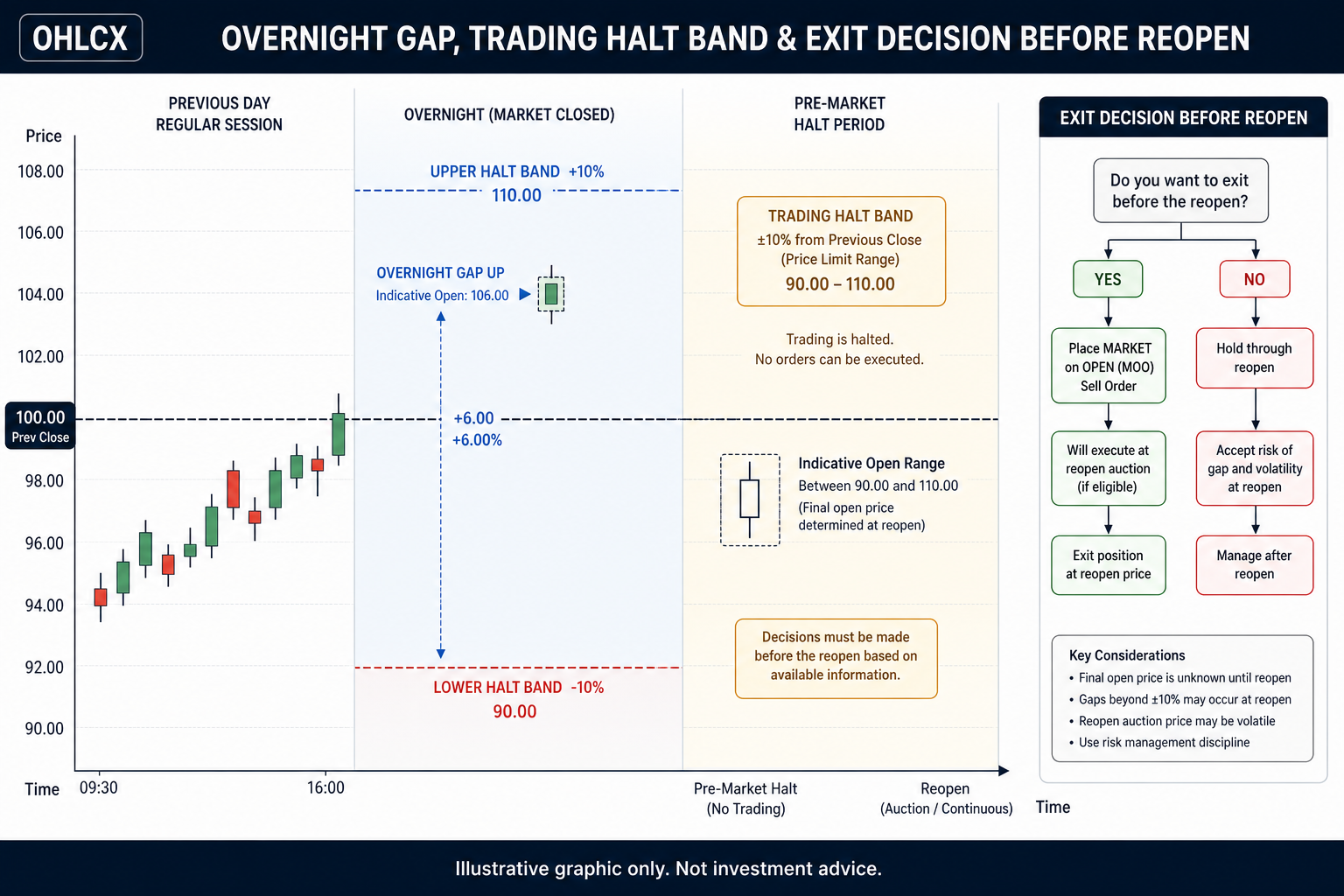
Opening gaps and trading halts expose a basic limit of every exit plan: price does not have to trade through the levels used to size the position.
A stock can close near one price and reopen far above or below it after earnings, a filing, or a broader market shock. During the session, trading can also pause while new information or a sharp order imbalance changes the relationship between buyers and sellers. When trading resumes, the next available price may have little connection to the range the trader was watching beforehand.
That changes how stops, targets, partial exits, and position size should be understood. A stop can define when the thesis is invalid, but it cannot guarantee an exit at the stop price. A limit order can protect a price boundary, but it can also leave the trader unfilled while the market moves farther away.
The practical lesson is not that gaps and halts can be predicted. It is that the exit hierarchy should already be clear before continuous trading disappears.
OHLCX supports that planning process by giving traders a Schwab-connected place to structure orders, choose exit flows, review risk, and verify what remains live after an abnormal move. It cannot control the reopening price or restore liquidity. It helps move the decisions that can be made in advance into the order workflow before the market becomes harder to manage.
Why do gaps and halts break ordinary exit logic?
Most trade plans assume some degree of price continuity. The trader identifies an entry, a stop, one or more targets, and a path between them.
A gap removes that path. The market may move from the prior close to a materially different opening price without trading at the levels in between. A stop order can trigger once the relevant condition is met, but the execution may occur at the next available price rather than the original stop level.
A trading halt creates a related problem. Continuous trading stops, and the eventual reopen may reflect a new auction imbalance rather than a smooth continuation of the previous tape. The first tradable price can incorporate information, urgency, and liquidity conditions that were not visible before the pause.
That is why a bracket should not be mistaken for a guarantee. OCO, OTOCO, TSP, TRIM, and TRIMMER can help organize an exit policy, but the market still determines which prices are available when the order reaches execution.
What should be decided before abnormal tape risk?
A trader does not need a script for every possible headline. The plan does need a few decisions that remain useful when price moves beyond the expected range.
Before carrying meaningful gap or halt exposure, the trader should define:
- The price behavior or new information that invalidates the thesis
- The maximum dollar exposure the account can absorb if the next tradable price is beyond the stop
- Whether completion or price control takes priority during an urgent exit
- What should happen to unfilled entries, working limits, brackets, and staged orders
- How partial fills will affect the remaining position and its protection
- Which correlated positions should be reduced first if several names move together
These decisions should be made while the trader can still think in terms of risk rather than recovery.
The central question is not, “Where do I hope the stock reopens?” It is, “What action still makes sense if the market reopens somewhere I did not expect?”
Classify the event before choosing the response
Not every gap requires the same exit.
Gap inside the broader structure
A stock may gap through a prior-day level while remaining inside the higher-timeframe structure that supported the trade. That does not automatically justify holding the full position, but it also does not automatically invalidate the thesis.
The trader may decide to reduce size, avoid new adds, take an earlier partial, or use more responsive trailing protection. The important point is that the decision follows the broader structure and the account’s risk tolerance, not the shock of seeing a different opening price.
Gap through structural invalidation
If the new price breaks the level or information that defined the thesis, restoring risk control should take priority over preserving the original trade narrative.
The trader may need to exit, cut the position to a minimal remainder, or wait for fresh confirmation before considering another entry. A wider stop drawn after the gap does not repair an invalidated thesis.
Trading halt and reopen
A halt should be treated as a change in execution conditions. The trader may not know exactly when the security will resume or what the reopening imbalance will produce.
Before the reopen, the trader should know whether the plan favors an urgent marketable exit, a defined limit boundary, or staged reductions if liquidity returns in an orderly way. The decision should not be invented from the first flashing quote after trading resumes.
Market, limit, or staged exit?
Gaps and halts make the tradeoff between completion and price control more severe.
A market order prioritizes completion but accepts uncertainty around the execution price. That may be appropriate when the thesis has clearly failed and remaining in the position is more dangerous than taking additional slippage.
A limit order defines the worst acceptable price but carries non-fill risk. In a fast reopen, the market may trade through the preferred area without giving the trader a complete fill. Repeatedly canceling and chasing the price can turn a limit strategy into delayed market urgency.
Staged exits can make sense when the position is large relative to available liquidity and the thesis still allows time. TRIM or TRIMMER-style partial exits can reduce exposure in steps while leaving some participation in the move. They become less useful when invalidation is clear and the market is moving faster than the trader can verify each remainder.
Extended-hours conditions deserve additional caution because spreads and displayed depth may differ from regular-session trading. The trader should also confirm which order types and conditions are available through the broker and session being used.
Protect the position that remains
A gap or halt does not only affect the shares or contracts that exit. It can also leave behind a remainder that no longer matches the original plan.
A partial fill may reduce one side of an OCO or staged exit while another order remains active. A target may already be behind the reopened market. A trailing plan may trigger differently than expected, or an unfilled add may still be working even though the thesis has changed.
After any abnormal fill sequence, the trader should verify the live quantity, average execution price, working orders, attached protection, and remaining account exposure. The trader cannot manage the position they intended to have. They can only manage the position that actually exists after the reopen.
OHLCX order history, live positions, and structured order views can support that reconciliation. If the Schwab connection or platform status is unclear, the priority should be confirming the authoritative account state before sending more orders or rebuilding the bracket.
Correlated gaps turn one exit into a portfolio problem
A gap in one name may be manageable. A gap across several positions tied to the same sector, factor, or macro event can change the account much faster.
A semiconductor earnings surprise may move suppliers, customers, thematic ETFs, and options positions together. A rate shock may affect regional banks, real estate, small caps, and growth stocks in the same session. The individual tickets may look separate while the portfolio is effectively managing one shared event.
When several positions need to be reduced, sequencing matters. A trader may choose to reduce a liquid ETF first to lower broad exposure, exit the weakest expression of the theme, or stagger less urgent trims to avoid competing with their own book for liquidity.
Risk Gauge and portfolio visibility can help keep capital deployment and broader exposure in view during that process. OHLCX also includes bulk action controls for situations where the trader decides that reducing a category of exposure matters more than managing every symbol separately.
The tool supports the mechanics. The trader still decides which risk needs to leave first.
How should automation handle known event windows?
Automation should not assume every session offers continuous liquidity.
If a trader uses Strategy Builder for recurring setups, the workflow should define what happens near known catalysts, before an earnings release, or when an order remains unfilled longer than the setup allows. An expiry order time limit can help prevent an entry from staying active after its original opportunity has passed.
The rules should also address whether new entries pause during a known event window, how partial fills affect the next step, and when a trader must review the account before the workflow continues.
OHLCX automation is optional and rule-based. It does not predict halts or decide that a gap has invalidated the thesis. The trader defines the conditions and remains responsible for whether the workflow still belongs in the new market state.
Short positions require an additional decision
Short positions can become especially difficult when price gaps higher or a halted security reopens with strong buying pressure.
The immediate issue is the buy-to-cover path and the possibility that available liquidity is worse than expected. Borrow and locate conditions may also affect whether a trader who reduces the position can later re-establish it under the same terms.
That does not mean the trader should hold a broken short simply to preserve the borrow. It means the plan should recognize that closing and rebuilding may not be operationally equivalent.
The exit decision still begins with risk. Borrow availability is a constraint, not a reason to ignore invalidation.
Review the reopen, not only the outcome
A profitable gap trade can still reveal a weak process. A losing exit can still reflect disciplined risk control.
The review should compare the planned hierarchy with what actually happened. Did the market gap through the stop? Did the order fill fully or partially? Did the trader follow the intended market-versus-limit policy? Did correlated positions create more exposure than expected? Were any stale orders still active after the thesis changed?
OHLCX order history and timestamps can help reconstruct the sequence without relying on memory from a stressful session. That review should affect the next plan, whether the change involves smaller size, simpler brackets, clearer expiry rules, or a more deliberate portfolio unwind.
The goal is not to engineer a perfect response to every abnormal move. It is to reduce the number of decisions that still need to be invented after liquidity has already changed.
Plan for the price you may actually receive
Gaps and trading halts matter because they remove the assumption that the market will give the trader an orderly path out.
A durable exit plan defines the thesis break, the maximum event exposure, the completion-versus-price tradeoff, the treatment of working orders, and the response if several correlated positions move together. Structured exits can make those decisions executable, but they cannot guarantee the path or the fill.
OHLCX supports that workflow through structured order entry, OCO and OTOCO logic, TSP, TRIM and TRIMMER exits, expiry order time limits, Risk Gauge visibility, portfolio views, bulk controls, order history, and optional rule-based automation.
Request access to OHLCX to evaluate how those tools fit your event-risk and reopen process. When the next tradable price is somewhere else, the quality of the plan is revealed by what was decided before the screen went quiet.
Leave a Reply