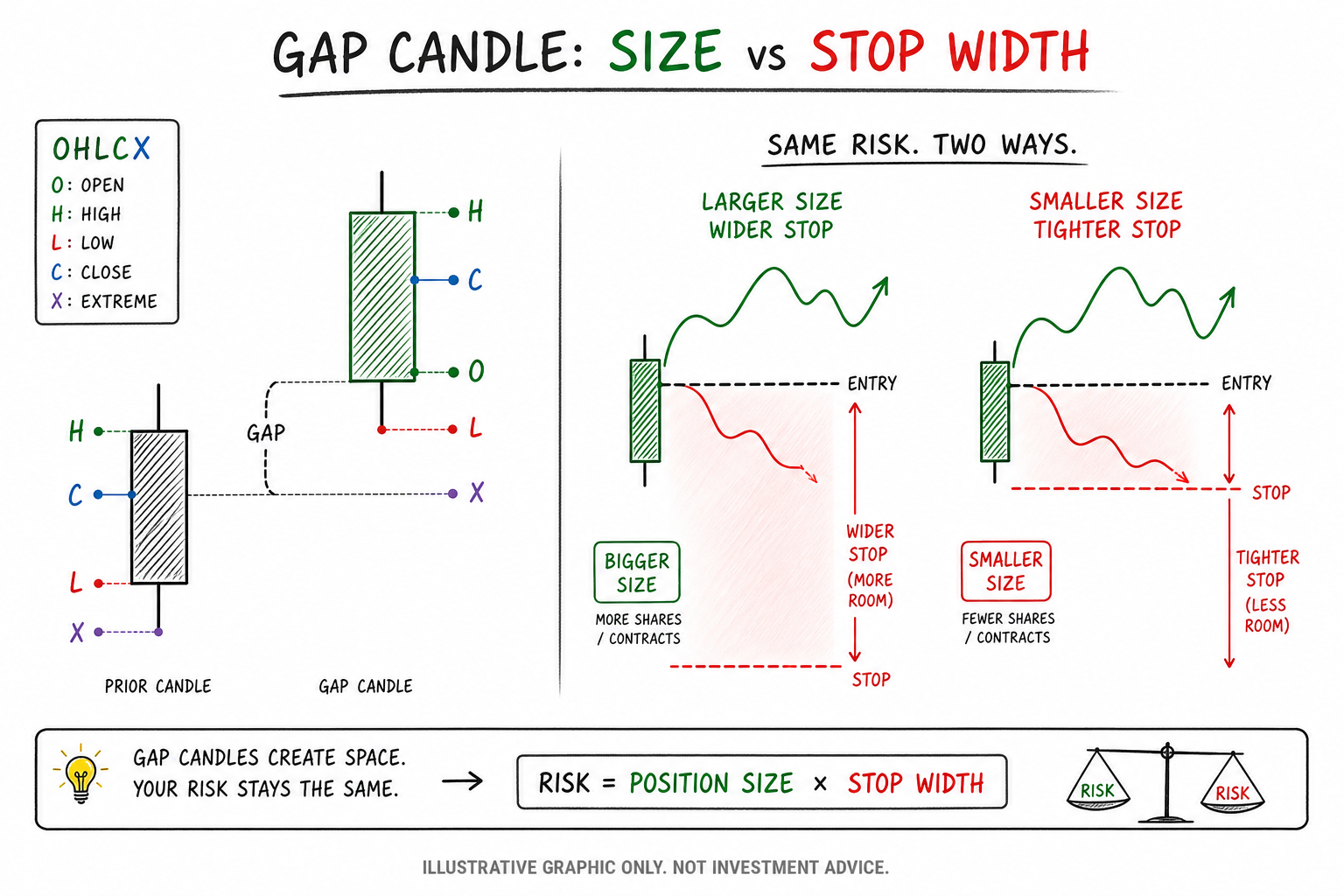
Earnings create a different kind of trading risk because new information can reprice a stock before the market gives the trader time to respond. During a normal session, price often moves through a sequence of tradable levels. Around an earnings release, a position can close near one price and reopen far above or below it, with little or no trading in between.
That discontinuous move changes the role of a stop. A stop can define where the thesis is no longer valid, but it cannot guarantee that the position will be closed at the stop price after a gap. Widening the stop may give the trade more room under normal conditions, but it does not remove the risk that the market moves through the entire planned exit area.
For positions held through an earnings announcement, size is therefore the more direct control over dollar exposure. Stop width still matters, but it should remain tied to the thesis and expected price path rather than serve as a substitute for reducing risk.
OHLCX supports this planning process by giving traders a Schwab-connected place to structure orders, choose exit flows, set expiry order time limits where appropriate, review Risk Gauge visibility, and use optional rule-based automation. It cannot predict the earnings reaction or guarantee an exit price, but it can help turn an event-risk policy into a more deliberate order workflow before the announcement arrives.
Why is earnings volatility different?
Earnings risk is not simply ordinary volatility at a higher setting. It is event risk, with the potential for a company’s revenue, margins, guidance, competitive position, or future outlook to be reassessed in a matter of minutes.
The initial release may trigger one move, and conference-call commentary may trigger another. Liquidity can be thinner outside regular hours, trading may be interrupted, and the opening auction can establish a price far from the previous close.
A stock that closes at $50 with a protective stop at $47 could open near $40 after a negative surprise. The stop may trigger, but the loss is not automatically limited to $3 per share because the next available execution price may be much lower.
Options add another layer. The underlying stock may move in the expected direction while the option behaves differently because implied volatility contracts after the event. Direction, volatility repricing, time decay, spread width, and liquidity can all affect the result.
An earnings plan therefore has to account for more than a familiar chart level. It needs to address what happens when the print lands well outside the range the trader expected.
Which lever actually controls event exposure?
Shrinking size and widening the stop solve different problems.
Reducing size lowers the amount of capital exposed to the event. If the gap is larger than expected, fewer shares or contracts absorb the move. Size reduction does not make the outcome predictable, but it directly reduces the dollar impact of an adverse surprise.
Widening the stop gives the position more room before the planned invalidation point. That may be reasonable when the trader expects wider post-event movement but still has a defensible thesis beyond the normal intraday range. It becomes dangerous when the stop is widened mainly to avoid closing the trade.
Size controls how much exposure crosses the event. Stop placement defines what price behavior invalidates the thesis under conditions where an exit can still be executed. During a gap, the market may move through both the original stop and the wider stop without trading at either level, which is why widening alone is not a reliable answer to earnings risk.
When does shrinking size make more sense?
Reducing size is often the cleaner choice when uncertainty rises but the trader still wants exposure to the event.
This can apply when the expected edge is difficult to estimate precisely, when the stock or option has thin liquidity, or when the trader already holds other positions tied to the same sector, customer base, supplier network, or macro theme. It can also make sense when several companies in the portfolio report during the same week.
Smaller size preserves participation without requiring the trader to pretend the reaction is predictable. It also gives the post-print position more room to be evaluated without one event dominating the account.
The process should not become casual simply because the position is smaller. The same entry, exit, and verification standards still apply. Reduced size is a risk decision, not permission to use a weaker ticket or an undefined thesis.
Risk Gauge visibility can help place the event position in the context of capital deployment and the rest of the account. A position may look small by itself while several earnings-sensitive holdings create a much larger combined exposure.
When can a wider stop be justified?
A wider stop can make sense when the invalidation level genuinely sits beyond ordinary post-event movement.
For example, a trader may expect a sharp reaction after the release but still believe the thesis remains intact unless price breaks a larger structural level. In that case, the wider stop reflects the actual trade rather than an intraday rule carried into the wrong environment.
The position size should be recalculated around that wider distance. Keeping the same size while moving the stop farther away increases planned dollar risk even before gap risk is considered.
A wider stop is harder to justify when it appears only after the trader becomes uncomfortable. If the explanation is simply that earnings can be volatile, but the trader cannot state what post-print information or price behavior would invalidate the thesis, the extra room may be denial rather than risk management.
Conviction does not change that math. A high-conviction position can still gap beyond the expected range.
What should be decided before holding through earnings?
An earnings plan should be complete before the final session leading into the announcement. At minimum, the trader should decide:
- How much capital can remain exposed through the release
- Whether the position is intentionally being held through earnings
- What price behavior or new information would invalidate the thesis
- Whether the size still fits the wider event-risk range
- How OCO, OTOCO, trailing, or staged exit logic should behave after a gap
- Whether unfilled entry orders should expire before the announcement
- How correlated earnings positions affect total account exposure
- What conditions require automation to pause or return to manual review
OHLCX’s expiry order time limit can be useful when an entry is valid only before a specific point. An unfilled limit order should not quietly remain active into the announcement if the trader never intended to carry that event risk.
The same principle applies to structured exits. The trader should know which orders are meant to remain active, what quantity they apply to, and whether the exit design will still be understandable if the stock reopens far from the previous session.
How should structured exits be used around earnings?
OCO, OTOCO, TSP, TRIM, and TRIMMER can help traders define an exit policy before the trade goes live. Earnings do not make those structures irrelevant, but they do change the assumptions behind them.
An OCO bracket can connect a target and protective stop, while OTOCO can stage that bracket after an entry fills. TRIM and TRIMMER can support partial exits, and TSP can support trailing protection when that fits the trade. None of these structures guarantees execution at the intended price through a gap.
A post-earnings move can also make a multi-stage exit plan too complicated. If price opens beyond several planned targets, the trader needs to confirm what filled, what remains open, and what protection still applies. If the position gaps against the trade, completion may matter more than preserving a carefully drawn ladder.
The right structure is the one the trader can still understand and verify after the market has repriced.
How should Strategy Builder handle earnings windows?
A recurring strategy should not treat an earnings window like an ordinary session unless carrying that event exposure is intentional.
If a trader uses Strategy Builder, the workflow should define whether new orders are allowed before an earnings announcement, whether size changes for event holds, and what happens to unfilled orders as the release approaches. A separate earnings version may make sense for a setup that uses different sizing, exit logic, or timing around known events.
That does not mean OHLCX decides whether the earnings trade belongs in the account. The trader needs an accurate event calendar and a clear policy for when the workflow continues, pauses, or requires review.
OHLCX automation is optional and rule-based. The trader defines the conditions and remains responsible for the exposure those rules create.
Watch correlated earnings exposure
Earnings events are not always independent.
Several companies may report during the same week while sharing a sector, supplier, customer base, or macro driver. A semiconductor company, an AI infrastructure name, and a technology ETF may all respond to one report even if only one ticker is announcing results.
That creates portfolio-level gap risk. A trader can reduce size in each name and still carry too much event exposure when the positions depend on similar outcomes.
Before the week begins, it helps to define the maximum number of earnings-sensitive positions the account can carry at once. New trades may need smaller size, an entry veto, or a requirement that another event position be reduced first.
Risk Gauge and portfolio visibility can support that review, but the trader still has to recognize the relationships between the positions.
What should happen after the earnings release?
The first task after the print is not to make another prediction. It is to confirm the live account state.
The trader should review the actual gap, average fills, open quantity, working orders, attached stops or targets, partial exits, and any orders that expired or remained active. If the Schwab connection or platform status is unclear, positions and orders should be verified before new edits are made.
The original exit plan may no longer fit the new price. A target could already be behind the market, a stop may have triggered at a different price than expected, or a partial fill may have left an odd remainder. The account may also have more correlated exposure if several related names moved together.
OHLCX order history, timestamps, live positions, and structured order views can help reconstruct what happened before the trader makes another decision. That review matters because the new chart should not be trusted until the live order state is clear.
Review the event, not only the P&L
A profitable earnings trade can still reflect poor risk control, just as a losing event trade can still follow a disciplined plan.
The review should compare the implied move or expected range with the actual gap, while recognizing that the implied move is context rather than a guaranteed boundary. It should also record the size carried through the event, the planned invalidation, the actual exit, and whether the bracket or staged exit behaved as expected.
Over several events, patterns become more useful than one memorable winner or loss. The trader may learn that a certain setup needs smaller size, that options spreads are consistently worse after the release, or that a detailed TRIM ladder is less useful than one partial and a simpler remainder.
OHLCX order history can anchor that review in what actually happened rather than what the trader remembers under pressure.
Use size to control exposure and stops to define the thesis
Earnings force traders to decide how much uncertainty the account can carry.
Shrinking size directly reduces the capital exposed to a discontinuous move. Widening a stop may be appropriate when the thesis has a wider structural invalidation, but it does not guarantee protection through a gap and should not be used to postpone a difficult decision.
In many cases, the more coherent answer is a combination: smaller size, a thesis-based stop, simpler partial exits, and less exposure left open through the announcement. In other cases, the right decision is not to hold through the print at all.
OHLCX supports that workflow through structured order entry, OCO and OTOCO logic, TSP, TRIM and TRIMMER exits, expiry order time limits, Risk Gauge visibility, order history, and optional rule-based automation in one Schwab-connected execution layer.
Request access to OHLCX to evaluate how structured tickets, event-aware expiry controls, and post-print order visibility fit your earnings process. Conviction may justify holding through the print, but sizing determines how much of the surprise reaches the account.
Leave a Reply