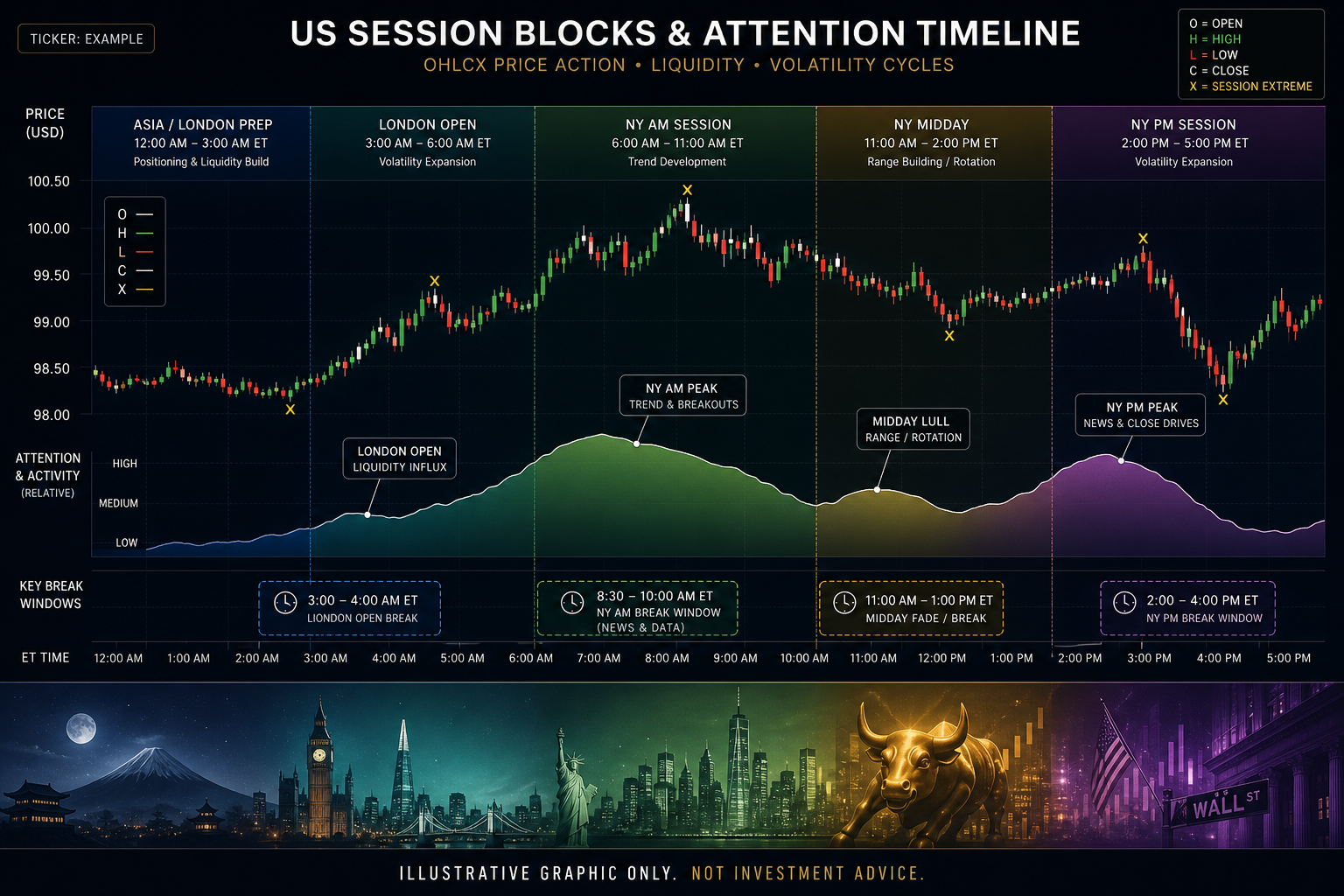
U.S. session trading rewards stamina as much as analysis. Attention is a budget, and live execution spends it in bursts: the open, macro prints, power hour. Research tries to spend the remainder all day long. Fatigue does not wait politely for the session to end. It edits your risk-taking in real time, through slower reactions, softer cancel discipline, and stops that quietly widen for “breathing room.”
That is why session design belongs in the same category as stops and size limits. How you structure the day is a risk decision, and like most risk decisions, it works better written down in advance than improvised at 3pm.
Allocate attention like capital
Capital has limits and so does attention, so budget it the same way. Reserve your sharpest windows for opening new risk and making complex adjustments, and push everything else into lower-stakes blocks:
- Research blocks: Reading and analysis with no broker window open, so nothing can be sent on impulse.
- Execution blocks: The ticket and risk view front and center, research minimized, entries and adjustments handled with full attention.
- Admin blocks: Journaling, reconciliation, and housekeeping, kept entirely outside execution windows.
The point of the separation is simple: mixing deep research with a live ticket during volatility is how “just tweaking” a working order while half-reading a headline happens.
What does fatigue look like in the order record?
Fatigue shows up as execution decay before it shows up as losses, and the decay is countable. Slower placement of the second half of a bracket. Skipped trim steps that felt optional in the moment. Rising cancel-and-replace counts. Longer time-to-flatten after a thesis is invalidated. Treat these as fatigue metrics, not character flaws, because they respond to schedule changes, not to self-criticism.
The order history makes part of this reviewable. Use timestamps on orders and fills alongside your journal to review slippage, rule breaks, and exit delays by hour of day instead of only by setup, and look at what the clock explains. If trim discipline loosens only after lunch, the problem is biological timing, not a new market regime, and the fix is a schedule rule rather than a strategy overhaul.
When should breaks happen?
Take short breaks after the known bursts, not heroic marathons broken by collapse. The natural pause points are after the opening drive settles, after scheduled data releases, and after any halt resolution you traded through. Two minutes away from the screens after a burst is cheap insurance, and it is far cheaper than the fat-finger fix or the impulse entry that tired eyes produce. The worst break schedule is none, and the second worst is one long break at a random time that misses the windows your playbook actually needs you present for.
Set the hard caps before the session
Some rules should not depend on how you feel, because how you feel is the thing being degraded. Decide in advance when new risk stops: a defined time after which no new positions go on unless a pre-qualified catalyst exists and the full pre-send check is completed. Decide a size reduction policy that kicks in after a defined loss or a defined stretch of screen time. And treat two windows with extra suspicion when tired: the first minutes after a major macro print and the final half hour of the session, where fatigue stacks with thinner, choppier prints. Managing existing positions according to the prewritten plan stays allowed throughout. The caps target new initiation, the same bright line a cooling-off rule uses.
Cut the zombie work
Many traders extend the day without extending the value. Premarket browsing without a written prep list is entertainment dressed as work, and post-close price watching without actionable liquidity steals recovery that tomorrow’s tickets need. The test is a plan: if the premarket block produces written, executable if-then statements, it is work. If it produces a mood, it is not. Batch the administrative tasks into their own block and protect the evenings, because tomorrow’s attention budget is funded tonight.
How OHLCX supports a fatigue-aware session
OHLCX does not measure fatigue and it will not stop you from trading tired. What the workflow can do is move decisions from tired hours to fresh ones and make the fatigue review possible. Structured order entry with persistent defaults can reduce the rebuild work that late-day errors feed on. Exits like OCO, TSP, and TRIM can be selected before the order goes live, and OTOCO can carry an if-then sequence so it is not held in working memory all afternoon, provided the template was rehearsed when you were fresh rather than first used mid-spike. The expiry order time limit fits the same logic: an order built to expire will not sit stale into hours when you are no longer the trader who placed it. And because the order history keeps timestamps on orders and fills, the hour-of-day review that reveals your personal fatigue curve becomes easier to build instead of reconstructed from memory. The session rules stay yours. The workflow just makes them cheaper to follow.
Session design is drawdown control
Attention, breaks, and hard caps deserve the same seriousness as stops, because they protect the same account. Design the day around when you are actually sharp, read the order record for the hours when you are not, and let the caps do their work on the days confidence outruns capacity. Request access to OHLCX to see how structured tickets, predefined exits, and a time-stamped order history fit a session built around real attention instead of imagined stamina.
Leave a Reply