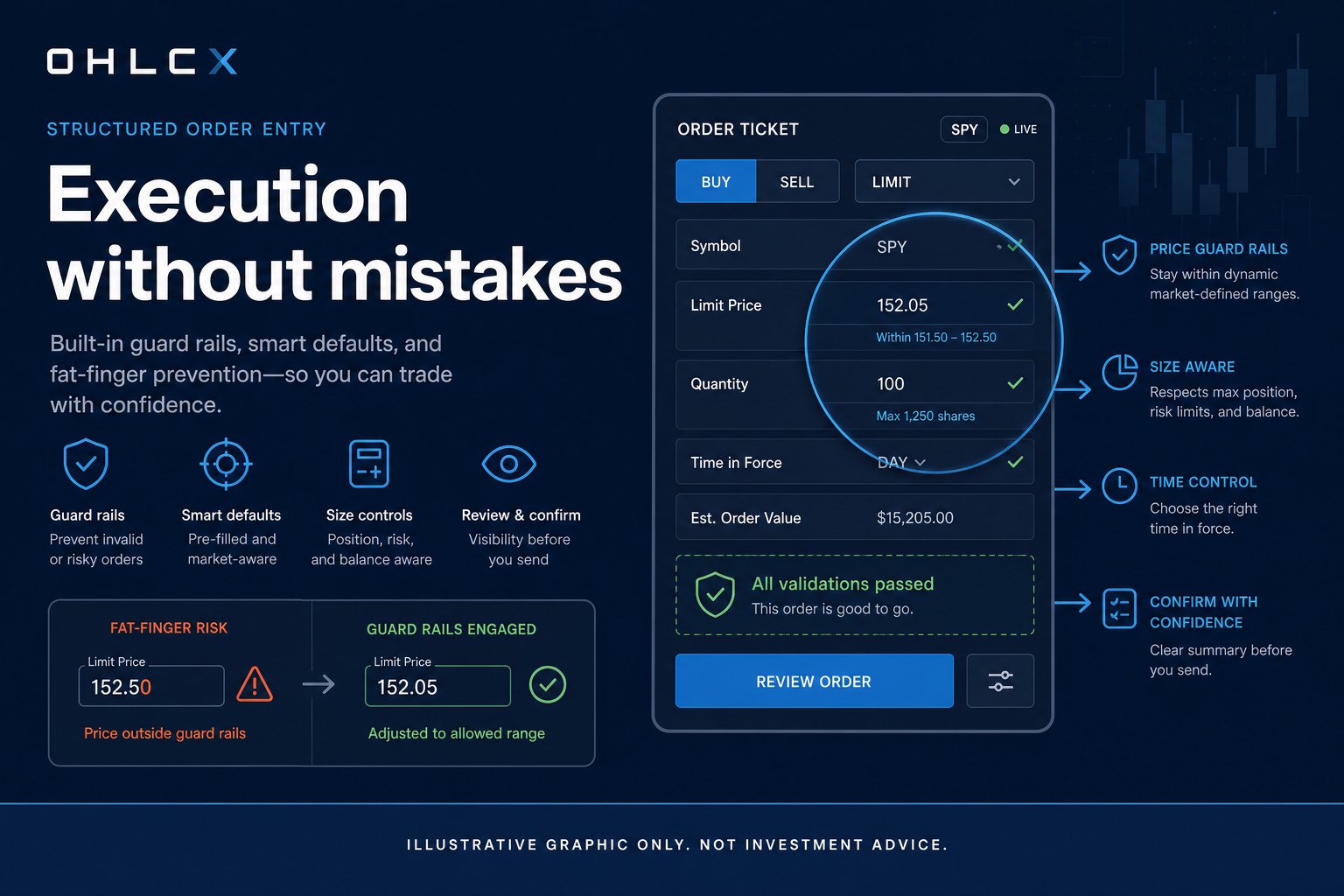
Fat-finger risk is not reserved for careless traders. It shows up when speed, attention, and order complexity collide.
One extra digit, the wrong side, a familiar symbol selected too quickly, or a partial exit that no longer matches the remaining position can change the trade. At low volume, those mistakes may feel like isolated slips. As activity increases, they become workflow risk.
Structured order entry is not there to make trading slower. It is there to make the mechanical parts of execution easier to confirm before the order goes live: symbol, side, quantity, price, time-in-force, stop logic, exit logic, and account exposure.
OHLCX is built around that execution layer. The platform helps traders express their own plan as structured order logic, so the order form carries more of the intended trade before it becomes live risk.
Where fat-finger risk shows up first
The obvious errors are usually the easiest to name. A trader enters the wrong quantity, misses a decimal, selects buy instead of sell, chooses the wrong contract, or types a price too quickly. In a slow review, those mistakes stand out. In a fast market, across multiple windows and moving quotes, they are easier to miss.
The more dangerous errors are the ones that look complete at first glance. A bracket is attached, but built around the wrong quantity. A partial exit is changed, but the remaining size is not reviewed. A cancellation removes one leg of the order, while the trader assumes the full structure is still intact.
That is where structured entry matters. The ticket should make the order readable as a whole, not force the trader to reconstruct intent from memory, chart notes, and scattered follow-up actions.
What should the order form make obvious?
A strong order form should make the highest-risk details easy to review before send. That includes:
- Symbol or contract
- Side
- Quantity
- Price
- Order type
- Time-in-force
- Stop logic
- Exit logic
- Account impact
Those fields are not equal in every trade, but they all affect whether the order reflects the trader’s intent. A wrong quantity changes exposure. A wrong side changes the position entirely. A time-in-force setting can change how long an order remains active. A missing or mismatched exit path can leave the trader managing risk manually when they thought structure was already in place.
For simple orders, the review may be quick. For bracketed orders, staged exits, or protective logic, the order form has to carry more of the trade’s structure. The more moving parts involved, the more important it becomes for the ticket to show how those parts connect.
Why scale changes the risk
Fat-finger risk grows as order activity increases. That is not a judgment on the trader. It is a workload issue. More tickets, more symbols, more partial exits, and more order adjustments create more chances for small mistakes to repeat. The cost is often not one dramatic error. It is the slow leak of small mismatches that get corrected late, rebuilt manually, or missed until review.
A trader placing a few straightforward orders may catch most issues by slowing down. A trader managing active workflows needs more than caution. They need an order path that reduces unnecessary degrees of freedom where extra freedom adds no edge.
That is the point of structure. It protects the parts of execution that should be clean, while leaving judgment where it belongs: the setup, market context, risk decision, and choice to send or not send the order.
Exits and partials need clean inputs
Fat-finger risk does not end once the entry is correct.
OCO, OTOCO, TRIM, TRIMMER, and TSP only work as intended when the underlying details line up with the trade. Quantity, side, price, time-in-force, stop logic, and exit logic all have to match what the trader meant to send.
That matters most when the trade includes partials or protective logic. If the size changes, the remaining exposure has to make sense. If the trader scales out, the exit path has to match the position that remains. If protection follows the trade, the logic has to align with the actual exposure, not the trader’s memory of what should still be open.
Structured order entry gives those relationships a clearer place to live. The trader still defines the plan. OHLCX does not decide whether a trade is good, predict direction, or replace judgment. It helps keep the entry, protection, and exit path closer to the rules the trader already chose.
Account-level mistakes start at the ticket
Not every fat-finger mistake is obvious from one order alone.
The symbol can be correct while the account is already too exposed to the same theme. The size can look reasonable by itself while pushing total risk higher than intended. Two tickets can each look clean while creating a larger concentration problem together.
That is still execution risk.
OHLCX’s Risk Gauge supports this part of the workflow by keeping exposure visible while the trader is building and managing orders. The point is not to replace the trader’s risk decision. It is to make account impact harder to ignore before the ticket becomes live risk.
This is where structured order entry becomes part of risk management. The order form should not only answer, “Is this order typed correctly?” It should also help the trader see whether the order still fits the account.
Clean constraints for experienced traders
Experienced traders may resist structure when it feels like the platform is getting between them and the trade. That concern is fair. A trading platform should not flatten discretion or force every setup into the same process.
But there is a difference between discretion and mechanical risk.
Discretion belongs in the market read, setup selection, sizing decision, and send decision. Structure belongs where variance does not add useful information: quantity, side, symbol, order type, time-in-force, bracket attachment, exit logic, and account-level checks.
A trader does not gain edge from having more ways to mistype size or attach protection to the wrong structure. They gain from a workflow that makes the intended order easier to review before it becomes real exposure.
Make disciplined entry the default
Fat-finger risk scales with activity faster than intuition improves. The more a trader does, the more important it becomes for the order form to carry the mechanical parts of execution clearly.
Structured order entry turns the ticket into part of the risk process. It keeps key fields visible, helps exit logic stay aligned with the position, and supports a more consistent workflow when order volume, speed, or complexity increases.
OHLCX is built for that layer of execution. Capital and custody stay with Schwab. The trader’s decisions stay with the trader. OHLCX provides the execution workflow that helps turn those decisions into clearer, more structured order logic.
Request access for a firsthand look at structured flows, or Explore the platform to compare against pure broker-native tickets.
Leave a Reply