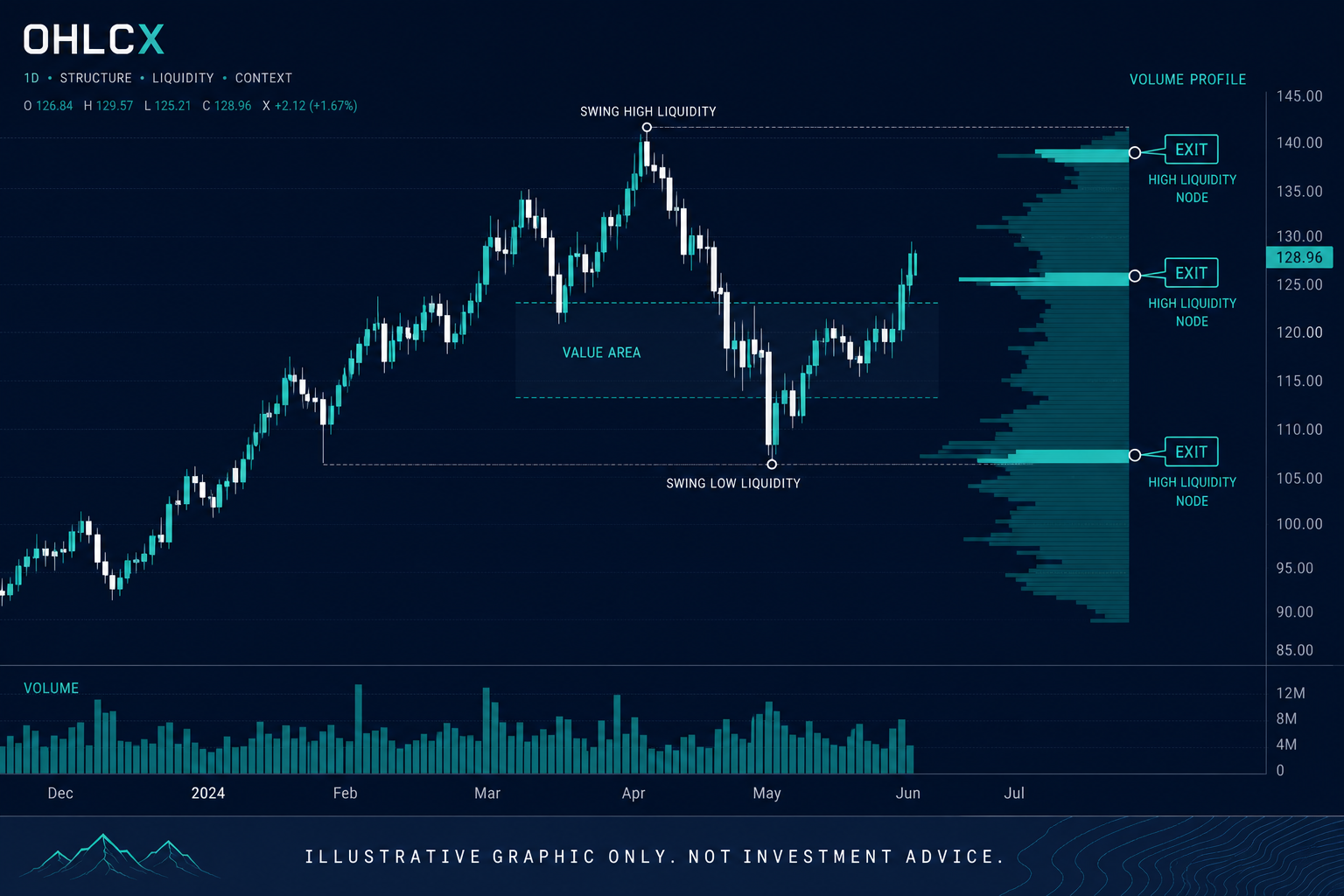
Scaling out is not simply selling in pieces. It is an exit path, and that path has to account for liquidity, urgency, market impact, and what remains open after each partial exit.
Entering and exiting do not carry the same pressure. When a trader enters, they can often wait, reduce size, or skip the setup. When a trader exits, the position already exists. There may be open profit to protect, downside exposure to reduce, a spread widening, or a closing window approaching.
That is why scaling out needs more structure than “take some off here.” A clean plan defines how much to close, where to close it, how the remainder should be protected, and when patience should give way to completion. Without that structure, partial exits can become scattered decisions that feel disciplined but leave the trade harder to manage.
OHLCX supports this part of the workflow by giving traders a Schwab-connected place to choose structured exit flows before the order goes live, review risk, and track what happened after the exit begins. The trader still owns the plan, but the exit logic has a clearer place to live.
Why is exiting not the mirror image of entering?
Exiting is different because the trader is managing something that is already live. A planned entry can be missed without creating account exposure. A poorly handled exit can leave the trader with a position they no longer want, a stop that no longer matches the remaining size, or a partial exit that changed the risk profile without a clean follow-up plan.
Market conditions also matter differently on the way out. A trader exiting into stable liquidity may be able to use patient clips and protect average exit quality. A trader exiting after a thesis break, a news shock, or a late-day liquidity drain may need completion more than price improvement.
Short exits can add another layer of complexity. Borrow conditions, locate availability, and buy-to-cover liquidity can make the exit path behave differently than a simple long sale. The point is not to overcomplicate every exit. It is to recognize that the market structure around the exit matters.
The goal is not to make every exit slow and elegant. The goal is to match the exit path to the trade’s current priority. Sometimes that means trimming patiently. Sometimes it means reducing exposure quickly. The mistake is deciding which one only after price starts moving against the trader.
What should a scaling-out plan define?
A scaling-out plan should be written before the exit becomes emotional. It should define how profit is harvested, how risk is reduced, and how the remaining position is managed after each partial exit.
A useful scaling-out plan should define:
- The first trim level or condition
- The size of each partial exit
- The maximum number of exit stages
- The order type or execution style for each stage
- The stop, target, or trailing logic for the remaining position
- The liquidity conditions that make the plan valid
- The point where patience ends and completion becomes the priority
That last point matters. A scaling-out plan without an escalation rule can leave the trader stuck between two instincts: wait for a better price or get out now. The weakest exits often come from switching between those instincts mid-candle.
In OHLCX, TRIM and TRIMMER can help structure staged exits before the trade goes live. OCO can connect a target and stop. TSP can support trailing protection when that fits the setup. These tools do not make the exit decision for the trader, but they can help keep exit logic attached to the order instead of relying on memory after the fill.
Design trims around liquidity, not chart aesthetics
Exit ladders should not be built only because the chart has clean horizontal levels. A target may look sensible on the chart, but if the spread is wide, the book is thin, or the option contract has limited volume, the planned trim may not behave the way the trader expects.
Clip size should reflect the liquidity available, not only the profit the trader wants to capture. Some positions can support more granular exits. Others are better served by fewer, more purposeful trims. If each clip is too small, the trader may create operational friction without materially improving the average exit price. If each clip is too large, the trader may create unnecessary market impact or accept more slippage than intended.
The better question is not, “How many targets can I draw?” It is, “How much can I realistically exit at this stage without damaging the rest of the plan?”
OHLCX’s Asset Detail view can support that decision by keeping chart context, options data, Level 2 depth, technical indicators, instrument details, and the order ticket closer together. More information does not guarantee a better exit, but it can help the trader decide whether the planned clip size fits the market in front of them.
Protect what remains after each partial exit
The most important part of scaling out is often what remains. A trader may close part of a position and feel good about realizing profit, but the remaining position still has to be managed.
After a partial exit, the stop, target, or trailing logic may need to be checked against the position that is actually left. If the stop applies to the wrong size, the trader may believe the remainder is protected when it is not. If the target still reflects the original full position, the exit plan may no longer match the live trade. If a trailing stop is part of the plan, it should be reviewed against the reduced exposure, not the entry idea from earlier in the session.
This is where scaling out can quietly drift. The trader gets the psychological benefit of taking something off, but the remaining position becomes less coherent with every trim. The trade may still be profitable, but the process is no longer clean.
A partial exit should create a checkpoint. What filled? What remains? What protection is still active? Does the remaining position still deserve to stay open? Those questions do not need to slow the trader down for long, but they should not be skipped.
When should urgency override patient trims?
Patient exits are useful only while patience still fits the trade. If the thesis breaks, liquidity deteriorates, spreads widen sharply, or the market is approaching the close with too much position still open, the trader may need to prioritize completion over price improvement.
That does not mean the original scaling plan was wrong. It means the market condition changed. A good exit plan should include the conditions that cause the trader to stop working patient clips and move toward a more urgent exit. That trigger might be a broken level, a volatility spike, a spread threshold, a time-to-close constraint, or a news event that changes the trade.
Without those rules, a trader can do the wrong thing twice. They may wait too long with limits that do not fill, then panic into urgency after the best liquidity has already passed.
A good exit path gives patience a boundary.
Watch correlation when scaling out multiple positions
Scaling out one position is an execution decision. Scaling out several related positions is also a portfolio decision.
If a trader exits multiple names tied to the same theme at the same time, each individual order may look reasonable while the combined exit creates avoidable pressure. This can happen across sector names, ETF plus underlying positions, correlated options, or trades exposed to the same macro catalyst.
Sometimes reducing the whole theme is the right decision. The point is that the trader should recognize when they are competing with their own book for liquidity. A staged exit in one symbol may be manageable. A staged exit across five related positions during a fast market may require different sequencing, smaller clips, or a more deliberate risk review.
Sequencing matters here. If several related positions need to be reduced, the trader should know which exits come first, which can wait, and whether simultaneous orders would create unnecessary slippage. That is not overengineering. It is acknowledging that portfolio-level exits can stress liquidity in ways single-ticket reviews miss.
Risk Gauge visibility can help keep that broader view in front of the trader before synchronized exits. The question is not only whether each exit makes sense by itself. It is whether the account is trying to unwind one crowded idea through several different tickets at once.
Build liquidity memory into future exits
Exit quality should improve as the trader gathers evidence.
Some sessions consistently punish rushed exits. The open can be noisy and thin. Midday may offer better patience in some names and dead liquidity in others. The close can bring imbalance pressure, spread changes, or urgency that makes passive clips less reliable.
A trader does not need a complicated system to learn from that. A small set of tags can be enough: open crush, midday drift, closing imbalance, event shock, thin options, crowded theme, or liquidity fade. Over time, those tags can show which exit paths actually worked and which ones only looked good in theory.
This is useful for discretionary exits and automation. If certain names or setups punish large clips near the close, the next scaling-out plan should reflect that. If a Strategy Builder workflow is used, the rules should not ignore what the trader has already learned about timing, clip size, and liquidity.
Liquidity memory keeps exit planning from starting over every session.
How should Strategy Builder handle scaling out?
Automation should not hide the exit priority. If a trader uses Strategy Builder or another repeatable workflow, the exit rules should define more than target levels. They should account for trim size, remaining-position protection, liquidity conditions, and what should happen if a partial exit does not fill as expected.
A repeatable exit workflow can reduce manual rebuilding, but it should not assume every exit path behaves cleanly. The trader should know whether the workflow continues, pauses, or requires review when fills are partial, liquidity changes, or account heat shifts.
For correlated positions, automation should also respect sequencing. If several exits fire at once across related names, the workflow may create avoidable crowding inside the same portfolio theme. Staggering or review rules can matter when the account is trying to reduce exposure in a fast market.
OHLCX automation is optional and rule-based. The trader defines the rules and remains responsible for the setup, risk, and order path. When automation is used, the workflow should still be explainable: what rule fired, what order was created, what filled, what remains open, and what happened next.
Review the exit path after the trade
Scaling-out quality should be reviewed with more than a glance at P&L. A profitable trade can still have a weak exit, and a losing trade can still have a disciplined one.
The review should separate thesis quality from execution quality. The trader can compare the planned exit path with what actually happened: where trims fired, how much filled, how the average exit price compared with the intended path, whether slippage changed the result, whether the remainder stayed protected, and whether urgency rules were followed.
That review should feed the next plan. If the exit path created too many small clips, future ladders may need fewer stages. If slippage clustered near the close, timing may need to change. If automation fired exits too tightly together, the workflow may need more spacing or review conditions.
Order history and timestamps matter here because memory is not reliable under pressure. OHLCX’s order history and audit trail can support that review by making it easier to reconstruct the exit sequence after the trade is done.
The goal is not to make every exit perfect. It is to learn whether the exit path protected the trade as intended.
Make the exit path part of the plan
Scaling out is useful when it turns open profit into controlled execution. It can help a trader harvest gains, reduce exposure, and keep part of a position working when the thesis still has room.
But scaling out only works as a discipline when the trader defines the clip size, liquidity assumptions, urgency triggers, and protection for the remaining position before the exit begins.
OHLCX supports that workflow by helping traders work from structured exit flows, Risk Gauge visibility, Asset Detail context, order history, and optional rule-based automation in one Schwab-connected execution layer.
The trader still owns the decision. The market still controls the fill. The work is making sure the exit path protects the trade, not only the price the trader hoped to capture.
Request access to evaluate OHLCX for TRIM-oriented, live execution workflows. Explore the platform for structured harvesting aligned with real books.
Leave a Reply