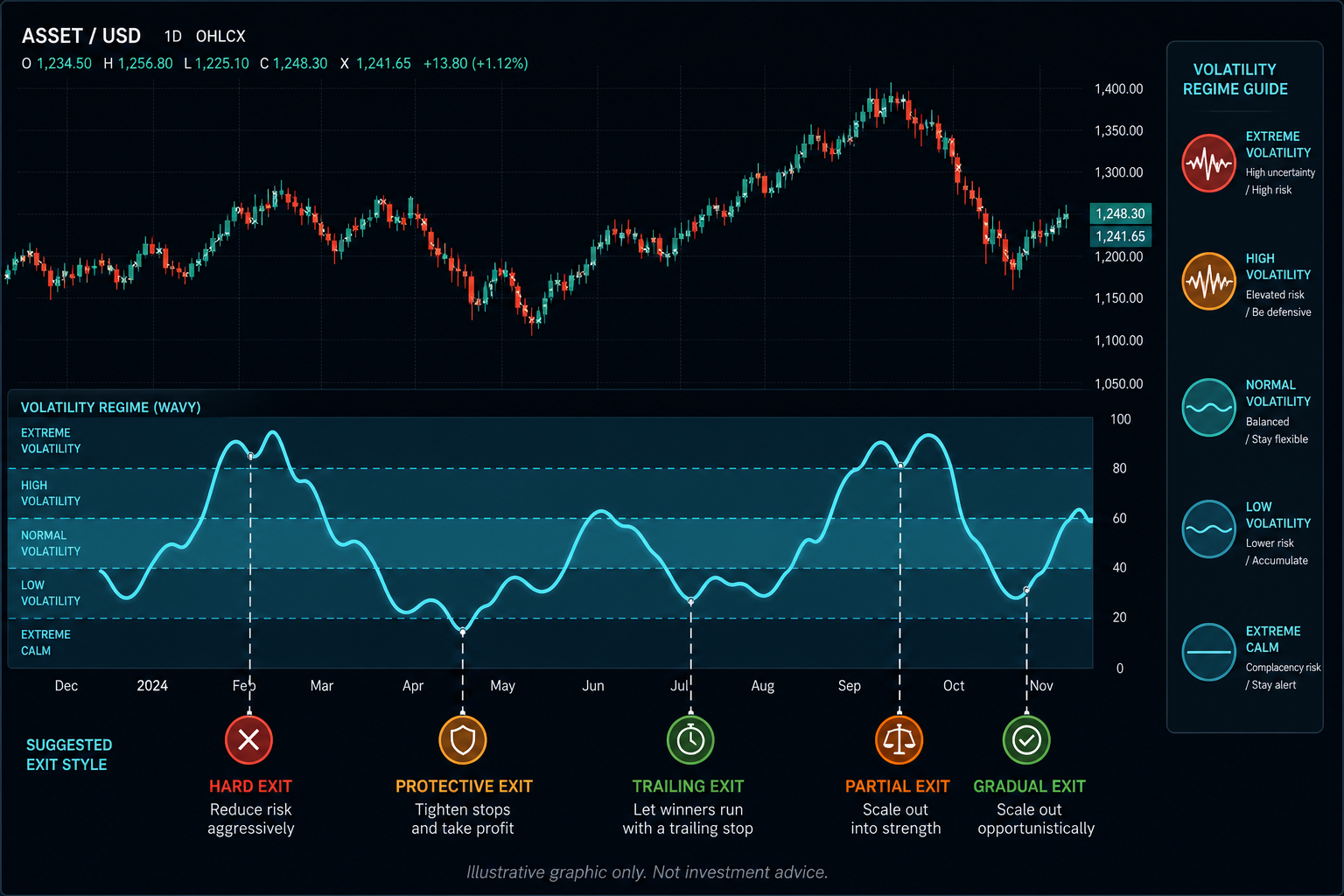
Volatility is not one dial that moves neatly from low to high. It changes the way prices travel, how often gaps occur, how much noise surrounds a valid setup, and how reliably a trader can use patient limits, tight stops, or multi-stage exits.
That matters because exit logic built for a calm market can fail in a choppy one. A trailing stop that worked during an orderly trend may trigger repeatedly when intraday noise expands. A stop widened to tolerate that noise may create too much account risk if position size stays the same. A detailed profit-taking ladder may also become harder to manage when liquidity thins and several positions demand attention at once.
The lesson is not that traders should tighten every exit when volatility rises. It is that the entire exit plan should be reviewed when the market environment changes. Position size, invalidation, partial exits, trailing behavior, execution urgency, and the amount left open all work together.
OHLCX supports that workflow by giving traders a Schwab-connected place to structure orders, choose exit flows, review Risk Gauge visibility, and use optional rule-based automation. The platform does not identify the correct volatility regime or decide how an exit should change. Those judgments remain with the trader.
What is a volatility regime?
A volatility regime is a period when the market shows a relatively consistent pattern of price movement, gap behavior, dispersion, and liquidity.
A quiet regime may have narrower daily ranges, more stable spreads, fewer large gaps, and cleaner reactions around technical levels. A high-noise regime may produce wider ranges, frequent reversals, thin liquidity pockets, and repeated moves through levels that would normally hold. A directional high-volatility regime is different again. Price may travel farther, but with less back-and-forth than a choppy market.
That distinction matters because high volatility does not always mean random volatility. A strong trend and a wide, directionless range can produce similar daily movement while requiring very different exit logic.
Traders can use both realized and implied volatility as context. Realized volatility describes how price has actually been moving. Implied volatility reflects how much future movement the options market is pricing. Neither measure tells the whole story by itself. Exit decisions should also consider liquidity, gap risk, event density, and whether the current movement is directional or two-sided.
A practical regime review might include average true range relative to its recent baseline, the frequency of gaps, spread and depth conditions, market breadth, cross-asset correlation, and implied volatility around known catalysts. The goal is not a perfect model. It is a consistent way to recognize when the environment has changed enough that the old exit assumptions deserve another look.
What is the main exit mistake during a regime change?
The most common mistake is adjusting only the stop distance while leaving the rest of the trade unchanged.
When noise expands, traders often widen stops to avoid being shaken out. That may reduce premature exits, but it also increases dollar risk unless position size is reduced. The opposite mistake is tightening stops because the market feels dangerous, even when the new stop sits inside ordinary volatility and is likely to be hit without invalidating the thesis.
Both reactions confuse discomfort with information.
A better approach starts with the reason the trade should be closed. If the thesis is invalidated at a structural level, the exit should still reflect that level. If the market has become noisier around the same structure, the trader may need less size, an earlier partial exit, a different entry, or a simpler exit plan rather than a wider stop on the original position.
Exit logic should adapt as a system, not as one isolated line on the chart.
What should change when volatility changes?
A useful regime adjustment reviews the whole trade:
- Position size: Wider expected movement may require a smaller initial position.
- Invalidation: The exit should remain tied to the thesis rather than moving with the trader’s fear.
- Partial exits: Profit may need to be realized earlier or in fewer, more decisive stages.
- Trailing behavior: Activation points and trail distance may need to change with the price path.
- Remaining exposure: Elevated event or gap risk may justify leaving less size open.
- Execution urgency: Thin liquidity or a broken thesis may make completion more important than price improvement.
The right change depends on the regime. In wide, directionless chop, smaller size and more room around valid structure may make more sense than a very tight stop. In a strong directional move, a trader may be able to use a more responsive trail once the position has moved far enough in their favor. During an event-heavy period, earlier partials and a smaller remainder may matter more than maximizing every target.
The point is not to become defensive by default. It is to make sure the exit architecture belongs to the market being traded now.
How should trailing exits adapt?
Trailing exits are especially sensitive to regime changes because they respond directly to the path price takes.
A TSP-style trailing plan that follows price closely may work well in an orderly move with controlled pullbacks. In a noisy market, the same trail may be triggered repeatedly even when the broader thesis remains intact. A trail set too loosely can create the opposite problem by giving back too much during a directional move.
The adjustment depends on more than the size of volatility. In choppy conditions, a trader may reduce position size, wait longer before activating the trail, or take an earlier partial so the remainder can tolerate more movement. In a strong trend, a more responsive trail may make sense once the trade is established and the trader wants to protect open profit without closing the full position.
Trailing logic also needs to be reviewed alongside the underlying order type. A trigger does not guarantee a specific execution price. Gaps, fast markets, and thin liquidity can produce a different fill than expected, while a limit-based exit may not fill if price moves beyond the limit. The trail distance, activation point, and expected execution behavior belong in the same decision.
OHLCX supports TSP, OCO, TRIM, and TRIMMER exit workflows that can be selected before the order goes live. Those tools give the trader a structured way to express the plan. They do not determine which parameters fit the current volatility regime.
When should exits become more aggressive?
Exit logic should become more aggressive when market or portfolio fragility rises, not simply because the trader feels nervous.
More aggressive does not always mean a tighter stop. It may mean reducing position size, realizing part of the trade earlier, carrying a smaller remainder, using fewer targets, or shortening the amount of time allowed for the setup to work.
That can be appropriate when liquidity deteriorates, event risk increases, correlations tighten, or several positions begin depending on the same outcome. It can also make sense when operational bandwidth falls. A trader managing several positions during a fast market may be better served by a simpler exit plan than by a detailed ladder that requires constant attention.
An earnings-heavy week may justify smaller initial size and earlier partials. A major macro release may justify avoiding a large unprotected remainder. A correlation spike across the portfolio may justify reducing exposure before each individual chart reaches its own stop.
Risk Gauge visibility can help keep capital deployment and account exposure in view while those decisions are made. The trader still has to decide whether the portfolio has become more fragile than any one trade suggests.
Simplify when the workflow cannot keep up
Complex exit logic is useful only when the trader can verify it.
A multi-stage TRIM or TRIMMER plan may fit a normal session, but the same number of exit tiers can become difficult to manage when spreads widen, partial fills accumulate, or several positions require attention at once. Under those conditions, fewer and more purposeful exits may protect the trade better than a detailed ladder that the trader cannot reliably monitor.
This is not an argument against structured exits. It is an argument for matching the structure to the trader’s operational capacity.
The trader should be able to answer four questions quickly: What filled? What remains? What protection is active? What happens next?
If those answers are unclear, the workflow may be too complicated for the current regime.
OHLCX can keep positions, structured exits, and live order state closer together in the execution workflow. That visibility helps, but it does not remove the need to simplify when the market is moving faster than the process can support.
How should Strategy Builder reflect volatility regimes?
A recurring setup should not rely on one permanent set of exit assumptions.
When a trader builds a workflow in Strategy Builder, the rules should reflect the conditions under which that workflow is intended to operate. A version designed for calmer markets may use different size, trailing behavior, partial exits, or expiry settings than a version intended for wider and faster conditions.
The goal is not to create endless versions of the same strategy. It is to avoid letting one default quietly operate outside the environment it was designed for.
A repeatable workflow should answer practical questions. What volatility conditions make the setup valid? What changes when average movement expands? What should happen when liquidity deteriorates? When should the workflow pause rather than continue using assumptions from a different market?
OHLCX automation is optional and rule-based. The trader defines the conditions and remains responsible for deciding whether the setup and exit logic still fit the current environment.
Review whether the regime or the exit rule was wrong
Post-trade review should separate three different errors.
The trader may have recognized the regime too late. The regime assessment may have been wrong. Or the regime may have been identified correctly, but the exit policy was still poorly calibrated.
Those problems require different fixes.
If expanding volatility was recognized too late, the monitoring process may need work. If the market was classified as directional but behaved as wide chop, the regime definition may need refinement. If the classification was reasonable but the trailing stop still produced poor outcomes, the exit parameters may need to change.
A simple weekly review can be enough. Note the regime that best described the week, the exit decision that worked, and the exit decision that failed. Over time, those observations can show whether the trader repeatedly misreads the environment or keeps using an exit policy that no longer fits.
OHLCX order history and timestamps can support that review by making it easier to reconstruct the actual order and exit sequence instead of relying on memory.
Retire exit rules that no longer fit
Exit rules should not survive only because they worked in an earlier market.
A stop distance, trailing setting, or partial-exit ladder may have been effective during a period of stable spreads and controlled ranges. That does not guarantee it belongs in a market with larger gaps, faster reversals, or thinner liquidity.
The answer is not to adjust the process after every losing trade. Constant changes can create overfitting and make it impossible to know whether a rule works. The better approach is to look for repeated evidence that the policy no longer matches the distribution of outcomes.
When that evidence appears, change one thing deliberately. Reduce size. Simplify the exit ladder. Adjust the trailing activation point. Carry a smaller remainder. Pause the workflow until the rules are updated.
Measured changes are more useful than rebuilding the entire process after one difficult week.
Keep exit logic tied to the current market
Volatility regimes matter because the same exit policy can behave very differently as noise, liquidity, gap risk, and directional movement change.
The answer is not to tighten every stop in high volatility or widen every stop to avoid being shaken out. It is to adjust the full exit architecture: size, invalidation, partial exits, trailing behavior, execution urgency, and the amount of exposure left open.
OHLCX supports that workflow through structured order entry, TSP, OCO, TRIM and TRIMMER exits, Risk Gauge visibility, order history, and optional rule-based automation in one Schwab-connected execution layer.
The trader still defines the regime and chooses the exit policy. The discipline is making sure that policy belongs to the market in front of them, not to the market they remember.
To see how OHLCX supports structured exit workflows, request access and contact us today.
Leave a Reply