A trader can have five strong ideas on the screen and still be building one crowded trade. The problem is not that every position looks the same. It is that different positions can depend on the same thing going right.
A regional bank and a commercial REIT may both be sensitive to the same rate move. A commodity name and an industrial ETF may both depend on the same global growth view. A momentum stock and an options position may both need risk appetite to hold. The symbols are different, but the account may still be leaning on one condition. Portfolio-level controls help traders catch that before the next order goes live.
Position-level risk asks, “Does this trade make sense by itself?” Portfolio-level control asks, “Does this trade still make sense with everything else I already have open?”
For active traders managing several themes, that second question matters. The next clean setup is not always the right next order. Sometimes the better decision is to reduce size, wait for another position to close, pause a new entry, or review the account before adding more exposure.
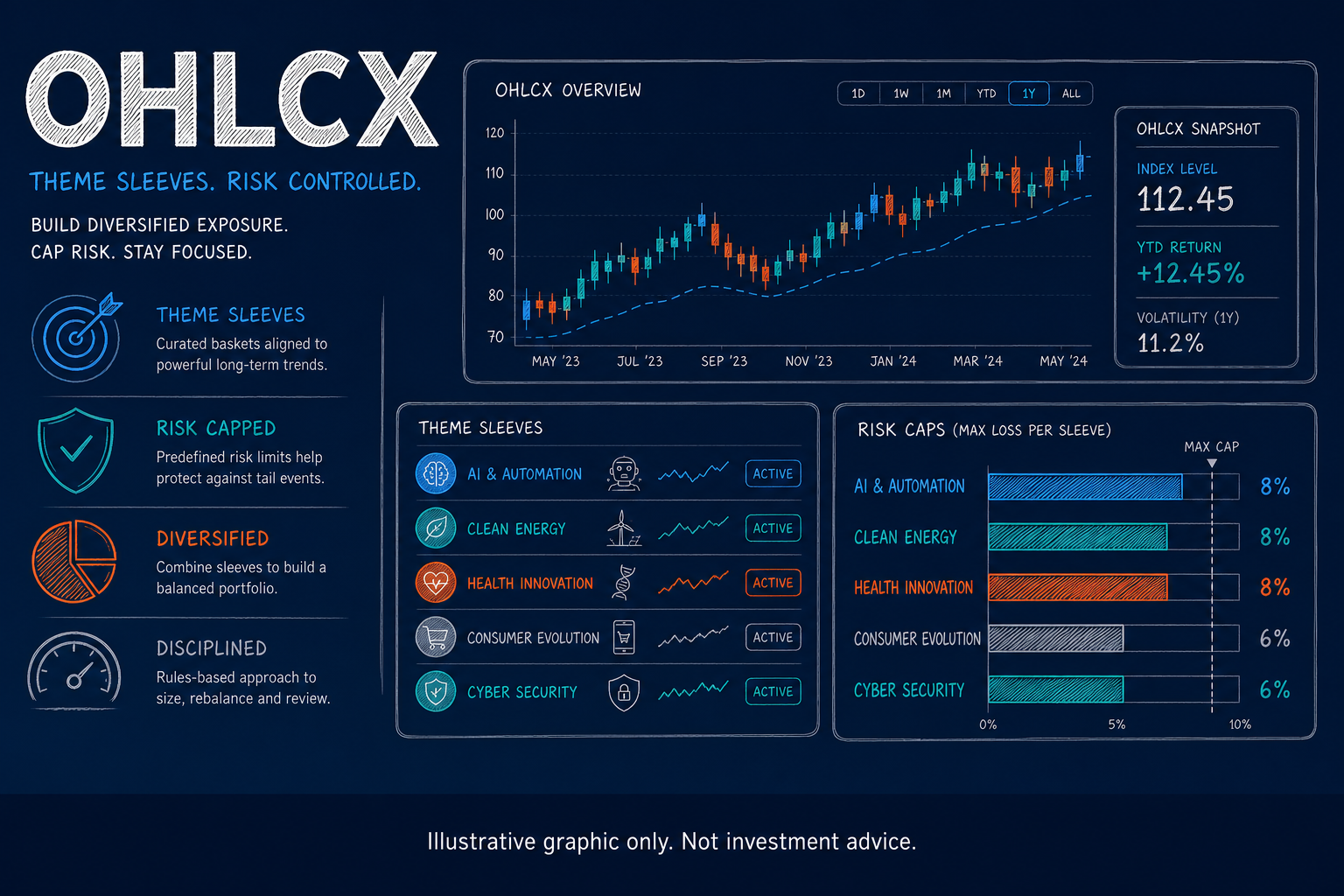
OHLCX is built around execution-first workflow, where structured order entry, risk visibility, and optional automation support the trading process without replacing judgment. For traders managing many themes, that visibility matters because the order can be clean while the portfolio is already crowded.
What do portfolio-level controls actually control?
Portfolio-level controls are the rules a trader uses to keep the full account from drifting into risk they did not mean to carry. They can cover:
- How many positions can be open in the same theme
- How much account risk can be tied to one macro view
- How many earnings or event-risk trades can be held at once
- When new correlated entries should be smaller or paused
- What happens after a drawdown, stop cascade, or rule breach
In trading terms, these controls answer a simple question: what has to happen before the trader is allowed to add more of the same risk?
These controls do not need to be institutional. They need to be clear enough to affect the next trade. A solo trader can use them. A small team can use them. The point is not to create bureaucracy. The point is to keep several reasonable trades from turning into one unmanaged exposure.
The simplest version is this: before adding risk, know what risk is already there.
Name the risk before adding the trade
Theme overlap is easy to miss because the trades can look different. A trader may think they are diversified because they hold different symbols. But a broad ETF, a large-cap stock, an options position, and a momentum trade may all depend on the same condition. That condition could be risk appetite, rates, energy prices, credit spreads, earnings sentiment, or liquidity.
The useful habit is not complicated. Before the order goes live, name the risk bucket the trade is adding to. That bucket can be a sector, macro driver, event window, liquidity category, or trading theme. The exact label matters less than the discipline of naming it before the trade is live. Not after the fill. Not during the weekly review. Before the send.
That one habit makes it harder for exposure to build quietly across a session. It also makes review more honest. If every trade from the week points back to the same rate view, AI theme, earnings window, or risk-on condition, the account is telling a different story than the symbol list.
This is where Risk Gauge visibility supports the workflow. It is not a separate risk dashboard to check later. It helps keep exposure visible while the order is being built, so the trader can ask whether the next order fits the account, not just whether it fits the chart. A strong setup can still be the wrong next trade if it adds to a risk the trader is already carrying.
Turn overlap into a rule before the order goes live
The best portfolio controls are set before the trader has to argue with them. A trader can decide in advance that a third position in the same risk bucket requires review. They can decide that new correlated entries must be smaller when exposure is already high. They can decide not to add another position tied to the same event window until one existing position is reduced.
Those are not complicated rules. They are pauses. A control gives the trader a reason to stop and ask: am I adding a new idea, or am I adding more size to the same idea? That question matters because crowded risk rarely arrives all at once. It usually builds through a series of trades that each looked reasonable on their own. Portfolio-level controls are there to catch the pattern before the account gets too crowded to manage cleanly.
Prevention, detection, and response
A control only matters if it changes behavior. Prevention sets the boundary before the trade is tempting. That may mean theme caps, event-risk limits, margin bands, or a review before adding another correlated position.
Detection shows when the book is drifting. A trader may notice that several positions were opened in the same theme, that partial exits reduced one position but left the account concentrated elsewhere, or that automation added more trades than expected. Response defines what happens next.
This is the part many traders skip. A breach should not become a journal note that gets reviewed eventually. It should trigger something specific the trader already agreed to before the session started. That response can be simple:
- The next correlated entry is half size
- No new additions in that theme until one existing position is reduced
- Automation pauses until the trader manually reviews the book
- One clean session is required before adding similar risk again
The response does not need to be punishing. It needs to remove the negotiation. A control that leaves room to talk yourself into the next trade is not a control. It is a suggestion.
What changes during high-volatility weeks?
High-volatility weeks make portfolio controls more important, not less. Correlations can tighten quickly. Positions that looked unrelated can start moving together because the market is responding to the same headline, rate move, index pressure, liquidity event, or earnings cycle. At the same time, the trader has less attention available for every bracket, partial fill, stop adjustment, and new signal.
A practical rhythm can stay simple. Before adding anything in the morning, the trader reviews open risk by theme and asks: if the market opens down two percent on a macro headline, which positions move together?
Before any new entry later in the day, the question is: am I adding another version of something I already have? After the session, the review should focus on process: did I breach a control, did I widen a stop to avoid a decision, did automation add something I would not have approved manually? Those questions are not there to create paperwork. They are there to catch drift before it compounds.
The controls that matter most during volatile weeks are usually the simplest ones: reduce incremental size, avoid adding to crowded themes without review, verify remaining exposure after partial fills, and slow new entries when too many positions already need active management.
Stop management needs to stay honest here. Widening stops across several related positions does not solve a crowded-book problem. It can simply allow the same cluster to lose more before the trader acts. A better question is: which exposure still earns its place if conditions get worse?
Sometimes the answer is to reduce the weakest related position before adding another. Sometimes the answer is to delay the new trade. Sometimes the answer is to accept concentration because the thesis is strong and the account can carry it. The important part is that the decision is deliberate.
Keep automation inside the same controls
Automation can make a repeatable process easier to run, but it should not sit outside the trader’s risk rules. If a trader uses Strategy Builder or no-code automation templates for recurring setups, those workflows should follow the same portfolio-level controls as manual orders. A trade that comes from automation still uses capital, adds exposure, and changes the book.
The risk is not automation itself. The risk is allowing automated or repeatable workflows to add trades without checking whether the account is already crowded. This matters most when related names are producing similar signals. The setup may be valid in each name, but taking all of them can create a very different account-level risk profile.
Automation can also add attention risk. During news windows, thin liquidity, or fast-moving conditions, a new automated entry may be acceptable on paper but still add another position that needs monitoring and verification when bandwidth is already stretched. A system that sees five valid signals across related names and fires all five has not done the portfolio-level work. It has just done it faster.
Accountability does not need to be heavy
A solo trader does not need a risk committee to use portfolio-level controls. What they need is a small set of rules that can be checked consistently. That may mean writing down theme caps, logging when a cap is broken, reviewing exposure after volatile sessions, or noting when a trade was added even though the book was already crowded.
The purpose is not to create paperwork. It is to make future review honest. If a trader repeatedly breaks the same control, the log is telling them something specific. Maybe the cap is set at a level that does not match how they actually trade. Maybe the category is too broad to be useful. Or maybe they are using new trades to avoid managing the positions already open.
Adding feels like doing something. Managing what is already there can feel harder than adding something new. The log does not fix that. But it makes the pattern visible enough that the trader cannot keep pretending it is not there.
Keep many themes legible
Managing many themes is not the same as being diversified. Diversification only helps when the positions respond to different risks. If several trades depend on the same market condition, the book may be more concentrated than it looks. If too many positions need attention at once, the trader may run out of bandwidth before running out of capital.
Portfolio-level controls help make that visible. They give the trader a way to manage theme overlap, risk limits, event exposure, automation, and attention before the account becomes crowded.
OHLCX supports that kind of execution workflow. Capital and custody stay with Schwab. The trader’s decisions stay with the trader. OHLCX provides the structured order environment where entries, exits, automation, and risk visibility can work closer together. Many themes are not diversification. They are only diversification if the book can tell the difference. To see the workflow in action, request a walkthrough through the OHLCX platform page.
Leave a Reply