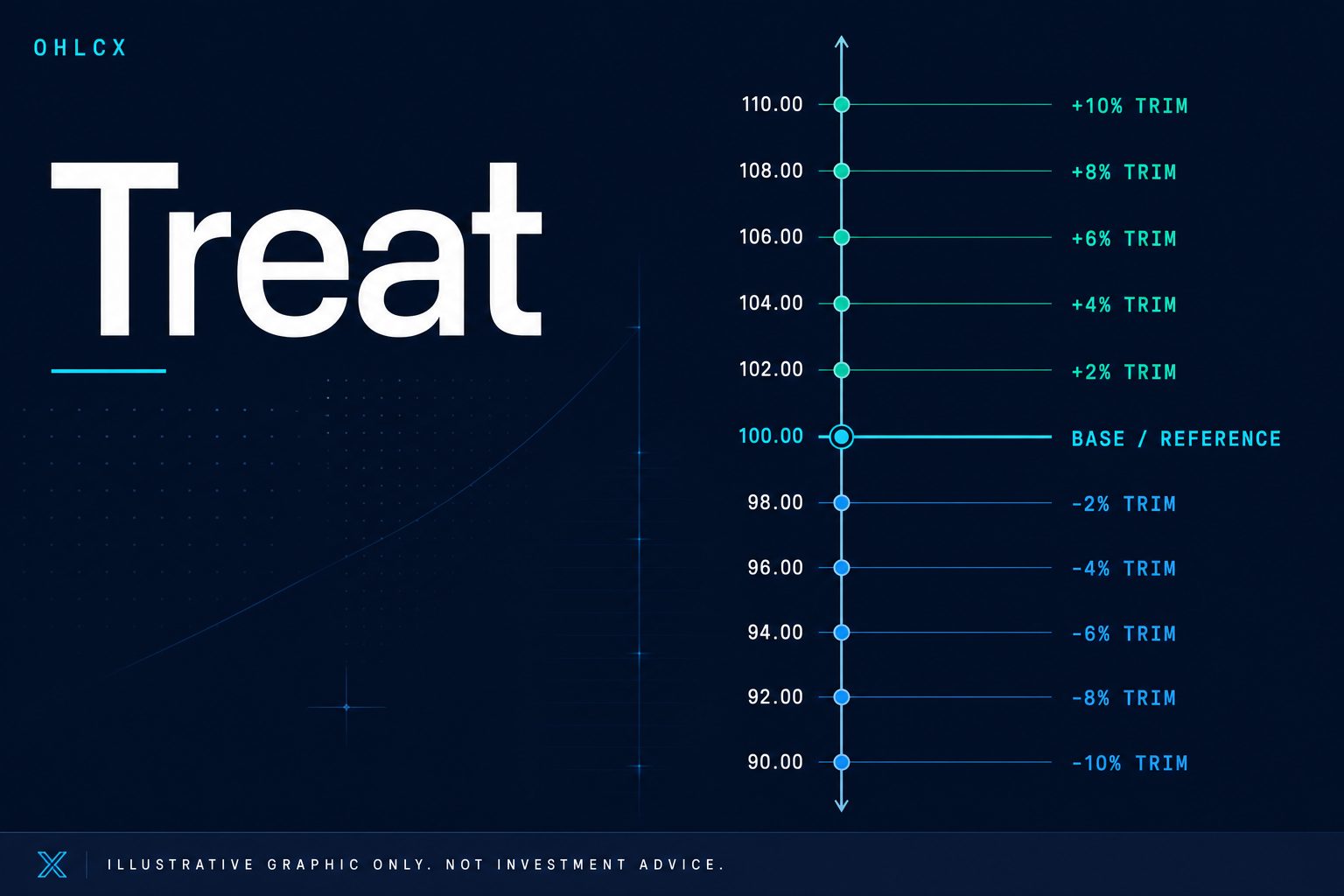
Taking profit sounds simple until the trade is actually working. Exit too early, and the runner keeps going without you. Wait too long, and a strong move can turn into a round trip that should have been managed better. Most traders know both sides of that frustration. The real problem is not the desire to take profit. It is making that decision from scratch while price is moving, attention is split, and open profit starts to feel personal.
That is where staged profit taking becomes useful.
A staged exit plan gives the trader a way to take something off without treating the entire position as finished. It does not remove judgment or guarantee a better outcome. It gives the exit decision more structure before the trade has to be managed under pressure.
OHLCX is built around that execution layer. TRIMMER fits naturally inside that workflow because it helps traders define staged exit logic based on their own rules. The setup, risk, and exit plan remain with the trader. TRIMMER helps make that plan part of the order workflow instead of leaving every partial exit to memory or emotion once the position is live.
Why staged profit taking needs rules
Partial exits are hard because they sit between two valid instincts. One instinct says to lock in profit while it is available. The other says to let the trade work if the original thesis is still intact. Neither instinct is wrong. The problem is making that decision differently every time because the trade feels different in the moment.
Without a clear policy, partial exits can wander. A trader may take profit too quickly after a losing streak, hold too long after a winning streak, or change the size of the exit based on frustration, relief, or fear of giving back gains. Over time, it becomes harder to tell whether the exit process is helping or simply reflecting mood.
Rules create a cleaner comparison. If the trader defines how staged exits should work before the trade is live, post-trade review becomes more useful. The question is no longer, “Why did I sell there?” It becomes, “Did the staged exit plan fit the way this setup behaved?”
Systematic profit taking is not about being cold or mechanical for its own sake. It is about making a repeatable decision in a part of the trade where emotion can easily take over.
How can traders take profit without killing the runner?
The short answer is to separate the first profit-taking decision from the decision about the rest of the position.
A partial exit does not have to mean the trade is over. It can reduce exposure, realize part of the move, or make it easier to hold the remaining position if the setup still has room. But that only works if the trader has already thought through what the remainder is supposed to do.
If the remaining position has no plan, the partial exit only moves the uncertainty forward. The trader may feel better for a moment, but the next decision is still waiting: hold, tighten, trail, reduce again, or exit fully.
This is where the tradeoffs matter:
- More tiers can smooth emotion, but they also add operational load.
- Fewer tiers keep the plan cleaner, but they can increase regret if the trade gives back a larger move.
- Tighter trailing logic can protect open profit, but it can also increase the chance of getting shaken out in chop.
- Wider spacing can give the runner more room, but it may leave more unrealized profit exposed.
None of those choices is automatically right. The right structure depends on the setup, liquidity, volatility, position size, and the trader’s tolerance for giveback. The goal is not to create the most complicated exit plan. The goal is to create one the trader can actually follow.
What problem does TRIMMER help solve?
TRIMMER helps address the gap between the partial exit plan a trader intended and the exits that actually happen once the trade is moving.
That gap can show up in small but meaningful ways. A trader plans to scale out, but closes too much too soon. A trader wants to leave a runner, but never defines what should happen to the remaining position. A trader adjusts one exit manually, then loses track of how that change affects the rest of the trade.
TRIMMER gives staged exit planning a clearer place inside the order workflow. It supports adaptive staged exit logic based on rules the trader configures, so partial exits are not treated as separate reactions after the fact.
TRIMMER does not predict direction or turn a weak plan into a disciplined one. Its value is more practical: it helps carry the exit logic into execution with less dependence on memory once the position is open.
Profit taking still affects the whole book
Staged exits are usually planned at the position level, but the result shows up across the account. That matters when several correlated trades are working at the same time. Trimming multiple winners can reduce exposure in one part of the book while leaving the trader concentrated somewhere else. It can also make the account more cash-heavy than intended if several staged exits fire close together.
The opposite can happen too. A trader may leave runners in related names and think each position is smaller after partial exits, while the remaining exposure is still tied to the same theme.
This is where portfolio context matters. TRIMMER can help structure staged exits on the trade itself, but the trader needs to understand what those exits do to account-level exposure. OHLCX’s Risk Gauge supports that review by keeping risk visibility part of the workflow, not a separate afterthought. Profit taking is not only about what gets sold. It is also about what remains.
Automation should not outrun oversight
Automation is most useful when the trader already knows what they want repeated. For staged exits, that means the policy should come first. The setup, risk, and exit logic need to be clear before automation carries them into the order workflow. Otherwise, automation can make an unclear process move faster without making it better.
In OHLCX Pro, Strategy Builder and no-code automation templates can support repeatability for traders who work with recurring setups. The value is not that automation replaces review. The value is that repeated parts of the workflow can become more consistent while the trader keeps control over whether the trade should be sent.
A vague exit plan does not become disciplined just because it is automated. If the rules are unclear, automation can repeat the same weak process with more confidence than it deserves.
Some traders may need fewer active automations during fragile sessions, not more. Around news, thin liquidity, or fast-moving conditions, the better choice may be to simplify the exit path until oversight catches up with speed.
Automation should make the intended workflow easier to run. It should not become a way to avoid deciding what the workflow should be.
Review the staged exit after the trade
A staged exit plan should be reviewed like any other part of the trading process. The review does not need to be complicated, but it should be specific. Did the partial exits reduce stress without cutting too much of the opportunity? Did the remaining position have enough room to work? Did slippage or liquidity make the staging less effective than expected? Did the trader override the plan, and if so, was the override justified?
These questions help separate a bad outcome from a bad process. A staged exit can be well-designed and still produce an imperfect result on one trade. The more useful question is whether the same approach improves consistency over time.
A few practical review points can help:
- How much of the move was captured before the position was reduced
- How much was given back after the first partial exit
- Whether the remaining position followed the original plan
- Whether manual overrides improved or weakened the trade
- Whether the exit structure still made sense after fees, spreads, and liquidity
The goal is not to adjust the plan after every trade. That creates a new kind of inconsistency. The goal is to collect enough evidence to know whether the staged exit process is actually helping the trader manage winners.
Keep the staged exit plan simple enough to trust
The most advanced exit plan is not always the best one. A trader can overbuild staged exits the same way they can overbuild an indicator stack. Too many rules, too many small exits, or too many exceptions can make the workflow harder to trust when the trade is moving. At that point, the trader has structure, but not clarity.
A useful staged exit plan should be easy to explain. The trader should know what gets taken, what remains, and what would make the plan no longer valid. If the trader cannot explain that clearly before the order is live, the exit process may still be too vague.
This matters for both newer and experienced traders. Newer traders may need structure to avoid emotional exits. Experienced traders may need structure to keep repeatable setups from becoming one-off decisions under pressure.
TRIMMER is useful when it supports that clarity. It gives staged profit taking a place in the workflow, but the logic still has to fit the setup.
Make profit taking part of the order workflow
Profit taking is not separate from execution. It is part of the trade plan. When partial exits are handled only after the trade starts moving, the trader is forced to make important decisions while price, emotion, and attention are all shifting. A staged exit workflow brings more of that decision-making into the order path, where it can be defined with more intent.
OHLCX is built for that kind of execution workflow. Capital and custody stay with Schwab. The trader’s decisions stay with the trader. TRIMMER helps make staged profit taking part of the structured order process, so the exit plan can follow rules instead of becoming a series of reactive clicks.
Systematic is not soulless. It is accountable.
To see the workflow in action, request a walkthrough through the OHLCX platform page.
Leave a Reply