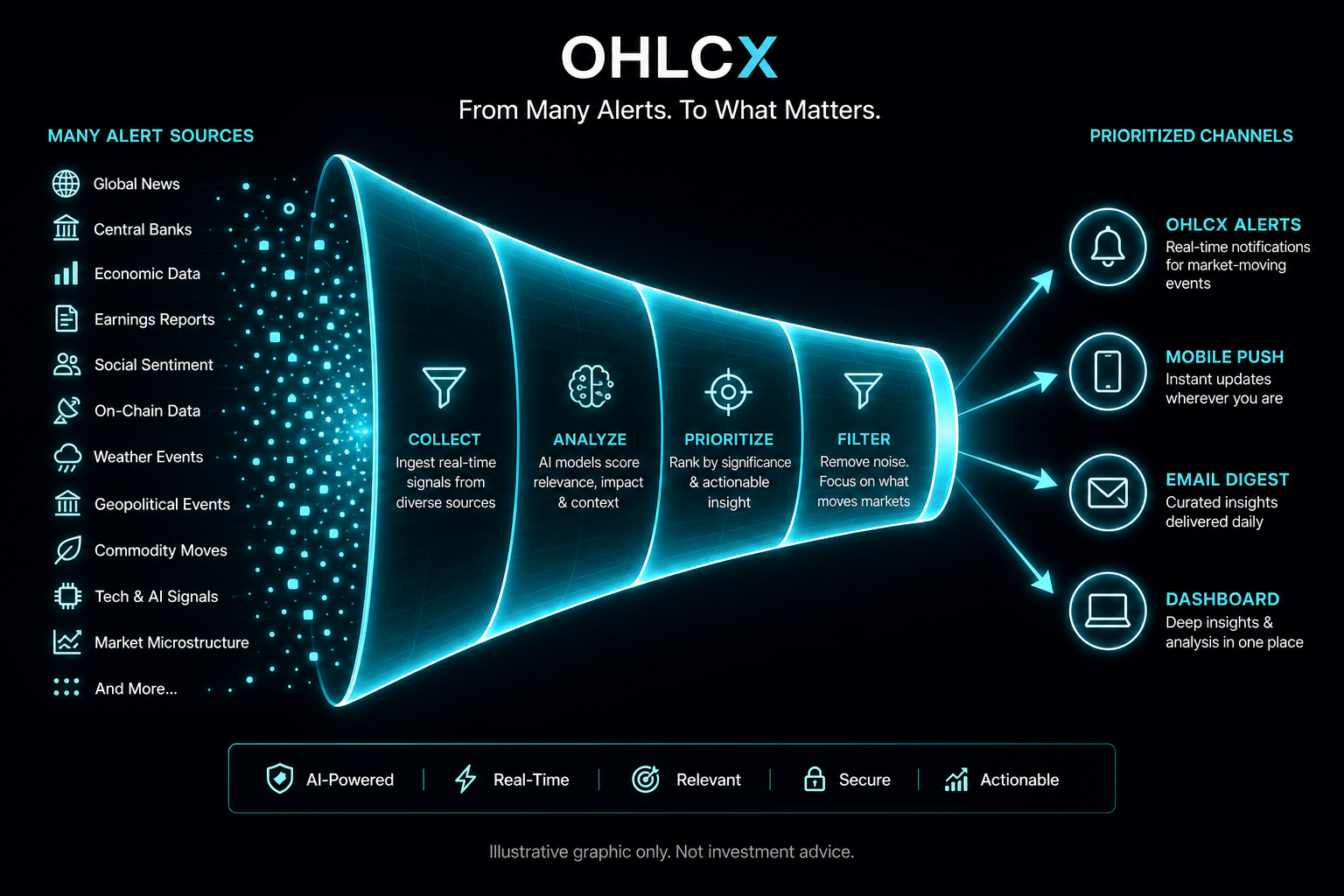
Alerts can make a trader feel covered. Every price level, headline, volatility shift, and account notice has a chime attached, so it feels like nothing can slip through. But more alerts do not create more control. They often create a screen where every ping asks for attention and very few deserve it.
An alert without automation has one job: help the trader make a better manual decision. If it cannot do that, it is another interruption between the trader and the ticket. That matters because live execution already demands attention for sizing, exposure checks, order type, and exit selection. A loose alert stack competes with those decisions at the exact moment the trader needs less noise, not more.
Give every alert class a job
The first mistake is treating all alerts as equal. A price alert, a macro calendar notice, a margin warning, and a research headline carry different urgency and different consequences if ignored. A useful alert stack separates them before the session starts.
- Execution alerts: Price, volume, spread, or level-based alerts tied to a possible ticket decision.
- Risk alerts: Account, exposure, margin, working-order, or position-state alerts that may require action even when no new trade is planned.
- Research alerts: Headlines, filings, and broader market context that may matter later but should not interrupt an active order.
- Maintenance alerts: Platform, connection, and calendar reminders that need attention, just not in the same channel as trade signals.
The goal is not silence. The goal is routing. A research alert that lands in the execution lane can make a trader treat a story like an order instruction, and that is how “just checking” becomes “just sending.”
Which alerts deserve to interrupt live execution?
The test is not whether an alert is interesting. The test is whether it changes a defined action.
Before an alert earns interrupt status, it should connect to a specific decision: send, defer, reduce, cancel, review, or ignore. It should have a time limit, because a level that mattered ten minutes ago may not matter now. It should also account for current exposure, because a valid signal can still be the wrong next trade if the book is already leaning the same way.
An alert that fails those checks belongs in a lower-priority channel. It may still be useful, but it should not compete with order review. Most alert stacks break down because they are built around market curiosity instead of execution capacity. Over time, they become a machine for producing maybes, and maybes are expensive during live execution.
Cut duplicates before tuning thresholds
A noisy alert stack is usually redundant before it is inaccurate. The same catalyst can arrive through a scanner, a news feed, a social source, a chart alert, and a watchlist notification. That can feel like confirmation, but it is often the same prompt wearing five jackets.
Pick one primary source for each alert class. Decide whether the chart, scanner, or platform notification owns a price level. Give macro events a single calendar lane. Keep account and risk notices out of the same stream as research.
Only then do thresholds deserve tuning. Wider bands on noisy names, session-specific conditions, and cooldown windows between repeat alerts usually do more for execution quality than adding another source. The real question is not “How do I catch everything?” It is “What can I process without degrading the next ticket?”
Alerts need expiration, not permanent permission
Every actionable alert should have a half-life. Some signals are valid for minutes. Some are valid for a session. A few belong on a weekly review list. When an alert has no expiration, it can keep arguing with the current market long after its original reason disappeared.
For manual traders, expiration has to stay simple. A momentum alert might expire after ten minutes without follow-through. A breakout alert might expire if the spread widens beyond policy. A watchlist alert might expire at the close unless it is deliberately reset.
Stale alerts teach two bad habits. First, they train the trader to ignore notifications. Then, when one finally matters, it lands in a channel the trader has already learned to distrust. An alert should not keep authority forever. It should earn it again when structure changes.
Existing inventory comes first
Before honoring a fresh alert, check what the account already owns. This is where alert noise turns into portfolio risk.
A breakout in one ticker may look clean on its own while the account already holds correlated exposure through another name, an ETF, an option position, or a macro-sensitive proxy. The alert may be valid, and the trade may still double the same bet. In that case, reducing, waiting, or routing the idea back to research may be the cleaner response.
A simple rule helps: no new alert gets acted on until current exposure has been checked, not remembered. That matters most when several alerts fire together. Concurrent signals often share the same driver, so priority should start with risk impact, then liquidity, then novelty. The newest alert is not automatically the most important one.
Mobile alerts should have a narrower job
A phone makes every signal feel closer to action, but the screen is weaker for order-state review, exposure checks, and complex ticket work. Mobile alerts are not useless. Their job should be narrower.
Mobile is better suited to risk reduction, position verification, and alerts that tell the trader to return to the full setup. Optional research pings, weak price levels, and “maybe” setups do not need to follow the trader everywhere.
If a mobile alert sparks an idea, the safer default is to log it and review it later. If it is a true risk event, handle it according to the playbook. The phone should not become a portable reason to create new risk under worse conditions.
Review the alert stack like a position
An alert stack deserves the same periodic review as a watchlist or strategy rule. Once a quarter, look at which alerts fired most, which actually changed a ticket or risk decision, which arrived too late, which duplicated another source, and which interrupted order entry.
Anything that consumes attention without changing behavior should be deleted, muted, or moved to a slower channel. An alert that fires repeatedly and never changes a decision is not harmless. It trains the trader to tolerate noise.
How OHLCX fits a cleaner alert workflow
Most of this work happens after an alert earns attention, which is where OHLCX fits. A signal that points to a possible trade still has to go through an exposure check, a chosen order structure, and an exit decision.
OHLCX can support that step by keeping those pieces closer together: structured order entry for the ticket, Risk Gauge as a clearer reference point than memory when reviewing exposure, and exits such as OCO, OTOCO, TSP, and TRIM that can be selected before the order goes live.
Expiration applies to orders as much as alerts. A working order can outlive the signal that produced it, and a trader-set expiry time limit can help keep it from sitting stale in a market that has moved on. Order history and timestamps then provide a record to compare against the alert’s original purpose, so the review runs on evidence instead of impressions.
The trading decision stays with the user. An alert does not become a trade because it fired, and OHLCX does not decide which signals deserve capital. If an alert is going to interrupt live execution, it should end in a deliberate order path rather than an improvised click.
Curate alerts before they curate you
Alerts without automation still need a system. Separate the lanes, delete duplicates, set expiration, check inventory first, keep mobile alerts narrow, and review the stack with the same honesty you would bring to a position that keeps consuming capital.
A cleaner alert stack will not make the market easier. It makes the trader harder to interrupt when execution needs attention. Request access to OHLCX to see how a qualified alert can move into structured order entry instead of an improvised click.
Explore our platform and request access to connect cleaner alert paths with structured tickets and repeatable workflows when you outgrow manual ping debt.
Leave a Reply