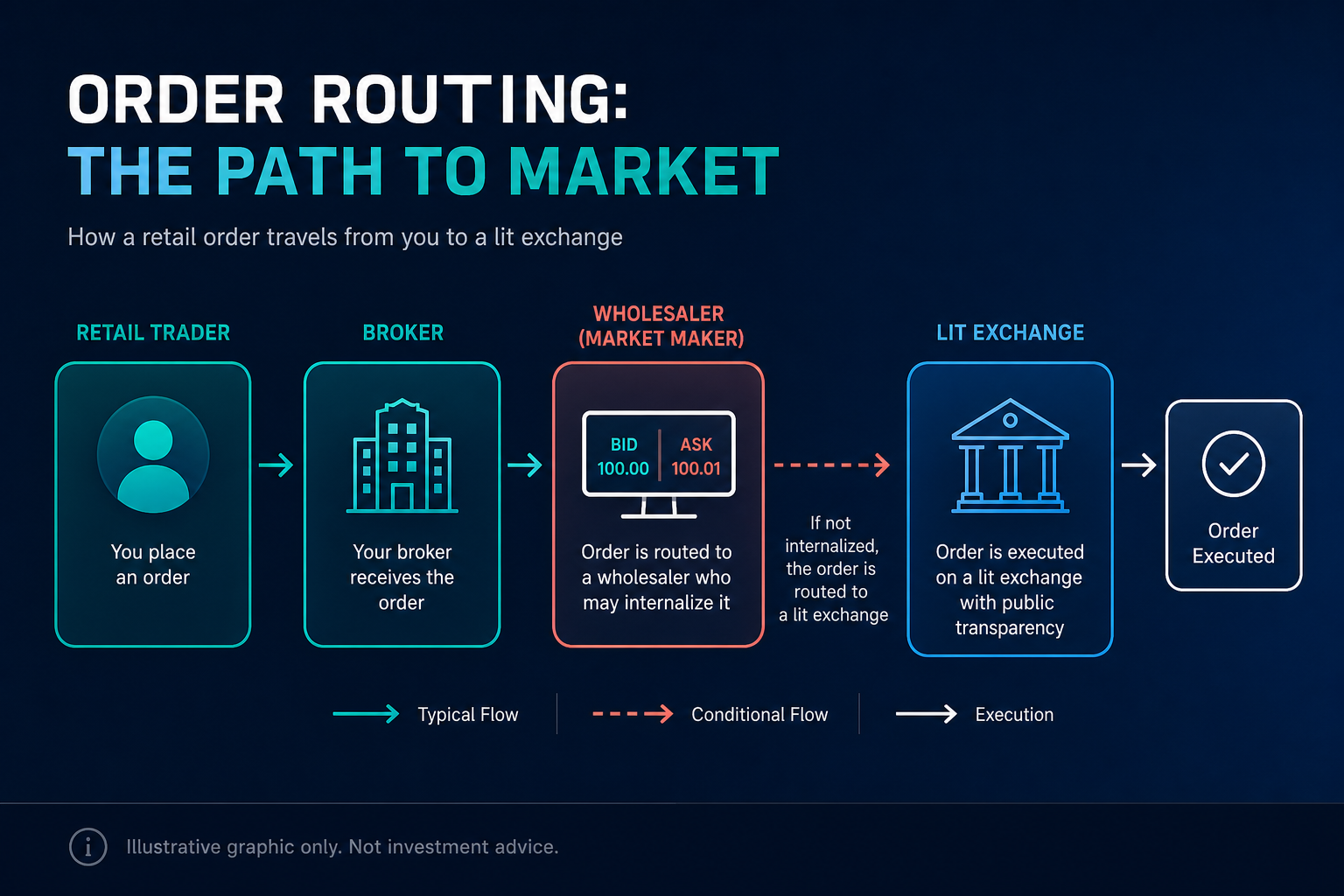
Once a trader hits Send, the order ticket leaves the workstation and enters the broker’s routing process.
That is the moment control changes. The trader still owns the instruction they sent: the order type, limit price, time-in-force, size, session, and exit structure. But they usually do not control every decision that happens after the broker accepts the order. Investor.gov explains that many online investors assume they have a direct connection to the securities markets, but the order goes to the broker, and the broker then decides which market to send it to for execution.
That is why dark pools and retail routes matter. A retail order may interact with an exchange, another exchange, a market maker, an ECN, internal firm inventory, or another broker-dealer path. Some market makers pay brokers for routing orders to them, which Investor.gov defines as payment for order flow. Internalization can also occur when the broker sends an order to another division of its own firm to be filled from inventory.
The useful question is not only, “Where exactly did my order go?” The better question is: did I send a clear instruction, and does my fill record show a repeatable problem after similar orders are compared?
That distinction keeps the trader out of two bad habits. One is pretending routing opacity does not matter. It does. The other is treating every frustrating fill as proof that the venue path was unfair. A poor fill can come from routing, but it can also come from urgency, spread width, thin liquidity, order size, session timing, or a stop triggering into a fast market.
This article draws the line between what traders can and cannot control. Traders cannot control every router decision, hidden order, venue interaction, internalization path, or off-exchange print. They can control the ticket they send, the urgency they demand, the price protection they require, the size they expose, the session they trade in, and the evidence they keep after the fill.
The goal is not to turn dark pools into a villain or pretend routing complexity does not matter. The goal is to make the next order more deliberate before it leaves the screen, then review the result with records instead of guesses.
What dark pools and retail routes actually are
A dark pool is a trading venue where orders are not displayed in a public order book before execution. FINRA explains that dark pools do not broadcast pre-trade data, including the presence, price, and size of buy and sell orders, the way traditional exchanges do. FINRA also notes that dark pools were originally designed to help large buyers and sellers trade large blocks without immediately moving the market against themselves.
That limited pre-trade display can sound suspicious, especially if the trader first hears about dark pools after receiving a bad fill. But “dark” does not mean unreported. FINRA states that listed-stock trades occurring on ATSs, including dark pools, must be reported to a FINRA Trade Reporting Facility and published on the consolidated tape.
Off-exchange routing is broader than dark pools. FINRA explains that alternative trading systems, single-dealer platforms, and wholesalers are different types of execution venues, and that off-exchange, off-ATS activity must still take place at a registered broker-dealer subject to SEC and FINRA oversight.
The scale matters. The SEC’s 2026 Regulation NMS proposal says U.S. equity markets have become increasingly fragmented and complex, with 17 operating national securities exchanges that trade NMS stocks and three more approved but not yet operating. The same release notes that off-exchange volume rose to 51.9% for Nasdaq-listed stocks and 47% for NYSE-listed stocks by January 2026.
For traders, that means off-exchange execution is not fringe. It is part of the market structure. The practical response is not panic. It is better ticket control and better fill review.
What stays inside the trader’s control?
Retail traders may not control the final venue path, but they control the instruction quality.
That controllable layer includes the order type, limit price, time-in-force, order size, session, spread tolerance, and exit structure. It also includes the decision to demand immediate execution or allow the order more time to work.
CFA Institute’s trade-execution material frames trade strategy around motivation, risk aversion, urgency, order characteristics, market conditions, and execution quality. It notes that order size, liquidity profile, intraday volume, bid-ask spreads, volatility, and market impact all belong in the execution decision.
That is the practical standard. A routing review should begin with the ticket.
Before blaming the venue path, the trader should ask:
- Did the order type match the real priority?
- Was the limit price realistic for the spread?
- Was the clip too large for the available liquidity?
- Was the order sent during a thin session, event window, open, or close?
- Did time-in-force match the intended urgency?
- Did the exit structure match how the position would actually be managed?
- Did similar orders behave the same way, or was this fill an outlier?
This does not excuse poor routing. It keeps the review in the right order. Control the instruction first. Then evaluate the fill.
Payment for order flow is a conflict to measure
Payment for order flow deserves attention because it can create routing incentives. It does not prove that a specific order received a poor fill.
Investor.gov explains that some market makers pay brokers for routing orders to them, and that brokers have a duty to seek the best execution reasonably available for customer orders. Investor.gov also notes that price improvement is an opportunity, not a guarantee, and that brokers must consider the trade-off between potential price improvement and the extra time some markets may take to execute.
CFA Institute’s report, Dark Pools, Internalization, and Equity Market Quality, is more pointed. It warns that when investors become disincentivized from displaying orders, bid-offer spreads are likely to widen. It also recommends that broker-dealers either internalize marketable retail order flow with significant price improvement or route that flow to an exchange to execute against displayed quotations in the order book.
That is the fair position. Payment for order flow is not something traders should ignore. It is also not enough, by itself, to explain one fill.
The better question is whether the trader’s comparable fill records show a pattern. Did marketable orders begin receiving worse execution after a platform or routing change? Did price improvement decrease? Did slippage increase for similar symbols, similar size, and similar sessions? Did fills deteriorate only when the trader demanded speed in weak liquidity?
Payment for order flow belongs in the review. It should not replace the review.
Run the 30-day fill test before blaming the route
A routing concern becomes useful when it can survive a clean comparison.
One bad fill during a fast move may reflect volatility, urgency, spread width, or thin liquidity. Several weeks of worse fills in comparable orders deserve a closer look.
Start with a 30-day fill review. Keep the fields tight enough that a trader will actually use them:
- Symbol
- Order type
- Time-in-force
- Session
- Clip size
- Decision price or arrival price
- Average fill price
- Notes on spread, urgency, or news
Then group the records. Market orders should be compared with market orders. Patient limits should be compared with patient limits. Regular-session fills should be separated from extended-hours fills. Calm sessions should be separated from event-driven tapes. Small clips should not be averaged with large clips.
CFA Institute describes market impact as the adverse price impact caused by trading an order and says it can represent one of the largest costs in trading. It also describes implementation shortfall as a way to compare actual execution with the paper return based on the decision price.
That framework gives the trader a better question than “Was the route bad?” It asks, “How much did the actual execution differ from the decision I intended to trade, and does that difference repeat under comparable conditions?”
CMT Association’s January 2026 commentary makes the same process point in plain terms: repeatable edge comes from process, including how traders screen ideas, size positions, manage risk, and review mistakes with humility instead of trying to forecast every move on a chart.
Routing opacity makes that discipline more important, not less. When the path is imperfectly visible, the trader’s record has to be cleaner.
Liquidity still has to be tested first
Routing gets blamed most often when liquidity is already under stress.
A clean venue path can still produce a difficult fill if the order is too large for the available liquidity. A less visible path can still produce an acceptable fill if the instruction is properly priced, sized, and timed. This is why traders should not separate routing from liquidity.
Kirkpatrick’s CMT risk-management material treats liquidity as an individual issue risk and describes it through the width of spreads and the size of offerings, not only dollar volume. It also notes that liquidity is often hidden and only apparent when the issue is under strain.
That is exactly when retail traders feel the routing problem most sharply. The spread widens. The book thins. A stop triggers into a fast move. A partial fill leaves size behind. A related group starts moving together. The trader sees the result and reaches for a venue explanation.
Sometimes the venue path matters. But liquidity has to be tested first.
If the spread is wide, the clip is too large, the session is thin, or the tape is moving quickly, the first defense is not a theory. It is a better instruction: smaller size, clearer limit, more realistic time-in-force, or a decision not to demand immediate execution.
Use disclosures, but do not expect a trade-by-trade answer
Retail traders are not completely blind to routing practices.
SEC Rule 606 disclosures are designed to help investors understand how broker-dealers route and handle orders and how those decisions may affect execution quality. The SEC’s 2018 adopting release says public reports must include information about payment for order flow arrangements, profit-sharing relationships, transaction fees, rebates, and the venues receiving significant non-directed order flow. Those reports must be posted on a free, readily accessible website for three years.
Those disclosures are useful for monthly review. They are not a real-time explanation for one fill.
A practical routine is enough for most active traders. Save the broker’s routing disclosure once a month. Note whether routing concentration or payment arrangements changed. Compare fill quality before and after major broker, API, platform, or routing updates. Keep the disclosure with that month’s execution records.
The point is not to become a market-structure lawyer. The point is to stop treating routing as either invisible magic or guaranteed corruption.
When should a routing concern be escalated?
A routing concern deserves escalation when the record shows a systematic change.
The strongest evidence is not one ugly fill. It is a pattern across comparable orders.
A trader should investigate when slippage worsens across similar symbols and sessions, fills deteriorate after a broker or platform update, partial fills increase without a size change, limit orders miss more often without an obvious liquidity reason, or the gap between decision price and average fill price widens in a way that survives grouping.
The escalation note should be boring and specific:
“Here are comparable orders over the last month. Median slippage changed after this date. The order type, session, symbols, and clip sizes were similar. Can you help explain the routing or execution-quality difference?”
That is stronger than a screenshot and far stronger than a theory.
It also gives the broker something concrete to review: dates, ticket IDs, order types, size, session, and execution outcomes. If the pattern is real, the evidence should make it easier to ask about routing behavior, execution quality, payment for order flow, or internalization without turning the conversation into an argument.
Automation does not remove routing discipline
Automation can make good routing discipline more consistent. It can also make a weak instruction repeat faster.
That is why rule-based workflows need the same review as manual orders. The trader still needs to know what instruction is being sent, under what conditions, at what size, with what order type, and during which session.
A strategy that sends marketable orders into thin liquidity may create the same footprint whether the order is manual or automated. A trailing exit that works at small size may need different clip logic when the position grows. A bracket that is sensible during regular hours may behave differently near the open, close, or extended session.
The routing path may be partly abstracted, but the trading instruction is not. The trader still owns the rule.
How OHLCX supports the controllable layer
OHLCX does not control the market venue path after an order reaches the broker. It does not choose dark pools, guarantee fills, reduce slippage, evaluate broker routing quality, or replace trader judgment.
What OHLCX can support is the controllable layer before and after the order. The OHLCX platform connects to Schwab thinkorswim through the official Schwab API for live order routing, account data, positions, and fills. OHLCX also describes its OMS/EMS layer as managing order lifecycle, state management, fill tracking, and event logging, with every trade, event, and account action logged for traceability.
That matters because routing review depends on reproducible ticket intent. If the trader changes size, order type, time-in-force, or exit structure mid-session without a clear record, the fill review becomes harder to trust.
OHLCX’s features page describes MKT, LMT, and STP order types, structured exit flows selectable at entry, streaming bid/ask spreads and volume, real-time positions, Risk Gauge visibility, and order history with CSV export, statuses, and timestamps. It also describes Level 2 market depth and buy-side and sell-side liquidity visibility.
Structured exit flows help keep intent clear. OHLCX’s exit-flows page lists TRIMMER, OCO, TSP, Limit, and Market exit flows routed through the official Schwab API. TRIMMER splits a position into configurable tranches, OCO pairs a profit target with a stop-loss, and TSP uses a configurable trailing offset.
Strategy Builder is relevant when the trader wants routing discipline inside a rule-based workflow. OHLCX describes Strategy Builder as a no-code workspace for entry logic, sizing, schedules, and exit flows, with automation levels for signals, trades, and live orders routed through Schwab.
The value is not that OHLCX reveals every venue or removes routing complexity. The value is that the trader can make the instruction clearer, attach the exit earlier, control size more deliberately, and review the record with less guesswork.
Keep the next ticket reproducible
Dark pools and retail routes are part of the market structure. They should be understood, not mythologized.
The trader’s job is not to solve every hidden pipe before placing the next order. The job is to control what can be controlled: order type, limit price, time-in-force, size, session, spread tolerance, exit structure, and review discipline.
When fills drift, start with the record. Compare similar orders. Separate urgent from patient. Review disclosures. Look for systematic change. Escalate with evidence if the pattern is real.
The market may route through places you cannot see. The ticket still has to say exactly what you mean.
Explore OHLCX to see how structured order entry, Strategy Builder, exit flows, Risk Gauge visibility, and order history can help traders keep execution intent clear before the order leaves the workstation.
Leave a Reply