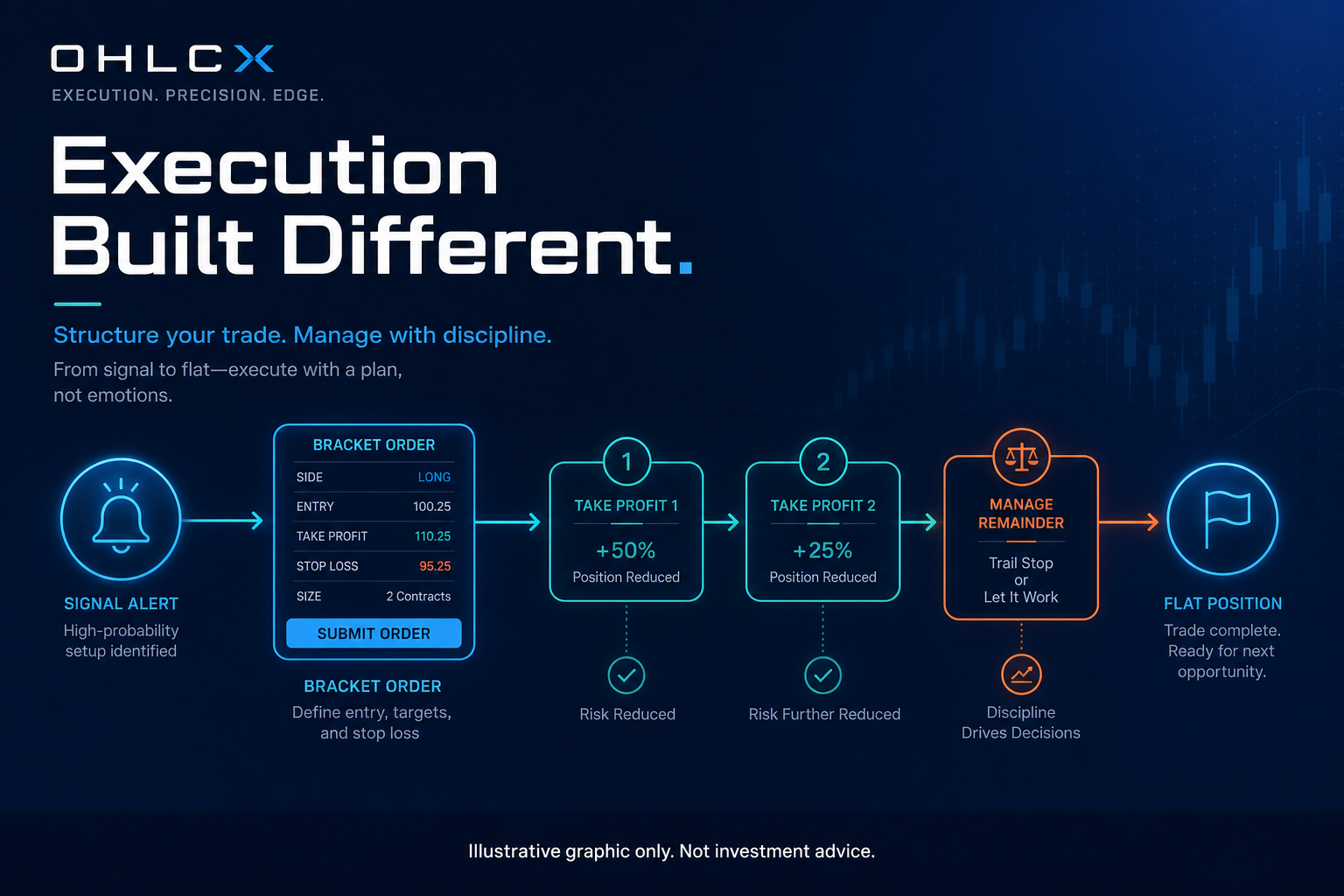
Most active traders do not need another chart to know when a setup is worth watching. The harder part is what happens when that setup has to become an order.
The order ticket, or order form, has to carry the entry, size, stop, and exit plan. If that logic is not built before the trade is live, even a solid idea can turn into a rushed fill, a loose stop, or a partial exit that has to be fixed later.
A trade is not fully planned when the setup looks right. It becomes real when the entry, sizing, risk, and exits are expressed in a way that can actually be executed. For active traders, the ticket is not just the final step. It is where the plan becomes live risk.
OHLCX is built around that execution layer. It does not tell traders what to trade. It helps traders express their own plan as structured order logic –explore OHLCX execution features.
The gap between “setup” and “send”
A setup is the idea. The ticket is where that idea turns into a live order.
The gap between the two is where many execution problems begin. A trader may know where they want to enter, where the trade is invalidated, and how they want to scale out if it works. But if those decisions are not reflected in the ticket or order form, they still have to be handled later.
That creates room for hesitation, inconsistent sizing, late stop placement, and exits that depend too much on memory.
A cleaner trade execution workflow asks the important questions before the order is sent:
- What is the entry?
- How much size is being used?
- Where is the trade wrong?
- What is the first planned exit?
- Will the position close all at once or scale out in stages?
- What should happen after a partial exit?
The goal is not to remove judgment. The goal is to make sure fewer decisions have to be rebuilt manually while the trade is already live.
What belongs in the order ticket?
A useful order ticket should do more than capture buy, sell, quantity, and price.
For active traders, the ticket should reflect the full order path. That includes entry type, position size, stop logic, exit logic, partial exits, and the next action if one side of the trade fills.
This is where structured order entry becomes useful. Instead of placing an order first and figuring out the rest after the fill, the trader can define more of the plan before the order reaches the broker.
In OHLCX, that is the point of the execution workflow. The ticket supports structured order entry and exit flows that help traders express their own rules more clearly. The decision still belongs to the trader, but the order path is less dependent on last-second manual edits.
How structured exits reduce rework mid-trade
Exits are often where discipline meets friction. A profit target without a protective stop can leave too much room for adjustment after the fact. A stop without a partial exit plan can turn every trade into an all-or-nothing decision. A staged exit that has to be managed manually can create extra work at exactly the wrong time.
When a trade starts working, the risk changes. The problem is no longer only getting stopped out. It is giving back a move that needed a clearer exit plan.
Structured exits help reduce that rework. For some trades, that means pairing a target and stop with OCO logic. For others, it means using OTOCO so a bracket can activate when the entry fills, or TSP when a trader wants protective logic to follow favorable price movement.
For partial exits, TRIM and TRIMMER keep the staged exit plan inside the workflow instead of leaving it as a note or manual follow-up task. TRIM allows traders to define partial exits ahead of time. TRIMMER supports adaptive staged exit logic based on rules the trader configures.
The trader still defines the plan. These flows do not predict direction, decide whether a trade is good, or replace judgment. They help the ticket reflect decisions the trader has already made.
When native tickets feel generic
Native tools are not “bad.” They are generic.
They are designed to support a wide range of account types, asset classes, and order paths. That breadth is useful, but it can also leave active traders rebuilding the same exit logic manually.
The issue is not whether a broker ticket can place an order. The issue is whether the workflow helps the trader stay consistent from setup to execution.
A generic ticket can leave too much of the plan outside the order path:
- The partial exit lives in the trader’s head.
- The stop gets adjusted after the fill.
- The next action depends on memory.
- Risk is reviewed separately from the ticket.
- The trader moves between tools to see the full picture.
OHLCX is designed to sit in that middle layer. It connects through Schwab and gives traders a focused workspace for orders, exits, partials, risk visibility, and optional automation. The Risk Gauge keeps exposure visible as part of the workflow, not as a separate check after the fact.
Capital and custody remain with Schwab. OHLCX is not the broker. It is execution technology that helps traders structure the order workflow around their own rules.
Automation should make the workflow more repeatable
Automation should make the workflow more repeatable, not more abstract.
For many traders, the practical value is not a fully automated strategy running without oversight. It is the ability to turn repeated steps into a more consistent workflow.
That can mean using templates, shortcuts, structured tickets, staged exits, or rule-based automation for setups the trader already understands. In OHLCX Pro, Strategy Builder supports a visual, no-code path for building that kind of repeatable workflow.
The important distinction is that automation should support the plan. It should not become a substitute for the plan.
Live execution also exposes assumptions that paper trading can hide, including partial liquidity, latency, and the time it takes to make a manual decision under pressure. Automation that assumes ideal fills is different from automation that runs against real conditions.
OHLCX keeps that distinction clear. The platform is not a recommendations engine. It does not replace trader judgment. It gives traders a way to configure order logic, exit behavior, and automation paths around decisions they are responsible for making.
Speed only helps when the workflow is controlled. A faster bad ticket is still a bad order.
See how TRIMMER-style exits fit a playbook
When discretion needs to take over
Templates are useful when market behavior fits the plan they were built for. They are less useful when conditions change in ways the template does not account for.
News events, halts, liquidity changes, data issues, and unusual volatility can all create situations where the template does not match the conditions. The right response is usually to pause automation, reduce size, and rely on manually reviewed brackets until conditions stabilize.
That does not make templates useless. It means the workflow needs room for discretion.
A strong execution process should make it clear when to use the default path and when to pause, reduce size, adjust the structure, or avoid the trade entirely. The trader should always know where judgment belongs.
The goal is not to abandon structured execution. It is to know when discretion takes over and when default paths return.
Make the ticket part of the plan
A trade execution workflow is not just what happens after analysis. It is the path that turns analysis into live risk.
When entries, exits, partials, stops, and risk visibility are handled inside the order workflow, the trader spends less time repairing tickets and more time managing the trade according to the original plan.
That is the role of OHLCX. It helps traders move from setup to structured execution through a Schwab-connected platform built around live tickets, advanced exit flows, staged exits, visible risk, and optional rule-based automation.
To see the workflow in action, request a walkthrough through the OHLCX platform page.
Leave a Reply