A post-trade review should do more than explain what happened. It should turn the actual fill sequence into a clearer rule for the next similar setup.
That rule does not need to be dramatic. It may be a smaller size cap, a tighter entry window, a clearer OCO condition, a simpler TRIM plan, a pause condition in Strategy Builder, or a new review step before trading around earnings. The point is not to make the platform decide anything for the trader. The point is to make sure the next execution reflects what the last trade revealed.
Many reviews stop too early. The trader explains the outcome, names a lesson, and moves on without changing the workflow. That can feel responsible, but it rarely improves the process. If the same size, bracket, timing, and automation rule remain unchanged, the review did not become part of execution.
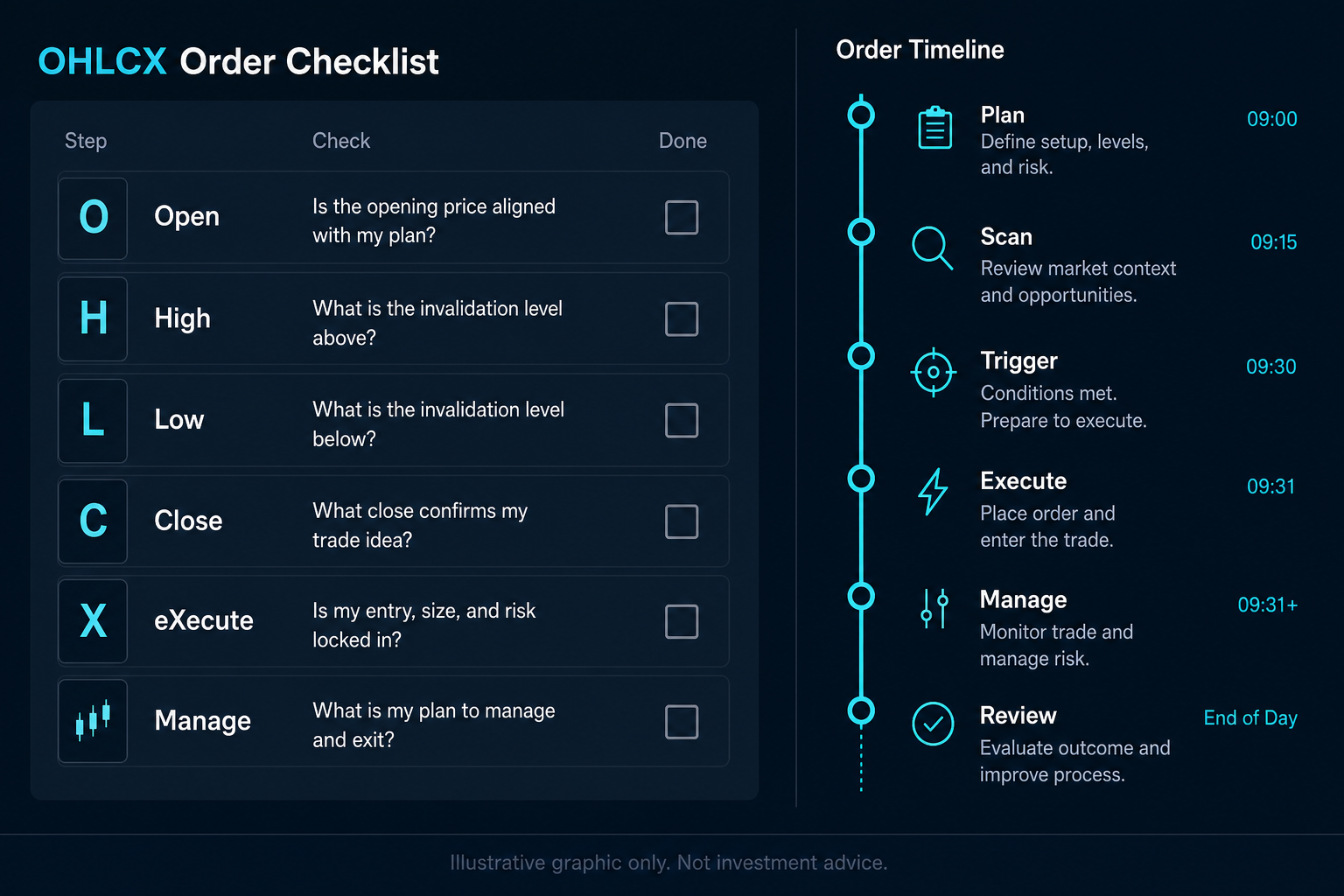
OHLCX fits this topic because it gives traders a Schwab-connected workflow for structured order entry, Risk Gauge visibility, order history, and optional rule-based automation. The platform does not decide what the lesson should be. It helps the trader connect that lesson to a more explicit execution rule.
What should a post-trade review produce?
A useful post-trade review should produce a specific rule change, not a general observation.
“Be more patient” is not enough. “Use a limit order unless the thesis is invalidated” is more useful. “Reduce size after two failed entries in the same symbol” is more useful. “Pause this Strategy Builder workflow during earnings week unless event risk is explicitly accepted” is more useful.
The minimum review can be built around three questions:
- Did the order match the plan before it filled?
- Did the fill, partial fill, or price path change the position in a way the plan had already addressed?
- What rule, parameter, or veto should change before the next similar trade?
Those questions keep the review close to execution. They also prevent the trader from turning every trade into a long essay. The goal is not to document every feeling around the trade. The goal is to identify the change that will make the next execution rule clearer.
Separate the setup from the order
A trade can fail for more than one reason.
The setup may have been weak. The market regime may have changed. The entry may have been chased. The size may have been too large. The exit may have been missing, late, or attached to a level that never matched the thesis.
Those are different problems, and they need different fixes.
If the setup was poor but the order was clean, the trader should refine the research or filtering process. If the setup was strong but the order was sloppy, adding another indicator will not help. The issue is order construction, size, timing, or follow-through.
A simple review can split the trade into three parts:
- Setup quality: Was the trade idea valid, timely, and supported by the conditions the trader expected?
- Order quality: Did the order reflect the intended size, invalidation, order type, exit structure, and portfolio context?
- Follow-through quality: Did the trader manage fills, changes, partial fills, and exits according to the plan?
This keeps a winning trade from hiding weak execution and keeps a losing trade from being dismissed too quickly. A profitable trade can still expose a bad habit. A losing trade can still prove the order was built correctly.
Start with the actual order history
Memory is not a reliable source after a stressful trade.
The trader may remember the market moving faster than it did, or remember a stop as more deliberate than it was. A partial fill may seem minor in hindsight even though it changed the position’s risk. A canceled order may be forgotten entirely if the final P&L feels clean.
The review should begin with what actually happened: order submitted, order modified, order canceled, order filled, quantity filled, average price, remaining position, and active protection.
OHLCX order history and timestamps can support that reconstruction. The value is not just recordkeeping. It is being able to compare the intended plan with the actual sequence before the trader edits the story to fit the outcome.
Review manual trades where discretion entered
Manual trades should be reviewed at the points where the trader made live decisions.
The trader should ask whether the order type fit the urgency, whether the size matched the risk plan, whether the exit was attached or planned before entry, and whether edits were made because the market changed or because the trader became uncomfortable.
For active traders, the most useful manual review often focuses on repeated leaks: orders sent too late after confirmation, limits left active after the setup expired, stops moved without a thesis-based reason, partial exits taken without updating the remaining protection, or related positions ignored while one symbol received all the attention.
These are not personality flaws. They are workflow issues. If they appear repeatedly, the fix should show up in the next order rule, checklist, or template.
Review automated trades for rule drift
Automated trades need a different kind of review.
The first question is whether the workflow fired under the conditions it was supposed to recognize. If Strategy Builder created an order, the trader should compare the live action with the rule version that was intended to be active.
The review should ask whether the correct strategy version ran, whether the conditions matched the current playbook, and whether the order size, exit flow, and timing reflected the active rule set. It should also ask whether the workflow should have paused because of volatility, earnings, spread width, account heat, or another condition.
When automation fails, the fix is usually not a motivational note. It is a parameter change, a pause condition, a version update, or a tighter rule around when the workflow is allowed to run.
OHLCX automation is optional and rule-based. The trader defines the rules and remains responsible for keeping them current. A review should make that responsibility visible instead of treating automation as a black box.
Include portfolio heat in the review
A trade can look reasonable by itself and still be wrong for the account.
That is why post-trade review should include portfolio heat, not only the individual symbol. A trade may have failed because the setup was poor, but it may also have failed because the account was already too exposed to the same theme, sector, or market condition.
Risk Gauge visibility can help the trader review whether the position fit the account at the time of entry and whether the exit should have happened sooner because the book was already carrying too much exposure.
This matters most after clustered losses. If several trades failed together, the review should not treat them as unrelated mistakes. The more useful question is whether the account had one shared risk wearing several ticker symbols.
A good review turns that into a rule. It may reduce size after a heat threshold, block new entries in a crowded theme, or require one related position to be reduced before another setup can be added.
Decide the right review cadence
The right cadence depends on how fast mistakes compound.
Day traders usually need same-day review because one weak habit can repeat several times before the week ends. Swing traders can often batch reviews, but a Risk Gauge breach, large gap, halt, automation error, or major rule violation should trigger a faster review.
A practical cadence can be simple. Review large losses, rule breaks, platform confusion, and clustered mistakes the same day. Review active intraday trading at the end of the session. Review lower-frequency swing setups weekly. Review strategy-level performance, regime fit, and automation rules monthly or quarterly.
The review does not need to be long. In many cases, twenty focused minutes is better than a long write-up the trader will never use. The work is deciding what changes before the next similar setup, not creating a perfect archive.
Keep team reviews factual
Teams need reviews that separate facts from opinions.
Before debating the lesson, everyone should agree on the sequence: what was planned, what was sent, what filled, what changed, and what remained open. If the data does not match across broker records, screenshots, or internal notes, the team should reconcile the account state before adding new risk.
The review should also assign ownership. If the action item has no owner and no review date, it is not a decision. It is a suggestion.
A simple team review can end with three lines: what changed, who owns it, and when it will be checked. That is enough to keep the process honest without turning the review into a meeting about the meeting.
Make the action item small enough to use
A review that produces ten action items usually produces none.
The better approach is to choose one to three changes that can be tested in the next cycle. The change might be a max-size reduction, an expiry time limit, a required OCO or OTOCO before entry, a Strategy Builder pause around earnings, a TRIM rule for partial exits, or a Risk Gauge threshold that blocks new entries.
Each action should be specific enough that the trader can tell whether it happened. If the next similar order looks identical to the last one, the review probably did not go far enough.
Exceptions should also be tagged separately. A broker issue, platform incident, data delay, fat-finger, missed cancellation, or accidental duplicate order should not be blended into the thesis result. The goal is not to assign blame. It is to make sure the next fix targets the real problem.
Turn review into an execution rule
The best post-trade review is not the one that sounds most thoughtful. It is the one that changes the rule the trader will use next time.
That change may show up in the size, exit flow, time limit, automation rule, portfolio heat threshold, or post-fill check. It should be visible somewhere in the workflow before the trader faces the same condition again.
OHLCX supports that loop through structured order entry, OCO and OTOCO logic, TSP, TRIM and TRIMMER exits, Risk Gauge visibility, Strategy Builder, order history, and Schwab-connected execution. A review is finished only when the lesson becomes something the trader can actually apply.
Leave a Reply