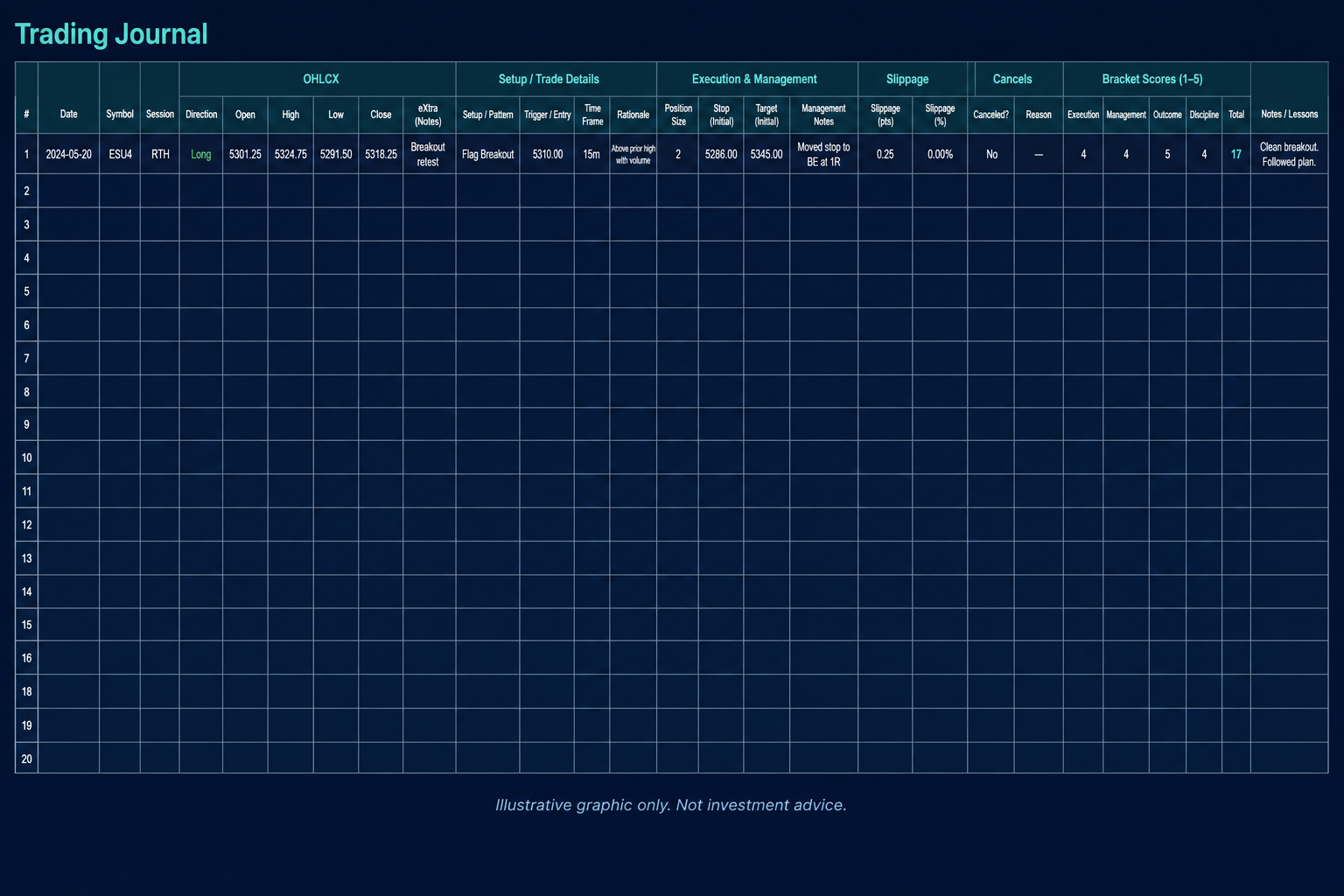
Your P&L tells you what a trade paid. It does not tell you whether you followed your plan, sized the position the way you intended, or got filled anywhere near the price you planned for. A journal that only records dollars leaves those questions open, and those are the questions that decide whether next month looks any different.
A useful journal connects each result to the decisions you actually controlled. That is the whole job. Not more writing, not more screenshots. A short record of what you planned, what you did, and where the two came apart.
Why P&L alone is not enough
A profitable trade can have bad process behind it. Maybe the entry was oversized, the stop was never placed, or a market order paid far more than the plan allowed, and the trade got paid anyway. A losing trade can be the opposite: correct size, clean entry, exit taken exactly at the planned invalidation point, and the market simply went the other way.
If you only track outcomes, you end up repeating the habits that happened to get paid and abandoning the ones that happened to lose. Over enough trades, that is how a working strategy quietly falls apart. The journal exists to catch the difference while it is still cheap to fix.
What should a trading journal actually measure?
Measure the decisions you control. For most active traders, that comes down to a short set of fields:
- Planned entry vs. actual entry
- Planned exit vs. actual exit
- Slippage or spread paid
- Position size vs. intended size
- Rule adherence: did you follow your own plan, yes or no
- Partial-fill handling: what did you do with the size that filled
- Portfolio heat at entry
- Strategy or setup tag
- Reason for exit: target, stop, time, or discretion
Notice what is not on the list. How confident you felt is not there, not because feelings are irrelevant, but because you cannot act on “felt sharp” tomorrow. You can act on the fact that your slippage doubles in the last hour of the session.
Track execution quality, not just trade ideas
Most journals grade the idea and ignore the execution, but execution is where controllable money leaks out. If you planned to enter at 50.20 and paid 50.45, that gap is data. If a limit order got canceled and would have filled ten minutes later, that is worth reviewing. The issue may be patience, timing, or a rule that needs to be clearer. If a market order went out where a limit was the plan, that is a rule break worth tagging even if the trade won.
Partial fills belong here too. A half-filled entry is a different position than the one you planned, with different risk and a different exit calculation. Write down what you did with it. The same goes for exit logic: if you use OCO brackets, trailing stops, or staged trims, record whether they behaved the way you set them up. When an exit fires somewhere other than where the plan said, find out why before assigning blame. Sometimes the ticket did not match the plan, and that is fixable at the ticket. Sometimes the ticket was right and a gap, thin liquidity, or the mechanics of the order type moved the fill. That is information about the market, and it belongs in the journal too.
Connect each trade to portfolio heat
Some losses are not really single-trade losses. If three tech positions stop out on the same afternoon, that is usually not three separate mistakes. It is one concentrated exposure that was wearing three tickers. A journal that treats them as three unrelated rows will send you looking for three fixes that do not exist.
The fix is one field: log your portfolio heat and what else you were holding when the trade went on. In OHLCX, the Risk Gauge gives you visibility into that exposure at entry, so recording it is a matter of checking what you were carrying rather than reconstructing your book from memory a week later.
Keep the journal light enough to survive real trading
A journal only works if you still fill it in on your worst day. Keep the required fields under ten and let short notes cover the rest. Expand the entry only for outsized wins and losses, where the detail is worth the time. If logging a trade takes longer than the trade took, you will quit within a month, and an abandoned journal predicts nothing.
How OHLCX supports process review
Some of the fields above do not need to be reconstructed by hand, because the execution record already contains them. In OHLCX, the structured order ticket captures the order logic you selected before the order went live, exits like OCO, TSP, and TRIM are defined in advance, and the order history keeps timestamps, fills, and exit behavior for every trade. Comparing the order plan to the result starts with the execution record instead of memory. If you run rule-based automation in Strategy Builder, note which version of your rules was live for each trade, so a change in results can be traced to a change in rules.
To be clear about the boundary: OHLCX records what happened and shows your risk while it is happening. It does not grade your trades or tell you which ones belonged in the account. That judgment stays with you, which is exactly why the record needs to be honest.
Review the process, then adjust one thing
The point of all this is not to journal more. It is to make the next trade cleaner. Pick the one metric that looks worst this month, change the one setting behind it, and watch whether the number moves. That loop, run steadily, is what separates traders who improve from traders who just accumulate history.
If your journal currently ends at the P&L column, start with the order history instead. Request access to OHLCX to see how structured tickets, risk visibility, and execution records can support a cleaner review process.
Leave a Reply