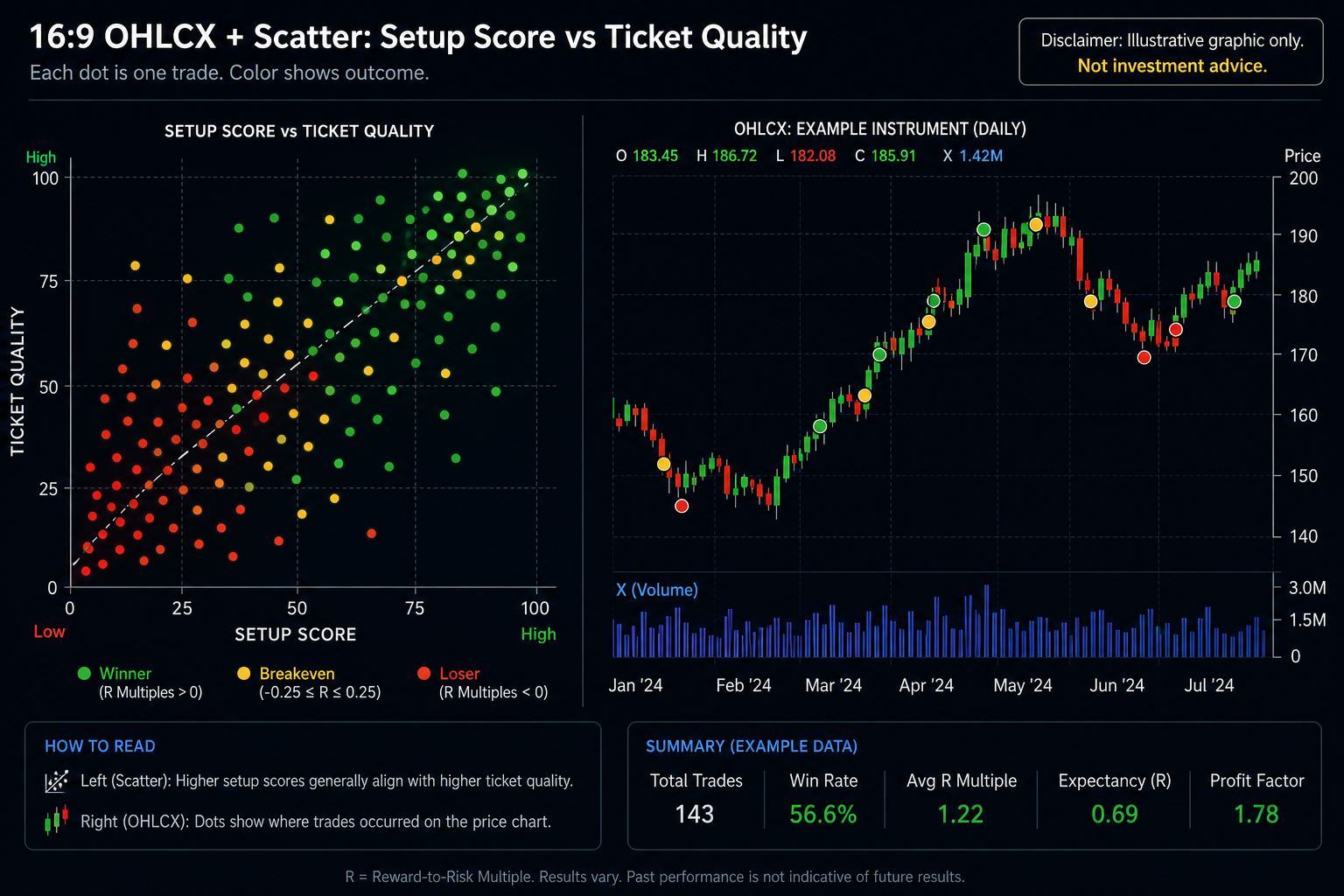
Every trade deserves two grades, not one. The first grade is for the setup: was this a trade worth taking at all? The second is for the ticket: did you execute it the way you planned? Most traders blend these into a single impression, usually colored by the P&L, and the blend teaches the wrong lessons.
If you grade only the chart, you learn slowly. If you grade only the P&L, luck does the teaching. A sloppy entry that gets paid reinforces the sloppiness, and a clean execution of a good setup that loses tempts you to abandon the setup. Splitting the scorecard is how you stop those two mistakes from feeding each other.
Why one grade misleads
Consider a trade where the setup was solid but the execution was not. You chased the entry with a market order where a limit was the plan, skipped half the bracket, and got out on feel. The trade won anyway. One combined grade says “good trade.” Two grades say “good setup, bad ticket,” which is the honest reading, because that execution will cost you on the next hundred trades even though it got paid on this one.
Now reverse it. The setup was marginal, but you sized correctly, entered at your price, and exited exactly at the planned invalidation. The trade lost. One grade says “bad trade.” Two grades say the execution was fine and the idea needs work. That distinction decides whether you fix your order habits or your watchlist, and those are very different projects.
How do you score a setup without the outcome contaminating it?
Score the setup before entry whenever you can, while you are still blind to the result. A simple 1 to 5 against a few predefined criteria is enough: does the setup fit the current market conditions, is the trigger clear rather than squinted at, is there enough liquidity for your intended size, and does the position fit inside your portfolio heat rather than stacking onto exposure you already carry.
Then hold one rule absolutely: the setup score never changes because the trade won or lost. If you find yourself revising setup grades after the fact, the P&L is grading your ideas for you, and it is a poor teacher.
What belongs on the ticket score?
The ticket score is where the execution details live, and most of them are checkable against the record rather than remembered:
- Planned entry and exit vs. the actual fills
- Whether the full exit structure was in place before the order went live, not patched in after the first tick
- Position size vs. intended size, and vs. your heat limit
- Time from trigger to send
- Whether OCO brackets, trailing stops, or staged trims behaved the way you configured them
- Any rule break, tagged even when the trade won
The ticket score is allowed to swing on slippage and rule breaks even when the setup was excellent. That is the point. It isolates the part of the result you controlled.
Read the two scores together
The combinations tell you where to work. High setup with low ticket means the ideas are fine and the execution needs repair: order type discipline, bracket completeness, send timing. Low setup with high ticket, especially on winners, deserves skepticism, because luck wears strategy clothing and clean execution of a weak idea is still a weak idea. Low on both says simplify or retire the setup. High on both is the only combination that justifies scaling up, and even then only if liquidity supports the added size.
When split scores still hide the real problem
There is one failure mode the split cannot catch on its own. If every losing trade in a bad week grades out as “good setup, bad ticket,” look up a level before accepting that story. Five individually reasonable setups can stack into one concentrated macro bet, and when they stop out together, the problem was portfolio construction, not five separate execution errors. This is why size versus heat belongs on the ticket score: a neat bracket on a position the book could not afford is not a clean ticket.
How OHLCX supports both sides of the scorecard
The setup score is yours alone, but the ticket score should lean on evidence, and this is where the execution workflow matters. In OHLCX, the structured order ticket shows the order logic you selected before the trade went live, exits like OCO, TSP, and TRIM can be defined in advance, and the order history keeps timestamps, fills, and exit behavior, which supports the planned-versus-actual side of the review. One honest caveat: the moment your discretionary trigger actually appeared is something only you saw, so time-to-send still needs a quick note from the trader. Risk Gauge visibility can give the heat check a clearer reference point than memory alone. If you automate setups in Strategy Builder, note which version of your rules was live for each trade, so ticket-score changes can be traced to rule changes rather than guessed at. OHLCX does not score your trades or tell you which setups deserve capital. It gives the ticket side of the review a cleaner execution record to work from.
Two grades, one improvement loop
The setup score tells you whether to keep hunting for that trade. The ticket score tells you whether you can trust yourself to take it. Keep both short enough to fill in every day, review them separately, and fix one side at a time. If you want the ticket side of your scorecard grounded in the execution record instead of recollection, request access to OHLCX and see what order history already shows about how your tickets actually behaved.
Leave a Reply