Revenge trading is usually described as a discipline problem, but that framing is only half right. It is what happens when a fresh loss meets an execution path with no speed bumps, at the exact moment the market is offering endless invitations to get it back. Willpower is not the fix, because the moment you need restraint is the moment you have the least of it.
The fix is a cooling-off rule that exists before the session starts: triggers you can count, a pause response decided in advance, and a re-entry standard that does not bend to mood. If the rule has to be invented after the loss, the person inventing it is the worst possible author.
Know what revenge looks like in the record
Revenge rarely announces itself. It shows up as faster clicking, size changes with no note attached, and re-entering the same symbol minutes after a stop with no new invalidation level, just a grudge. It also shows up in the order record: bursts of cancel-and-replace right after a loss, or a sudden position in a correlated name that exists to hedge feelings rather than exposure.
That last part matters because it makes revenge measurable. You do not have to diagnose your own state of mind in real time. You can count the behaviors instead.
What triggers should force a pause?
Tie the pause to behaviors and dollars you can count, not moods you interpret after the fact. The useful triggers are simple: a preset number of consecutive losses inside one session, a breach of the daily loss budget, two rule breaks inside an hour, or any order that went out without the pre-send check you committed to. Each of these is a practical warning sign that decision quality may be slipping, and none of them requires judgment in the moment. The trigger either fired or it did not.
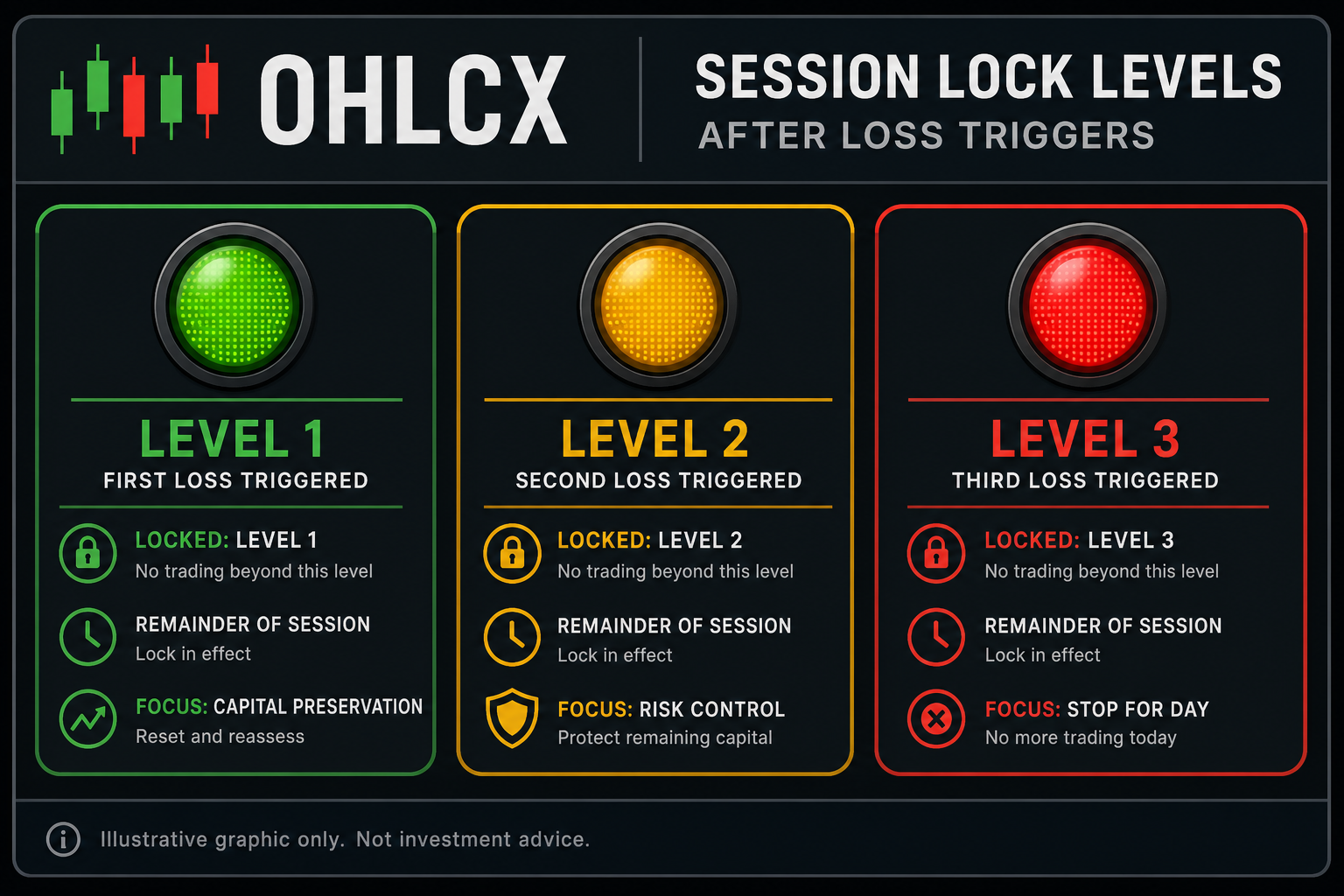
Then match the response to the severity:
- Level one: Fifteen minutes with no new risk. Existing positions get managed by the plan, nothing new gets opened.
- Level two: No new positions for the rest of the session. Use the time to review portfolio heat and what the losses had in common.
- Level three: Done for the day. Journal the trades, close the tickets, and let the review happen tomorrow.
The ladder works because it is proportionate. A rule that jumps straight to “stop trading” for every trigger gets resented and then ignored. Predictable, fair delays are the ones traders actually keep.
Managing open positions during a pause
A pause targets new risk, not existing risk, and that line needs to be bright. Positions already on should be verified and managed according to the prewritten plan: confirm the brackets, trails, and staged exits are still in place and behaving as intended rather than assuming they are. Defensive reductions are allowed. Adding is not, and neither is “restructuring” that quietly increases exposure. If your exits were defined before the order went live, the pause starts from positions that already have protection attached, which is one more argument for building them that way.
How do you come back without yo-yo trading?
Cooling off without a re-entry standard becomes oscillation: flat, bored, back too soon. Re-entry should require four things, and all of them are checkable. The pause window has actually elapsed. The losing trades have a journal note. Portfolio heat has been rechecked, not assumed. And the next trade carries a fresh setup score that stands on its own, independent of the loss it follows.
Two more rules close the common loopholes. No re-entry into the symbols tied to the loss cluster for a defined window unless something genuinely new happened, written down at the time. And size comes back at base level first. Earning back full size by demonstrating clean tickets is a much better test than demonstrating confidence. Watch the correlated version of this too: revenge often hops symbols, turning a loss in one name into oversized risk in a cousin name with a better story attached. Within an hour of a loss, treat same-theme entries as suspect regardless of how the setup reads.
How OHLCX supports a cooling-off rule
The rule is yours. OHLCX does not detect tilt, lock your session, or pause anything on its own. What the workflow can do is make the rule easier to keep and its violations harder to ignore. Structured order entry makes opening new risk a deliberate act rather than one hot click. Exits like OCO, TSP, and TRIM can be defined before the order goes live, so a pause begins from positions that already carry exit logic, which you then verify rather than rebuild. Risk Gauge visibility gives the re-entry heat check a clearer reference point than memory alone. And the order history keeps timestamps on orders and fills, which is where revenge patterns become easier to count: the rapid re-entries, the cancel-replace bursts, the size jump eleven minutes after a stop-out. If you run rule-based automation in Strategy Builder, the conditions are yours to define, and your cooldown policy should spell out how those rules are reviewed or used during a pause. That is the trader’s decision, not the platform’s.
Design the pause for your worst click, not your best day
A cooling-off rule is risk infrastructure, the personal version of an exchange circuit breaker: unglamorous, occasionally annoying, and protective at exactly the moments when it is hardest to be objective. Write the triggers on a flat day, make them countable, and let the ladder do its job. Then check the record monthly: violations, time to re-entry, and the quality of the first trade after each pause tell you whether the rule is calibrated or cosmetic. Request access to OHLCX to see how deliberate order entry, predefined exits, and a timestamped order history can make the rule easier to keep than to break.
Leave a Reply