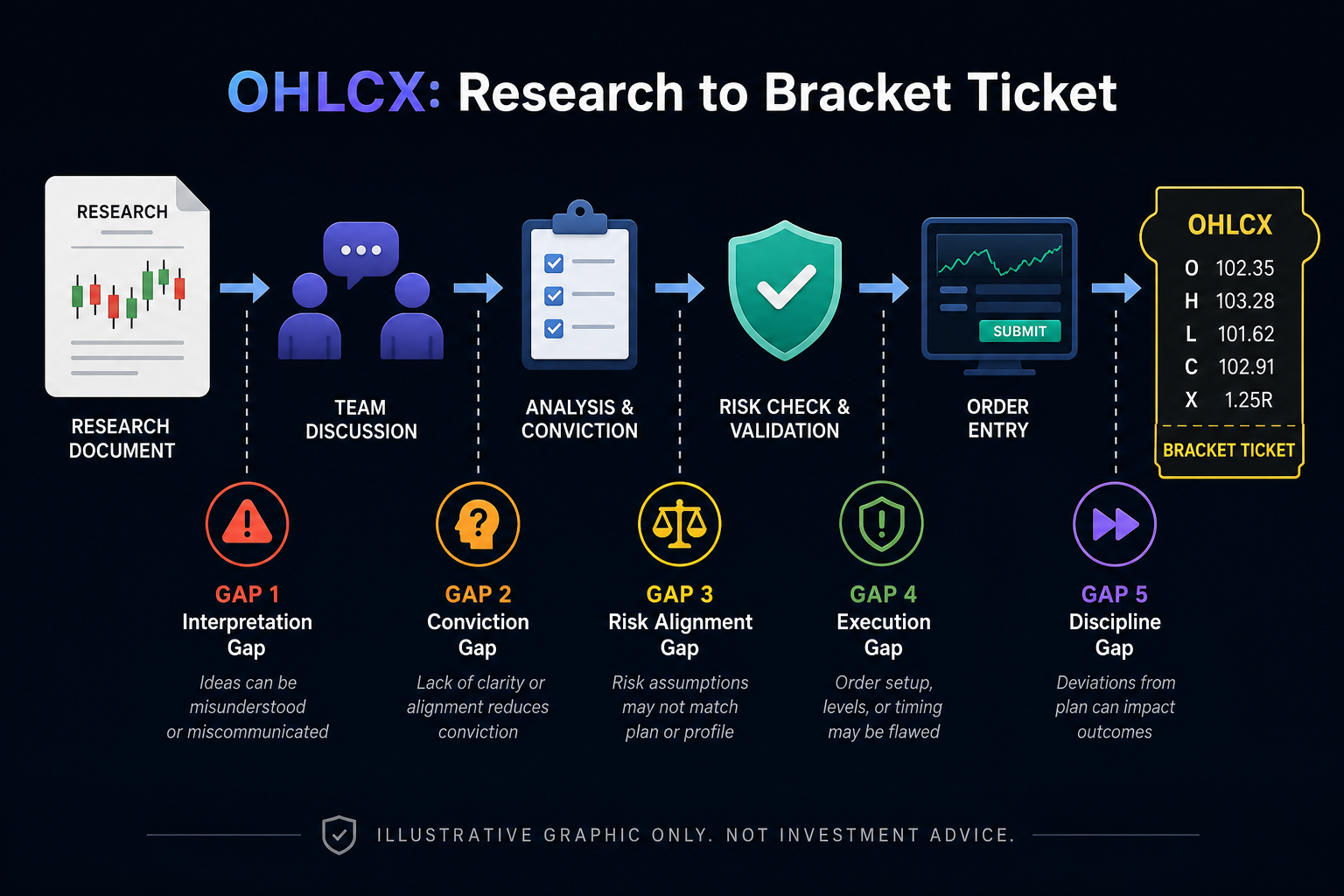
Good research can still produce a bad trade when the plan breaks during execution.
A trader may understand the company, the catalyst, the chart, and the expected move. The notes may be thoughtful. The thesis may even be right. But if that research does not translate into position size, invalidation, order type, exits, timing, and portfolio context, the live trade can still fail.
That is the execution gap: the space between “I have a good idea” and “the ticket reflects the actual risk of the idea.”
This is where many traders misdiagnose the problem. They add another indicator, refine the signal, or look for a better entry filter when the issue was not research quality. The issue was that the research never became a complete order plan.
OHLCX is built around that middle layer between idea and execution. It gives traders a Schwab-connected workflow for structured order entry, exit selection, Risk Gauge visibility, optional rule-based automation, and order history. It does not decide whether the research is right. It helps the trader turn the research into executable order logic that can be reviewed before and after the trade.
Why does good research still fail in live trading?
Research often describes what should happen. Execution decides what happens when price, liquidity, timing, and account exposure are no longer theoretical.
A research note might say the stock should break higher after consolidation. That does not answer how much to buy, whether the entry should be marketable or passive, where the thesis fails, whether the stop belongs at a chart level or a volatility-adjusted level, or how the trade interacts with other positions already in the account.
The live market adds frictions the research note may not include: spread width, partial fills, stale limits, fast reopen prices, correlated exposure, borrow conditions, options liquidity, and the trader’s own urgency under pressure.
A thesis can be directionally correct while the trade loses money because the entry was chased, the size was too large, the exit was undefined, or the position sat inside a crowded risk bucket the trader did not notice.
That is not always a research failure. Sometimes it is a translation failure.
Where does the execution gap usually appear?
The gap usually appears in the details the trader assumes they will handle later.
A plan says the trade is invalid below support, but the ticket does not include a protective exit. A note says the setup should work before earnings, but the order remains active into the announcement. A trader expects to trim into strength, but no partial-exit rule is defined before the stock gaps. A position looks small by ticker, but Risk Gauge visibility would show that the account is already loaded into the same theme.
The most common execution gaps are practical:
- The research defines a thesis but not a trade size
- The chart defines a level but not an executable invalidation rule
- The plan names a catalyst but does not adjust expiry, timing, or open orders
- The trader expects partial exits but does not define quantity or sequence
- The setup looks independent, but the portfolio is already exposed to the same driver
- Automation uses an older version of the strategy after the research has changed
- The post-trade review focuses on P&L instead of whether the ticket matched the plan
This is why a strong idea can feel betrayed by the live trade. The market did not necessarily disprove the research. It exposed what the research did not specify.
What should research include before it becomes a ticket?
A trade is not ready just because the idea is clear.
Before the order goes live, the research should answer a few execution questions. What price or information proves the thesis wrong? How much size belongs in the trade if that invalidation level is reached? Does the order need immediate completion, or is price control more important? What exit structure fits the setup? What happens if the first order partially fills?
Those answers do not need to make the trade complicated. They need to make it complete.
For an equity setup, the trader may choose an OCO bracket to pair a target with protection. For an entry that should trigger a bracket only after fill, OTOCO may fit the workflow. For a setup that needs staged profit-taking, TRIM or TRIMMER can help express the exit path. For a trend-following remainder, TSP may fit if trailing logic matches the thesis.
OHLCX supports those structured exit flows so the trader can choose them before the order goes live. The important part is not the acronym. It is whether the order logic reflects the research instead of relying on the trader to remember the plan under pressure.
How does portfolio context change the trade?
Research often starts with a single symbol. Trading happens inside a portfolio.
A trader may study one stock in detail and miss that the account already holds three positions exposed to the same factor. Another trade may look attractive on its own but push the book too far into one sector, one macro view, or one event window.
That matters because the execution gap is not only inside the ticket. It can also be between the ticket and the rest of the account.
Risk Gauge visibility can help keep capital deployment and exposure in front of the trader before a new order is added. The question is not only, “Is this a good setup?” It is also, “What does this setup do to the book I already have?”
If adding the trade creates too much heat, the execution decision may need to change. The trader may reduce size, skip the entry, trim a related position first, or wait for a cleaner opportunity. That is not abandoning the research. It is fitting the research into account reality.
When is the problem research, and when is it execution?
Not every bad trade is an execution problem.
If the signal stops working across clean fills, reasonable spreads, appropriate sizing, and disciplined exits, the research or market regime may need to be reviewed. But if the trade repeatedly fails because limits are stale, sizing is inconsistent, exits are late, or the strategy fires in conditions the research did not approve, the ticket deserves attention first.
A useful review separates the two.
If the idea was wrong, the trader should refine the thesis. If the idea was sound but the execution was poor, the trader should refine the workflow. Confusing the two can lead to the wrong fix. The trader may discard a useful setup because the order process was sloppy, or keep researching a strategy that was never implemented cleanly enough to judge.
OHLCX order history and timestamps can support that review by showing what was actually sent, filled, canceled, adjusted, or left open. The record helps the trader compare the intended plan with the live sequence, not just the final P&L.
How should Strategy Builder handle research drift?
Research changes over time. Automated workflows need to change with it.
A Strategy Builder setup may start with a clear rule: enter under specific conditions, size within a defined range, apply a certain exit structure, and pause during certain event windows. Over time, the research may evolve. The trader may learn that the setup performs differently in high volatility, around earnings, or when liquidity is thin.
If the automated workflow does not update, the system can keep executing an older version of the idea.
That is research drift. The trader believes the plan has improved, but the live workflow is still using stale assumptions. The opposite can also happen: parameters are changed casually without documenting why, and the trader no longer knows whether the research or the workflow is being tested.
OHLCX automation is optional and rule-based. The trader defines the rules and remains responsible for keeping them aligned with the current thesis. A repeatable workflow should have version discipline: what changed, why it changed, and what evidence would cause another review.
How should teams reduce handoff gaps?
On a team, the execution gap often shows up between the person who researched the trade and the person who places or manages the order.
A research note may say “tight stop,” “small size,” or “trim into strength,” but those phrases leave room for interpretation. The executor needs concrete instructions: invalidation level, maximum size, order type, session constraints, exit structure, automation permissions, and any conditions that pause the trade.
A simple ticket spec can prevent a lot of avoidable confusion. It should be short enough to use, but specific enough that another person could build the order from it.
That discipline matters for solo traders too. If the trader cannot hand the plan to a future version of themselves and reconstruct the ticket, the plan is not complete.
What should the post-trade review ask?
The review should not begin with whether the trader made money.
It should begin with whether the ticket matched the research. Was the position sized according to the risk plan? Did the order type fit the urgency of the trade? Did the exit logic reflect the thesis? Were partial fills handled as planned? Did portfolio heat change the decision? Did automation follow the intended version of the strategy?
Only after that should the trader review the thesis itself.
This order matters because P&L can hide process problems. A profitable trade can reward sloppy execution, and a losing trade can still prove that the workflow behaved correctly. The goal is not to excuse losses. It is to know what kind of problem the trader is fixing.
Over time, those reviews can show where execution gaps cluster. They may appear more often in certain symbols, sessions, order types, strategy versions, or market regimes. That pattern is more useful than one dramatic trade story.
Make the ticket prove the research
Research earns its keep only when the ticket can carry it into the market.
A good thesis should not remain trapped in a note, a chart annotation, or a mental plan. It should become size, invalidation, order type, exit structure, timing, and portfolio context. If those pieces are missing, the trader is not testing the research cleanly. They are testing the research plus improvisation.
OHLCX supports that translation through structured order entry, OCO and OTOCO logic, TSP, TRIM and TRIMMER exits, Risk Gauge visibility, Strategy Builder, order history, and Schwab-connected execution.
Explore OHLCX to see how a more structured workflow can help reduce the distance between research and live orders. A strong idea still needs a ticket that knows what to do when the market stops behaving like the note.
Leave a Reply