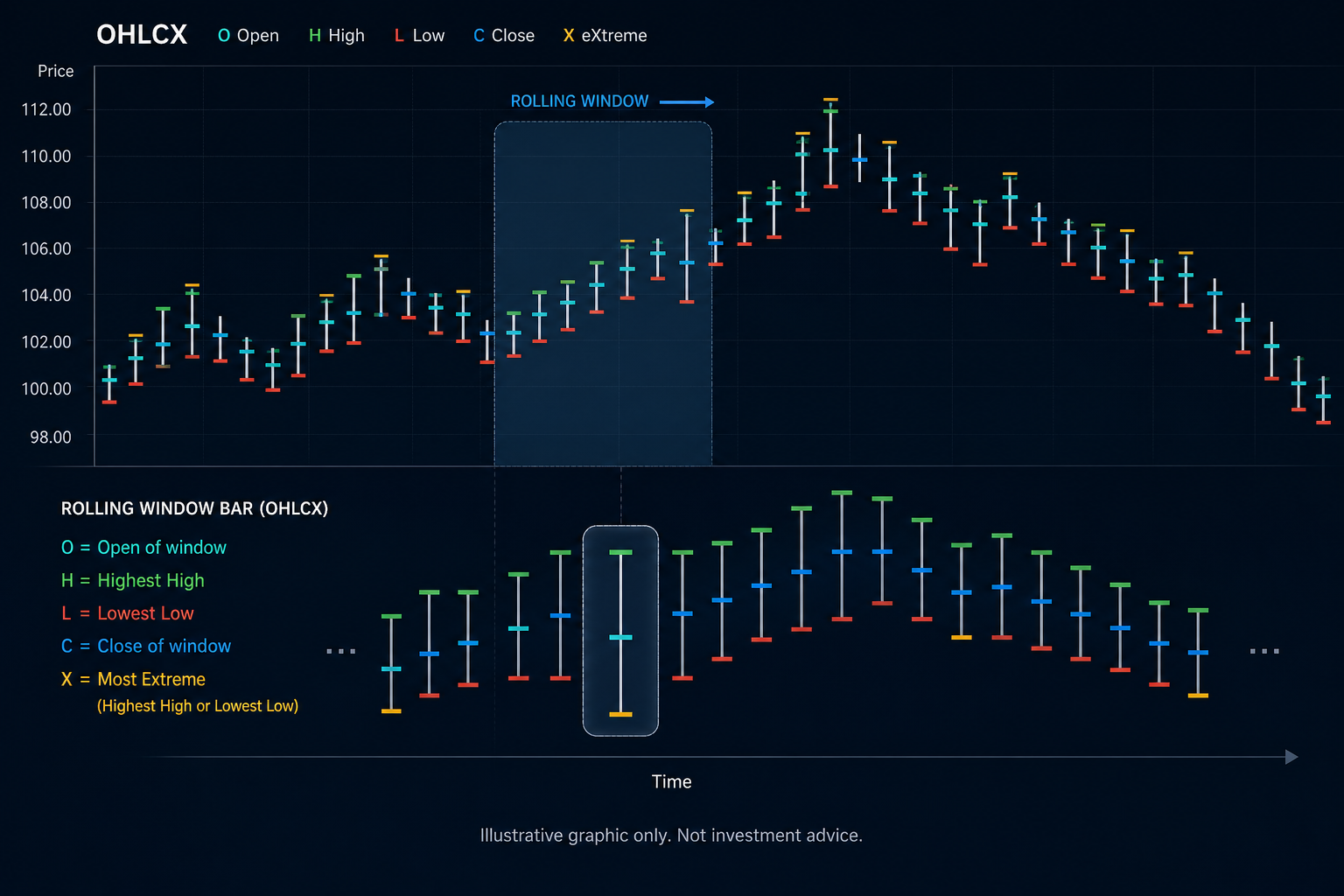
Walk-forward testing is a way to keep a trading strategy honest after the first backtest looks promising.
A normal backtest asks, “How would this rule have behaved across past market data?” That is useful, but it still leaves a problem: the trader can keep adjusting the rule after seeing the result. A moving average length changes. A filter gets added. A stop gets widened. A bad month gets explained away. The strategy may improve on paper, but the trader may no longer know whether the rule is durable or just better fitted to the past.
Walk-forward testing adds chronological discipline.
The trader uses one period of history to define or tune the rule, freezes the rule, then tests it on the next period that was not used for tuning. After that forward window ends, the process rolls forward and repeats. Robert Pardo’s work on walk-forward analysis describes it as evaluating trading performance on out-of-sample data, meaning data not used to optimize the strategy.
The value is not exotic math. The value is that the trader stops rewriting the past every time the present gets uncomfortable.
For active traders, the real question is practical: if this rule was frozen before the next window began, would it still have produced trades worth taking, tickets worth sending, and execution records worth trusting?
Walk-forward testing starts with a freeze
A walk-forward test only works if the trader freezes the rule before the forward window begins.
That freeze should include more than the indicator setting. It should include the entry rule, exit rule, stop logic, sizing method, time-in-force, instrument universe, allowed trading windows, and any filters that decide whether a signal is valid.
If the strategy uses staged exits, brackets, trailing stops, or discretionary review points, those belong in the frozen rule set too. A trader cannot compare results honestly if the backtest assumed one exit style and the forward window quietly used another.
This is where many strategies lose discipline. The rule is frozen in name, but adjusted in practice. A trader changes a filter after a bad week, skips trades that “felt off,” adds a new exception, or edits the test window after seeing the outcome.
Those changes may be reasonable, but they have to be labeled. Otherwise, the forward test becomes another backtest with better manners.
Out-of-sample is a behavior, not a checkbox
Out-of-sample testing is supposed to protect the trader from seeing the answer before taking the test.
That only works if the trader behaves like the future was unknown. No after-hours edits because the window looked ugly. No quiet filter changes because one sector broke the model. No deleting a trade because the chart “obviously” looked different in hindsight.
Back-tested performance is hypothetical, and Investor.gov warns that it does not reflect actual performance or predict how a strategy will perform in the future. That does not make backtesting or walk-forward testing useless. It means the trader should be careful about treating historical evidence like finished proof.
A clean out-of-sample review should separate three things:
- Frozen-rule trades: Signals that followed the rule exactly as written.
- Discretionary overrides: Trades skipped, adjusted, resized, or exited differently.
- Operational exceptions: Trades affected by platform issues, routing delays, data problems, halts, or situations where the trader could not act cleanly.
That separation matters because each bucket teaches a different lesson. A weak rule needs research. A weak override needs behavior review. A weak operational process needs workflow repair.
Blending them together makes the numbers easier to summarize and harder to trust.
What should a minimum viable walk-forward review include?
A walk-forward review does not need to look like an institutional research deck. It does need enough structure to keep the trader from telling stories after the fact.
At minimum, each forward window should record:
- Freeze date: When the rule was locked.
- Training window: The historical period used to define or tune the rule.
- Forward window: The untouched period used for evaluation.
- Rule version: The exact entry, exit, size, stop, and filter logic.
- Execution assumptions: Slippage, fees, spread, borrow, order type, and time-in-force.
- Trade count: Enough context to avoid treating a tiny sample as a verdict.
- Live or paper status: Whether trades were actually routed or simulated.
- Overrides: What changed, who changed it, and why.
- Operational tags: Days where trading conditions, data, routing, or account state affected execution.
- Decision after review: Keep, revise, reduce size, extend the test, or retire.
This does not have to be complicated. The point is to preserve the state of the strategy as it was understood at the time.
The forward window should answer a simple question: did the frozen version still make sense when the trader was no longer allowed to improve it with hindsight?
Do not judge the window by P&L alone
Forward results need context.
A profitable window can still hide poor execution, excessive risk, or a strategy that depended on one unusual trade. A losing window can still be useful if the rule behaved as expected, losses stayed within plan, and the trader learned which market condition weakens the setup.
The review should look beyond total return. For active traders, useful forward metrics include:
- Realized slippage versus expected slippage
- Fill rate versus modeled fill rate
- Average time in trade
- Maximum adverse excursion
- Turnover and transaction costs
- Stop behavior and gap behavior
- Partial fills and remainders
- Portfolio heat when several signals fire together
- Performance by liquidity window
- Difference between mechanical trades and discretionary overrides
This is where walk-forward testing becomes more useful than a clean equity curve. It shows whether the strategy is weakening, whether execution is drifting, or whether the trader is changing the plan under pressure.
A single rough window may be variance. Repeated deterioration across multiple forward windows deserves attention.
Sample size matters, especially for active traders
A walk-forward review can be honest and still too small to mean much.
Some strategies trade often enough to produce a useful forward sample quickly. Others need more time. A slow swing strategy may not generate enough trades in one month to support a strong conclusion. A fast intraday strategy may generate many trades, but still need review across different volatility and liquidity conditions.
This is why the forward window should match the strategy’s expected life and trade frequency. A fast setup may need shorter review cycles. A slower setup may need longer ones.
The key is to avoid theatrical conclusions. If the sample is too small, say so. “Insufficient data” is a valid result. It is also more useful than forcing a verdict because the trader wants closure.
Walk-forward testing is not there to create certainty. It is there to reduce self-deception.
Watch for overfitting and parameter fragility
Walk-forward testing helps expose a common research problem: the strategy may have been tuned too tightly to the past.
If tiny parameter changes destroy the forward result, the original rule may be fragile. If the strategy works only with one exact lookback, one exact stop, one exact time window, and one exact universe, it may be describing a historical accident more than a durable process.
Backtest overfitting is a known risk in financial strategy research. Bailey, Borwein, López de Prado, and Zhu describe the problem as selecting a strong-looking strategy from many tested alternatives, where the selected version may underperform out-of-sample because it was effectively fit to noise.
A walk-forward mindset does not eliminate that risk, but it makes the risk harder to hide. If the rule needs constant rescue after each new window, the problem is not the window. The problem is the rule.
A useful test asks:
- Does the strategy survive nearby parameter values?
- Does it work across more than one market condition?
- Does it depend on one unusually favorable period?
- Does the edge survive costs, spread, slippage, and missed fills?
- Does the live ticket behave like the model assumed?
If the answer is no, the trader has learned something important before increasing size.
Execution assumptions should roll forward too
Walk-forward testing is not only about signal logic. It is also about execution.
A forward window that assumes clean fills, stable spreads, instant cancels, and perfect exits may still be too generous. Simulated or hypothetical results have inherent limitations because the trades have not actually been executed, and CFTC Rule 4.41 specifically notes that simulated performance may understate or overstate market factors such as lack of liquidity.
For active traders, this matters because execution assumptions can decay just like signals. Slippage can widen. Participation can rise. The same order size can become less appropriate. A setup that worked in calmer tapes may become harder to trade when volatility, spreads, or crowding change.
Each forward window should update the trader’s view of execution quality:
- Were spreads wider than the model assumed?
- Did fills arrive near the expected price?
- Did partial fills change the position path?
- Did exits occur cleanly or require manual repair?
- Did several signals create correlated exposure at the same time?
- Did costs or borrow make the strategy less attractive?
- Did the trader’s live workflow match the modeled workflow?
This is where live testing and walk-forward testing should connect. The forward window is not only asking whether the signal worked. It is asking whether the signal could be traded the way the model described.
The live ticket has to match the forward rule
The forward rule and the live ticket should use the same language.
If the forward test assumes one full-size exit at the close, but the live trader uses OCO brackets, the comparison is not clean. If the model assumes a simple stop, but the live ticket uses a trailing stop, the forward result and live result are not measuring the same thing. If the model assumes a single exit, but the trader uses staged partials, the exit path should be documented.
This is not a problem if the trader names it. The live workflow may be better than the research assumption. It may reduce complexity, fit the account better, or make the strategy easier to manage.
But it cannot stay invisible.
A walk-forward review should include a plain-language ticket vocabulary. What order type was modeled? What order type was used live? Were exits attached before entry, staged after fill, or managed manually? Were partial exits part of the rule or a live adjustment?
The goal is not to make the model prettier. The goal is to compare like with like.
When should a strategy move from test to more size?
A forward test should not automatically lead to bigger size just because the last window was profitable.
Size should follow evidence that the process holds up.
Before increasing size, the trader should know whether the rule stayed frozen, whether execution matched the assumptions, whether slippage stayed tolerable, whether partial fills were manageable, whether the strategy still fit current liquidity, and whether the trader followed the workflow under pressure.
A strategy can look strong at small size and become weaker as size increases. Participation rate, average daily dollar volume, options depth, spread width, and exit urgency all affect whether the account can responsibly carry more exposure.
A better capital decision asks: did the forward window prove ticket fidelity, not just profit?
If the answer is no, the trader may need another window, smaller size, a simpler exit plan, or a revised rule.
How OHLCX supports walk-forward discipline
OHLCX does not validate a strategy, prove a walk-forward test, recommend trades, or decide whether a setup deserves capital. The trading decision remains with the user.
What OHLCX can support is the execution side of the walk-forward loop. OHLCX Light connects to an existing Schwab brokerage account and brings order entry, structured exit workflows, positions, charts, asset details, account information, and execution updates into one broker-connected workspace.
That matters because a walk-forward process needs the live ticket to reflect the frozen rule. If the rule calls for a linked target and stop, a staged entry, a trailing stop, or partial exits, those choices should be visible before the order goes live. OHLCX Light supports TSP, OCO, OTOCO, TRIM, and TRIMMER within the order workflow, while the trader determines the setup, sizing, order structure, and exit inputs.
Order history, timestamps, position visibility, and Risk Gauge context can help the trader compare the forward rule against what actually happened in the account. The value is not that OHLCX makes the model right. The value is that the trader has a cleaner way to keep the tested plan, the live ticket, and the review record close enough to compare.
The plan stays yours. The workflow can still be deliberate.
Let the next window teach you something
Walk-forward testing is not about making research more complicated. It is about making the strategy harder to fool.
Freeze the rule. Test the next window. Label overrides. Separate signal results from operational issues. Compare the live ticket to the modeled rule. Then decide whether the strategy deserves another window, a revision, a smaller size, or more capital.
That process will not remove uncertainty. It will make the uncertainty more visible.
Explore OHLCX to see how structured order entry, visible risk context, predefined exits, and reviewable order history can support the move from frozen rules to live-tested tickets.
Leave a Reply