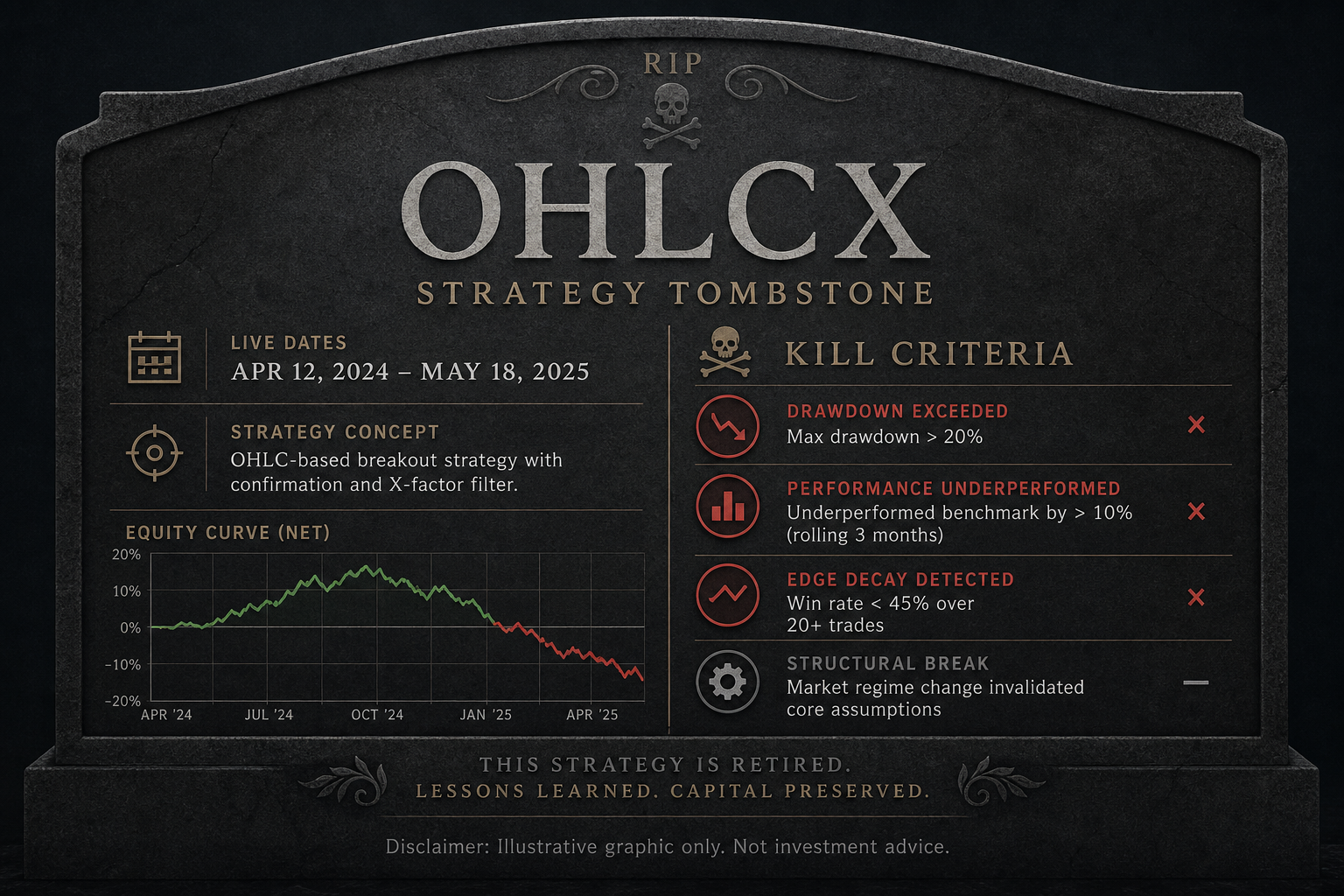
A trading strategy can take months, sometimes years, to earn trust.
You study the setup, test the rules, watch how it behaves across different markets, start small, refine the workflow, and slowly build confidence. Over time, the strategy becomes part of how you trade. You know the entry conditions, the exit logic, the expected drawdowns, the normal slippage, and the range of wins and losses that usually comes with it.
Then the behavior changes.
The same signals still appear, but the trades do not follow through the same way. Breakouts fail faster. Pullbacks stop holding. Spreads stay wider than they used to. Stops get hit in noise that once would have been survivable. Partial exits take more work. Short setups lose room after borrow costs. Names that used to diversify the book start moving together.
That is one of the harder decisions in trading because the strategy may not be “bad” in a simple way. The market may have changed. Execution friction may have increased. The strategy may need a cleaner filter, smaller size, a different exit rule, or a full pause before more capital is put behind it. In some cases, it may need to be retired from live use.
The mistake is making that decision from frustration or attachment. A trader can abandon a sound strategy after one ugly stretch, or keep funding a fading one because it used to work.
Martin Pring’s “weight of the evidence” framing is useful here. CMT Association cites Pring’s definition of technical analysis as maintaining a trading posture “until the weight of the evidence indicates that the trend has reversed.” Applied to strategy review, the point is practical: one bad stretch is not enough, but repeated evidence across fills, slippage, costs, correlation, and forward results should change the conversation.
Markets also adapt. Andrew Lo’s Adaptive Markets Hypothesis applies competition, adaptation, and natural selection to financial interactions, which is a useful way to think about why a strategy can work in one environment and weaken in another.
The question is not whether the strategy was ever good. The question is whether it still deserves capital in the market being traded now.
Why working strategies stop working
A strategy works because certain conditions support it, even when those conditions are not written into the rule set.
Liquidity matters. Volatility matters. Spread behavior matters. So do sector leadership, correlation, borrow availability, order-book depth, and the way a setup follows through after the signal. A trader may think the strategy is only about the entry, but the trade also depends on the environment around that entry.
When those conditions shift, the same setup can produce a very different result. A breakout strategy can struggle when follow-through weakens. A mean-reversion strategy can get punished when trends become more persistent. A short strategy can lose its edge when borrow costs rise or squeeze risk changes. A high-turnover strategy may still look reasonable before costs, then weaken once spreads and slippage widen.
This is why strategy review has to look beyond the signal. The entry can still make sense while the live trade becomes less attractive.
The strategy may not have failed all at once. The market may have stopped offering it the same terms.
Start with the cause before changing the rule
When a strategy starts underperforming, the first job is diagnosis.
Normal variance, execution decay, and true strategy decay can look similar if the only thing being reviewed is P&L. They require different responses.
A normal drawdown may call for patience, smaller size, or simply respecting the plan. Execution decay may call for different order handling, tighter liquidity rules, smaller clips, or a different trading window. Strategy decay may call for a revised rule set, a new forward test, or retirement.
Skipping that diagnosis creates two bad outcomes. The trader either rewrites a strategy that only needed time, or keeps trading a strategy whose conditions are clearly gone.
A useful review asks where the weakness is coming from before deciding what to do next.
What should traders measure before changing the strategy?
P&L should be part of the review, but it should not be the whole review.
For active traders, the early warning signs often show up around the ticket. Review the parts of the trade that decide whether the strategy can still be executed on acceptable terms:
- Slippage: Is realized slippage outside the strategy’s normal range?
- Spread width: Are spreads wider during the usual entry or exit window?
- Fill quality: Are limit orders being skipped more often or filled worse than expected?
- Partial fills: Are incomplete fills creating more remainders or manual repairs?
- Stop behavior: Are stops getting hit inside noise the original rule did not account for?
- Trade clustering: Are signals firing in names tied to the same sector, factor, or macro driver?
- Borrow and margin costs: Are short trades carrying more friction than the model assumed?
- Turnover: Is the strategy trading more often without better opportunity quality?
- Liquidity fit: Is the intended size still appropriate for the names being traded?
- Live-ticket consistency: Is the strategy being executed the same way it was tested?
Costs can change with the market environment too. Collin-Dufresne, Daniel, and Sağlam estimate trading costs using institutional trading data and find that realized trading costs are significantly higher when market volatility is high. That is a useful reminder that a strategy’s net result can change even when the signal logic has not.
The goal is not to build a giant dashboard for its own sake. The goal is to find the source of the problem before changing the rules.
Pause before you rewrite the rules
When a strategy starts failing, the temptation is to fix it immediately.
Add another indicator. Tighten the entry. Change the time window. Widen the stop. Remove the last losing setup. Add a market filter that would have avoided the worst stretch.
Some of those changes may be valid, but they should not happen while the trader is still reacting to the drawdown.
A pause gives the strategy room to be reviewed without continuing to receive normal risk. That may mean no new entries for a period of time, minimum-size observation trades, or a shift back into paper or incubation. The point is not to declare the strategy dead. The point is to stop adding capital until the cause is understood.
A simple sequence is usually enough: watch the metrics more closely, pause or reduce new entries, diagnose the weakness, decide whether to revise or retire, then redeploy capital deliberately.
That process keeps one bad stretch from becoming a funeral and one good rebound from becoming an excuse.
Revision is allowed, but it can create overfitting
A strategy that stops working does not always need to be retired. Sometimes it needs a new version.
Adding an indicator, factor, filter, or rule can be responsible when the change solves a specific problem. If trades keep firing during poor liquidity windows, a liquidity filter may make sense. If the setup only works when the broader sector confirms, sector strength may be worth testing. If stops are getting hit inside normal noise, the stop logic may need to reflect volatility more directly.
The change should answer an observable problem, not rescue the last weak period.
This is where overfitting becomes a real risk. The trader sees the current market, adds a filter that would have avoided recent losses, then adds another condition to clean up the next weak patch. The strategy starts looking better in the revised backtest, but it may only be getting better at explaining what just happened.
CMT Association’s backtesting material warns against curve fitting and cherry picking. In Matt Radtke’s backtesting discussion, he notes that if only one specific parameter version of a strategy looks attractive, “you probably don’t have a robust strategy,” and that a valid trading rule should show relatively stable performance across nearby parameters.
That source is speaking about backtesting, but the principle carries into live revision. If the revised version only works with one exact indicator value, one exact stop distance, one exact time window, and one exact filter combination, the trader may not have fixed the strategy. They may have customized it too tightly to the most recent market.
CMT Association’s May 2015 backtesting discussion makes the same broader point: as model complexity increases, the risk of overfitting rises, and simpler strategies built from intuitive factors are more likely to be robust than complex models with many factors.
The cleaner approach is to version the strategy. Keep the original record intact. Write down what changed and why. Freeze the revised rule. Start the next forward count from the revision date. Old results and revised results should not be blended into one track record.
A revision can be disciplined. It just has to be treated as a new test, not a quiet edit to the old one.
When retirement is the cleaner decision
Retirement should not be the first reaction, but it has to remain available.
A strategy may need to be retired when the original conditions no longer exist, when repeated revisions fail, when costs consume the edge, when liquidity no longer supports the size, or when the trader cannot execute the rule cleanly without turning it into something else.
That decision can feel personal because a working playbook carries memory. You remember the period when it helped. You remember the charts that made it compelling. You remember the confidence that came from having a repeatable setup.
Retirement is not a confession that the original idea was foolish. It is a capital allocation decision.
Investor.gov explains that back-tested performance is hypothetical and does not reflect actual performance, and that past performance cannot predict how an investment strategy will perform in the future. That matters because the trader’s job is not to honor the strategy’s best period. The job is to decide whether the current version still deserves capital, attention, and execution bandwidth.
A retired strategy can still be useful. It can become an archived lesson, a future research candidate, or a playbook that only returns under specific conditions. The key is to stop treating it like an active strategy when the evidence no longer supports active use.
Archive the strategy before memory rewrites it
A strategy archive should be plain enough to be useful later.
Save the launch date, rule version, instruments traded, forward-test windows, size changes, slippage history, fill behavior, costs, borrow assumptions, stop behavior, overrides, revisions, and the reason the strategy was paused, changed, or retired.
The archive should also say what would justify reopening the strategy. Without that, old strategies tend to return through memory instead of evidence.
At minimum, preserve:
- Last strong forward window
- First weak forward window
- Metric that triggered review
- Pause date
- Revision, retirement, or re-test date
- Execution assumptions at the time
- Notes on slippage, spreads, fill quality, borrow, and costs
- Whether live-ticket behavior matched the modeled rule
- What changed in the revised version, if anything
- Conditions required for a future re-test
This is not paperwork for its own sake. It is protection against romanticizing an old edge.
If the strategy comes back later, it should come back through a defined re-test, not because the trader missed trading it.
Clean up the workflow when a strategy changes status
A strategy is not paused, revised, or retired cleanly until the workflow reflects the decision.
Alerts tied to the strategy should be paused, relabeled, or moved to incubation. Watchlists should be updated. Automation rules should be disabled or versioned. Templates and default ticket paths should be reviewed so an old setup does not quietly reappear during a busy session.
Strategies leave habits behind. Old symbols, old position sizes, old alerts, old brackets, old exits, and old assumptions can survive long after the trader has supposedly moved on.
Residual positions and working orders need the same attention. A strategy can be retired for new entries while pieces of its risk are still live. Closing the playbook is not the same as cleaning the desk.
What about taxes and open positions?
A strategy may need to stop receiving new capital before every related position is gone.
That creates a separate wind-down decision. The trader may still need to manage open positions, tax lots, realized gains and losses, wash-sale considerations, or liquidation timing. Those issues can affect how the strategy is wound down, but they should not blur the strategy’s status.
The cleaner wording is simple: this playbook is retired for new entries, and the remaining positions will be managed under a separate exit plan.
That distinction matters because a strategy can stay “kind of active” for the wrong reasons. One position is still open. Taxes make liquidation inconvenient. A loss might be affected by a replacement trade. IRS Publication 550 explains that a wash sale occurs when stock or securities are sold at a loss and substantially identical stock or securities are bought or acquired within the 30-day period before or after the sale.
Tax treatment should be reviewed with a qualified professional, but the strategy’s status should still be clear. Retirement is about whether the strategy deserves new capital. Wind-down is about how existing risk is handled.
How OHLCX supports strategy review
OHLCX does not decide whether a strategy should be paused, revised, or retired. It does not validate a model, predict a change in market conditions, recommend trades, or replace trader judgment.
What OHLCX can support is the workflow between strategy logic and live execution. Strategy Builder lets traders define entry logic, sizing, schedules, and exit flows in a structured no-code workspace, then deploy to live Schwab accounts with a toggle. Its condition library includes price comparisons, volume, VWAP, pivot support and resistance, moving-average crosses, indicators such as RSI, MACD, ATR, and ADX, and more than 60 candlestick patterns grouped with AND/OR logic.
That matters when a strategy is being revised. If a trader adds a liquidity filter, changes a moving-average condition, adjusts an indicator threshold, or updates the exit flow, the change should be treated as a new version of the strategy logic. The product does not decide whether that revision is valid. The trader still has to write down why the rule changed, freeze the revised version, and test the next window honestly.
Strategy Builder also gives traders three automation levels: signals, trades, and orders. The orders level routes live orders through Schwab, while the strategy center lets traders review conditions, flags, generated signals, executed trades, statistics, performance charts, and timeline events. The page also lists deploy and pause controls per account, with an edit lock when live.
That gives the review process a practical place to live. A trader can build the strategy, deploy or pause it by account, monitor what fired, and review the resulting signals, trades, and timeline events. If the strategy needs revision, the trader can return to the rule logic and make the change deliberately rather than improvising around the ticket.
Exit flows also matter when a strategy is being revised or retired. If a playbook depends on TSP, OCO, OTOCO, TRIM, or TRIMMER, the trader needs to know whether those exits still fit the current market. OHLCX’s exit-flows page lists five structured exit types, including TRIMMER, OCO, and TSP, with routing through the official Schwab API.
The execution record matters after the decision. OHLCX’s features page describes order history with CSV export, date-range queries, symbol search, filled orders, cancelled orders, rejected orders, status, and timestamps.
The value is not that OHLCX tells the trader when to revise or retire a strategy. The value is that the trader has a more structured way to connect strategy rules, live execution, exit behavior, and reviewable records before deciding what still deserves capital.
Keep the discipline, even when the playbook changes
A strategy that stops working does not need drama. It needs a process.
Pause it when the evidence says the current version may no longer fit. Revise it when a specific rule change addresses a specific problem and can be tested honestly. Retire it when the strategy no longer deserves new capital. Archive it clearly so the story does not get rewritten later.
The goal is not to avoid every losing period. The goal is to keep capital, attention, and execution bandwidth attached to strategies that still fit the market being traded now.
Explore OHLCX Strategy Builder to see how traders can define, deploy, pause, and review rule-based strategies while keeping the final trading decision with the user.
Leave a Reply