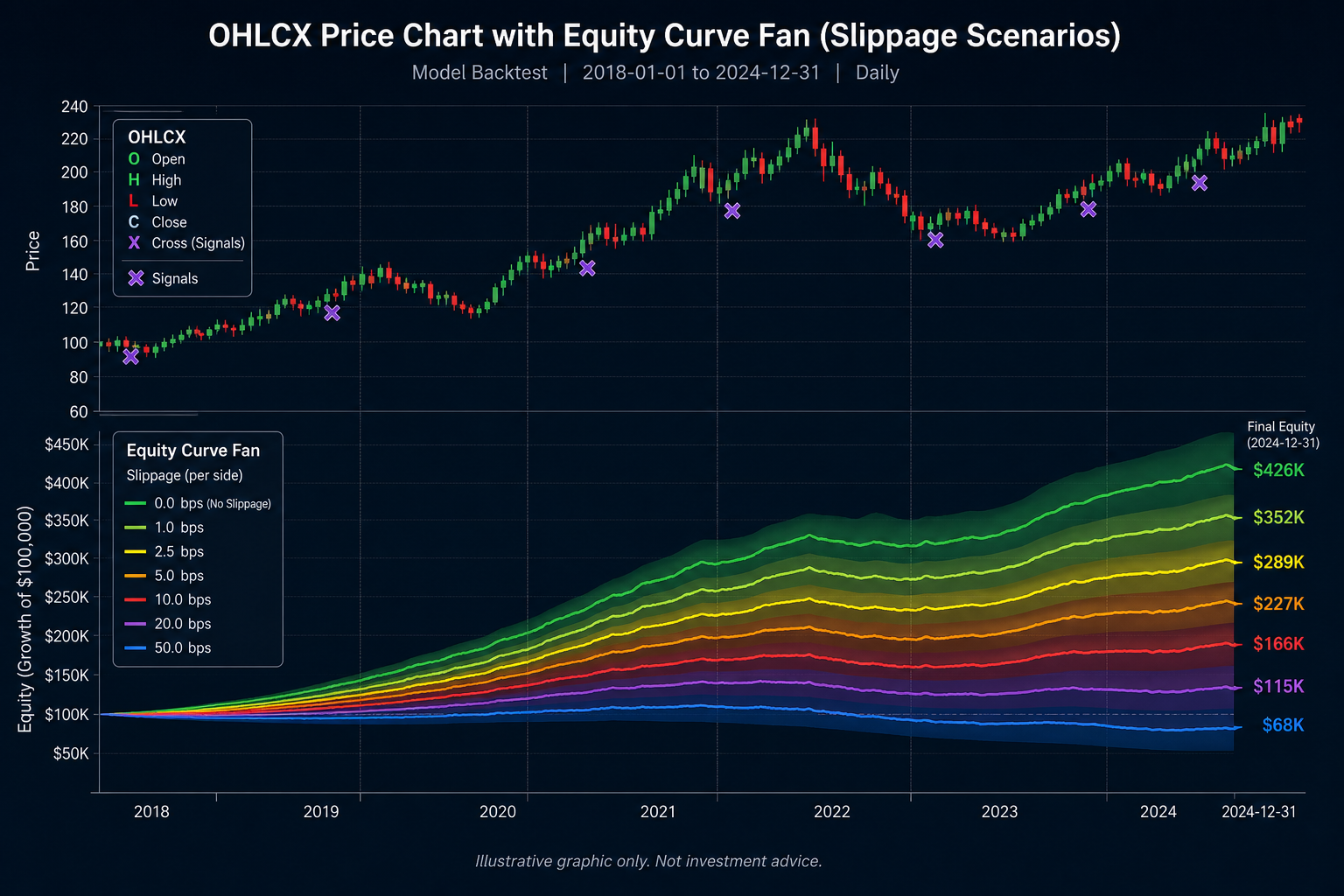
Backtesting is where a trading idea stops being a feeling and becomes a rule. For a technical trader, that might mean testing a breakout after rising volume, a moving average cross, a reclaim of support, a volatility contraction setup, or a defined entry-and-exit pattern. Instead of relying on memory or a few chart examples that looked obvious after the fact, the trader can ask a cleaner question: if this rule had been followed across past market data, what would have happened?
That is the value of a backtest. It can show how often a setup appeared, how trades behaved, where drawdowns showed up, how exits changed the result, and whether the idea deserves more serious review. It turns a chart read into something measurable.
Technical analysis can be part of that process. Andrew Lo, Harry Mamaysky, and Jiang Wang studied technical analysis through systematic pattern recognition and found that several technical indicators provided incremental information over a 31-year sample period. That does not mean every chart pattern predicts the future. It means technical ideas can be stated clearly enough to test.
But a backtest is still a model. A live ticket has to deal with the actual market: spreads, liquidity, partial fills, gaps, stop behavior, order timing, position size, fees, borrow, tax-lot decisions, and the trader’s ability to follow the rule while money is at risk.
That does not make backtesting weak. It makes the next step important.
A useful workflow connects the model to live testing: backtest the idea, trade it small, compare the execution record, update the assumptions, and only then decide whether the strategy deserves more size.
Past data helps define the question
A backtest is built from past market data. That is both its strength and its limit.
Past data gives the trader something concrete to study. It can show whether a setup historically appeared often enough to matter, whether the rule depended on one unusual period, whether losses clustered in specific regimes, and whether exits changed the trade more than the entry did.
That is useful. It is also not a promise.
Investor.gov explains that back-tested performance is hypothetical, does not reflect actual performance, and cannot predict how an investment strategy will perform in the future. That warning should not be treated as an attack on backtesting. It is a reminder to use backtesting for what it does well: forming a structured hypothesis, not declaring a finished truth.
The backtest can say, “This idea is worth testing.” It cannot say, “This idea will trade the same way next month.”
Technical analysis belongs inside a process
Technical analysis is strongest when it becomes specific.
“Support looks strong” is an observation. “Buy a reclaim of support after a failed breakdown, with a defined stop and a measured exit rule” is closer to a testable process. The difference matters because vague chart language is easy to remember selectively. Rules are harder to flatter after the fact.
A good backtest forces the trader to define the setup clearly enough that the same rule can be applied again. Where is the entry? Where is invalidation? What is the exit? What happens if the trade gaps through the level? What happens when the signal appears in five correlated names at once?
Those questions make technical analysis more useful, not less. They move the work from chart confidence into process design.
The strongest technical idea still has to survive the next layer: whether it can be executed in the live market the trader actually trades.
A small live test is part of the research
A strong backtest can make the work feel complete. The equity curve looks coherent. The drawdowns are visible. The rules are written. The trader can explain the setup.
That is progress, but it is not the same as live readiness.
The first live trades should be treated as process validation. Can the trader enter near the modeled price? Do the order types behave the way the test assumed? Are exits manageable? Do spreads, fees, and delays change the result? Does the trader actually follow the rule once the position is live?
The first goal is not to prove the strategy profitable. The first goal is to see whether the live ticket behaves close enough to the model to keep testing.
That is how backtesting becomes part of a trading workflow instead of a one-time report.
What should traders compare in a small live test?
Live testing only helps if the trader compares it against the backtest assumptions.
The review does not need to be complicated, but it does need to be written down. At minimum, compare:
- Modeled entry versus actual entry
- Modeled exit versus actual exit
- Expected slippage versus realized slippage
- Spread at signal time and send time
- Partial fills, remainders, and cancel-replace activity
- Time between signal, order send, and fill
- Stop, target, and trailing behavior
- Position size relative to liquidity
- Portfolio heat when multiple signals fire together
- Whether the trader followed the rule or changed it live
- Costs, borrow, and tax effects that were not included in the model
This is where the research becomes practical. The trader is no longer asking only whether the idea looked good in historical data. They are asking whether the strategy can be executed in the market they actually trade.
If that comparison does not happen, the backtest and the live account can drift apart quietly.
Fill quality can change the strategy
A backtest may treat a fill as a clean event. The signal appears, the order enters, and the model records the expected price.
Live execution is more specific. Investor.gov notes that the execution price for a market order is not guaranteed, that the last-traded price is not necessarily the price a market order will receive, and that parts of a larger order may execute at different prices when liquidity is not available at one price.
That matters most for active strategies, smaller names, options, fast entries, and trades near the open or close. It also matters when the average expected gain per trade is small. A strategy can look strong in the model and still become fragile if the live trader regularly enters a few cents worse, exits later than modeled, or misses the best fills.
The better question is not, “Was the backtest wrong?”
The better question is, “What fill quality does this strategy need in order to remain worth trading?”
Slippage, costs, and taxes deserve their own review
Slippage should not be one lazy number.
It can change by symbol, spread, time of day, volatility, participation rate, order type, and market regime. A one-cent assumption may be too conservative for one instrument and too generous for another.
A simple sensitivity grid can tell the trader a lot:
- Base slippage
- Double slippage
- Wider spread regime
- Missed-fill scenario
- Gap-open scenario
- Higher-cost or higher-borrow scenario
Costs belong in that same review. Transaction costs do not need to be dramatic to change a strategy, especially when turnover is high. Novy-Marx and Velikov found that transaction costs reduce both the profitability and statistical significance of stock-market strategies, which is why costs should be tested rather than treated as cleanup after the fact.
Taxes can create another difference between the model and the account. A backtest may show trade results before the trader considers realized gains, holding periods, tax lots, or wash-sale effects. IRS Publication 550 explains that a wash sale can occur when stock or securities are sold at a loss and substantially identical stock or securities are acquired within the 30-day period before or after the sale.
The point is not to turn a trading model into tax advice. The point is to avoid pretending that the modeled return and the account-level result are always the same thing.
For active traders, this matters most when turnover is high, losses are harvested or replaced quickly, or the strategy frequently exits and re-enters similar securities. Tax treatment should be reviewed with a qualified professional, but the assumption should not be invisible.
The point is not to punish the strategy. The point is to learn whether the edge still exists when execution gets less clean and the account has to absorb real-world costs.
Stops, limits, partial fills, and gaps need live evidence
Order types often behave more cleanly in a model than they do in a live market.
A limit order may touch the modeled price without filling in reality. A stop may define the trader’s invalidation level, but it does not guarantee the exact exit price in a fast move, gap, or thin book. Investor.gov explains that a stop price is not a guaranteed execution price because, once triggered, the stop becomes a market order and the execution price can differ based on available liquidity.
Partial fills also matter. A strategy that assumes full entry and full exit may behave differently when only part of the order fills, when one leg completes before another, or when a staged exit leaves a remainder that needs attention.
CFTC Rule 4.41 makes the same execution gap clear for simulated performance: hypothetical results have inherent limitations because the trades have not actually been executed and may understate or overstate market factors such as lack of liquidity.
This is not a reason to dismiss the backtest. It is a reason to let live evidence improve it.
Match the live ticket to the modeled strategy
One of the easiest ways for a backtest and live account to drift apart is for the trader to execute differently than the model assumed.
If the backtest assumes a single full-size exit at the close, but the live trader uses staged partials, the results are not directly comparable. If the model assumes immediate entry, but the live trader waits several minutes after each signal, that delay should be measured. If the model assumes a simple stop, but the live workflow uses a trailing stop or bracket, the difference should be documented.
This is not a criticism of the live process. The live process may be better. It may be more realistic. It may fit the trader’s risk tolerance more closely.
But it has to be compared honestly.
The backtest should describe the strategy the trader actually intends to execute, not a cleaner version that only exists in the research file.
Size should scale after the live process holds up
A clean backtest can tempt the trader to size based on the curve.
A better approach is to scale after ticket fidelity.
If the live test shows that entries are close to the model, exits are manageable, partial fills are understood, liquidity is sufficient, and the trader follows the rule, then the strategy has earned more review. If the live test shows missed fills, wider slippage, difficult exits, or unclear order state, those issues should be fixed before the size grows.
This matters because a strategy can be tradable at small size and fragile at larger size. Participation rate, average daily dollar volume, options depth, and exit urgency can all change how much capital the strategy can responsibly carry.
Scaling is not only a conviction decision. It is an execution-capacity decision.
How OHLCX supports the backtest-to-live loop
OHLCX does not validate a backtest, predict whether a strategy will work, or decide whether a setup deserves capital. The trading decision remains with the user.
What OHLCX can support is the execution layer where the tested plan becomes a real ticket. OHLCX is broker-connected execution technology that helps traders turn a defined plan into executable order logic through their existing Schwab account. Capital and custody remain with Schwab, and OHLCX is not a broker, custodian, recommendation engine, or substitute for trader judgment.
That matters in a backtest-to-live workflow because the trader needs to compare assumptions with actual order behavior. OHLCX Light connects to an existing Schwab brokerage account and brings order entry, structured exit workflows, positions, charts, asset details, account information, and execution updates into one broker-connected workspace.
Structured order entry can help the trader express the live version of the tested plan with clearer order logic. Exits like TSP, OCO, OTOCO, TRIM, and TRIMMER can be chosen before the order goes live, which gives the trader a cleaner record to compare against the original model. The trader still determines the setup, sizing, order structure, and exit inputs.
Order history, timestamps, position visibility, and Risk Gauge context can support the review step after a small live test. The value is not that OHLCX makes the backtest right. The value is that the trader has a cleaner way to turn the tested plan into a ticket, then compare the ticket back to the plan.
That is where the loop closes.
Let the backtest become part of the trading process
A backtest should not be treated as a promise, but it should not be dismissed either.
It is a useful way to study past market behavior, define rules, and decide whether a strategy deserves live observation. The next step is to connect that research to real execution: small live trades, recorded fills, visible exposure, actual exit behavior, and a review loop that improves the model.
That is how a backtest becomes more than a historical chart. It becomes part of a trading process.
Explore OHLCX to see how structured order entry, visible risk context, predefined exits, and reviewable order history can support the move from backtest assumptions to live-tested execution.
Leave a Reply