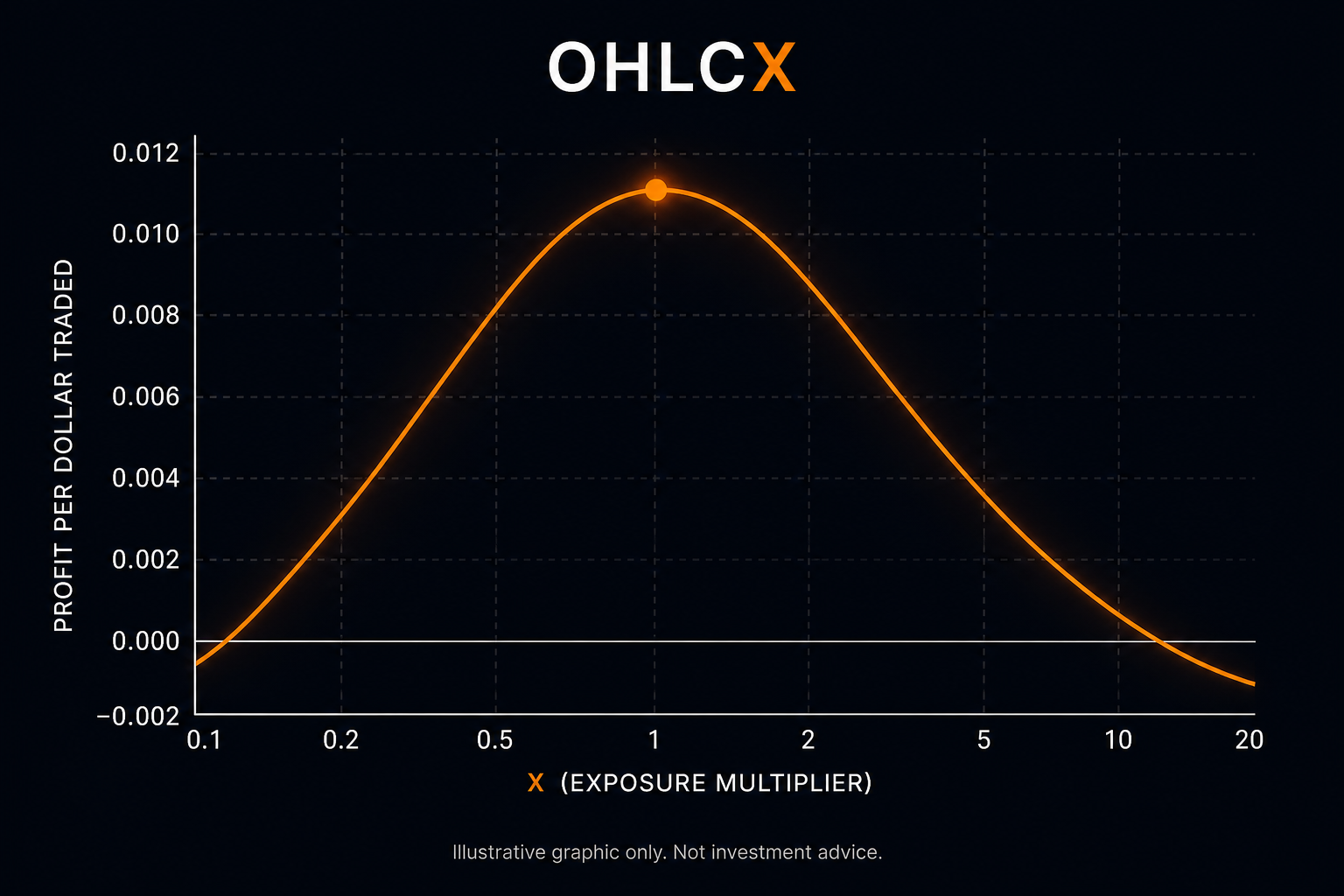
A strategy is not only judged by whether the signal works. It is judged by whether the trader can hold the right exposure, enter at a usable price, exit without breaking the plan, and stay disciplined when size increases.
That is where many strategies start to thin. The entry still appears. The chart still looks familiar. The setup may still have a real edge. But the trader adds more size, clusters too much exposure into the same theme, or asks a thin market to absorb more than it can handle. The strategy does not fail because the idea was useless. It fails because the exposure no longer fits the trader, the instrument, or the liquidity available.
That is the capacity problem.
Trading strategy capacity is the amount of size a strategy can handle before the trader’s own orders, risk exposure, or execution needs start reducing the edge. It is related to position sizing, but it is not the same thing. Position sizing asks how much capital or risk the trader puts into a trade. Capacity asks whether the strategy can still work at that size.
A simple example makes the difference clear. A trader with a $100,000 account may decide to risk 1% on a trade, or $1,000. If the stop is $2 away, that allows 500 shares from a risk-budget perspective. But if the stock is thin, the spread is wide, and 500 shares cannot enter or exit cleanly, the risk budget is not the real limit. Capacity is.
Charles Kirkpatrick’s CMT risk-management material points to a useful starting range: maximum position size is often calculated through methods such as risk of ruin, the theory of runs, or Kelly, and the material notes that many studies show an optimal percentage between 0.5% and 2.0% of total portfolio value, applied to the risk calculated for each issue. It also warns that drawdown risk requires testing all components of a system.
That gives this blog a practical center. A strategy is not only as good as its signal. It is only as good as the trader’s ability to size it, cap it, exit it, and reduce it when the evidence changes.
What capacity actually means
Capacity is the point where size starts changing the trade enough to change the result.
At small size, a trade may fill close to the expected price and exit without much effort. At larger size, the same setup may fill worse, take longer, create partial positions, or require more manual adjustment. The strategy may still look the same on the chart, but the account is no longer experiencing the same trade.
That is why capacity should not be reduced to “how much can I risk?” The better question is: how much exposure can this strategy carry before the order, the exit, or the portfolio starts working against it?
Capacity can show up in several ways:
- Trade risk: how much of the account is at risk if the trade fails
- Position exposure: how much capital is tied to the position
- Liquidity exposure: how much of the available market the order needs
- Portfolio exposure: how much the trade adds to an existing theme, sector, factor, or direction
- Execution exposure: how much slippage, partial fill risk, and exit difficulty the trade creates
- Trader exposure: how much attention and decision quality the position requires
That last one matters. A strategy that looks fine on paper can still be too large for the trader managing it. Exposure is not only mathematical. It is behavioral and operational too.
Start with exposure, not confidence
Confidence is not a sizing model. A trader can feel very confident and still be overexposed. They can have a good thesis and still size the trade beyond what the account, market, or workflow can support. This is especially common when a strategy has recently worked well. The trader starts treating the last run of results as permission to scale, instead of asking whether the next size level has been earned.
A more useful starting point is risk exposure.
For many active traders, the first written limit should be the amount of account equity at risk if the trade reaches its invalidation point. That is not the same as position value. A $20,000 position with a tight, realistic invalidation level may carry less planned risk than a $5,000 position in a volatile name with a wide stop. The risk is the distance between entry and planned exit, adjusted for slippage and the likelihood that the exit can actually happen near the expected level.
Using the CMT framework above, a practical starting range is often 0.5% to 2.0% of portfolio value at risk per issue or system, not 0.5% to 2.0% of notional position value.
For a trader turning that into a working ladder, a conservative structure might look like this:
| Exposure level | Account risk at invalidation | Use case |
|---|---|---|
| Test size | 0.25% to 0.50% | New or recently revised strategy |
| Working size | 0.50% to 1.00% | Strategy has enough live evidence and clean execution |
| Stretch size | 1.00% to 2.00% | Used only when liquidity, exits, and portfolio heat support it |
| No-go zone | Above 2.00% | Requires exceptional justification and system-level evidence |
These are educational starting points, not account-specific recommendations. The trader still has to adjust for strategy type, stop distance, liquidity, holding period, volatility, options risk, borrow, and correlation. The point is to stop treating size as a feeling.
Build the size ladder around promotion and demotion
The size ladder is the main control. Instead of jumping from “small live test” to “full size,” the trader defines plateaus. Each plateau has a purpose, and each one has to earn the next step through execution quality, not only P&L.
A useful ladder includes both promotion and demotion rules:
| Size level | Purpose | Promote only if | Demote if |
|---|---|---|---|
| Base size | Prove the strategy can trade live | Fills, exits, and slippage match the plan | Live behavior does not match the test |
| Working size | Normal operating size | The strategy holds execution quality over a fixed sample | Slippage, partials, or exit repairs increase |
| Stretch size | Limited use when conditions are unusually clean | Liquidity is strong, exposure is not clustered, exits are clear | Portfolio heat rises or exit quality weakens |
| No-go size | Hard cap | Do not promote beyond it | Any breach confirms the cap |
The demotion side matters most. Traders usually know what would make them increase size. Fewer write down what would make them cut size.
That is where exposure starts drifting. The trader increases after a strong streak, holds size after execution worsens, then only reduces after the damage is visible in P&L. A real ladder reverses that order. It uses fill quality, slippage, participation, exit behavior, and portfolio heat as early warnings.
A size ladder without demotion rules is only half a plan.
Use practical thresholds, not vibes
A capacity plan should include numbers the trader can review.
There is no universal threshold that works for every instrument or strategy. A liquid ETF, a thin small-cap equity, a weekly options contract, and a fast intraday strategy all need different bands. But a trader still needs written limits.
Useful starting thresholds include:
- Risk per trade: Keep normal working risk inside a defined band, often 0.5% to 1.0% of portfolio value at risk, with stretch risk capped before it reaches 2.0%.
- Participation: Measure the order against volume in the actual entry or exit window, not only full-day ADV. For active strategies, a trader may begin with a small participation band, such as 1% to 5% of observed volume in that window, then adjust based on fill quality.
- Slippage versus edge: If realized slippage regularly consumes 25% to 33% of expected gross edge, pause promotion. If it approaches half the expected edge, consider demoting the size step.
- Fill quality: If larger size creates repeated partial fills, missed intended entries, or regular cancel-replace behavior, the plateau has not earned promotion.
- Exit quality: If the exit cannot complete inside the planned window, or if exits breach the slippage band more than once in a review period, cap or reduce the size.
This is where the trader’s judgment still matters. The numbers are not magic. They are a starting structure. The trader has to calibrate them to the strategy’s expected edge, time horizon, spread, volatility, and liquidity.
Order mechanics make those thresholds necessary. Investor.gov explains that a market order’s execution price is not guaranteed, that the last-traded price is not necessarily the execution price, and that parts of a large market order may execute at different prices when liquidity is not available at one price. It also notes that a limit order is not guaranteed to execute.
In other words, exposure is not complete when the trader chooses the share count. Exposure is complete only when the trader understands how that size is likely to behave in the market.
Turnover lowers the amount of size a strategy can handle
Capacity is not only about how large one order is. It is also about how often the strategy needs liquidity.
A strategy that trades once a week may tolerate more size than a strategy that enters, exits, re-enters, and adjusts several times a day. Every round trip gives slippage and market impact another chance to eat into the expected edge.
This is where capacity research is helpful, even though institutional fund examples are larger than a typical active trader’s account. Bull, Serbin, and Zhu studied liquidity-demanding equity strategies and found an inverse relationship between fund size and net return because of rising market-impact costs. In one example, increasing a theoretical active fund from $5 billion to $20 billion decreased annual net return by 2 percentage points and reduced optimal monthly turnover from 50% to 34%.
The practical lesson is not that a trader needs a fund-level model. The lesson is that size and turnover should be reviewed together.
If a strategy trades often, the exposure limit should be lower unless the live record proves the fills can hold. A high-turnover strategy does not just need a good entry. It needs repeatable execution.
Portfolio heat can reduce capacity before one ticket looks too large
A trader can be under the limit in every individual position and still be overexposed at the account level.
That happens when trades share the same driver. Five separate tickers may really be one semiconductor trade, one regional bank trade, one high-beta software trade, one oil trade, or one small-cap liquidity trade. Each ticket may look reasonable by itself. Together, they can create an exit problem.
Kirkpatrick’s CMT material separates issue risk, system risk, market risk, and portfolio risk. It lists liquidity and trend change under individual issue risk, says the principal portfolio risk is the size of losing positions, and summarizes portfolio risk as position sizing.
For this blog, that matters because capacity is not only a ticker-level decision. A trader should know whether exposure is concentrated by symbol, sector, factor, theme, direction, strategy, or exit timing.
A useful exposure plan might say:
- No more than one stretch-size trade in the same theme at a time
- Cluster risk across related names cannot exceed the account’s normal strategy risk band
- If two correlated positions trigger exits in the same window, new entries in that theme pause
- If portfolio heat rises, the next promotion step is delayed even if the single-name trade looks clean
That is the part many sizing plans miss. The problem is not always that one position is too large. Sometimes the whole cluster is too large for the same exit door.
Options and short books need separate exposure math
Equities, options, and short strategies do not hit capacity in the same way.
For equities, the main questions are usually share size, dollar volume, spread, depth, time window, and exit path. For options, the stock can be liquid while the contract is not. Bid-ask width, open interest, expiration, strike depth, implied volatility, and multi-leg completion all matter.
A 10-contract trade may be fine in one chain and messy in another. A spread may look good in theory, then become difficult when one leg fills and the other does not. A trader scaling options should not rely only on delta-equivalent stock exposure. The contract market has its own capacity.
Short strategies have another constraint: borrow. The chart setup can still be valid while borrow cost or availability reduces the economic edge. Short exposure also has asymmetric risk if the trade moves sharply against the position.
This is why exposure should be written by style. A swing equity strategy, intraday scalp, options spread, and short book should not share one generic size rule.
Exits reveal whether exposure is too heavy
Capacity often shows up more clearly on exit than entry.
Getting into a position may look manageable, especially when the trader is patient or the market is moving in the intended direction. Getting out under pressure is different. Larger exits can create more slippage, more partial fills, and more decisions at the worst time.
Stop orders are a good example. Investor.gov explains that when the stop price is reached, a stop order becomes a market order, and the execution price can deviate from the stop price because of available liquidity.
That does not mean stops are bad. It means the trader should not confuse a stop trigger with a guaranteed exit price.
Before increasing exposure, the trader should know what happens if:
- The first exit only partially fills
- The spread widens during the planned exit window
- The stop triggers in a fast move
- Several correlated positions need to be reduced at once
- The trader is not at the desk when the position requires attention
The larger the exposure, the less room there is for vague exit policy.
How OHLCX supports exposure discipline
OHLCX does not tell traders how much risk to take. It does not detect capacity limits, guarantee fills, reduce slippage, recommend position size, or decide whether a strategy deserves more capital.
What OHLCX can support is the workflow around exposure. The OHLCX platform connects directly to Schwab thinkorswim through official APIs for live order routing, account data, positions, fills, and real-time account state. It also supports auditability around orders and account actions.
Strategy Builder is relevant because it lets traders define entry logic, sizing, schedules, and exit flows in a no-code workspace, then deploy to live Schwab accounts. The page also describes position sizing and allocation controls, schedule windows, risk management caps before orders route, deploy and pause controls, and strategy-center tabs for reviewing conditions, signals, trades, statistics, performance, and timeline events.
The OHLCX features page also supports the review side of the workflow with real-time positions, live account and risk information, bid/ask spreads and volume, order history with CSV export, filled, canceled, and rejected orders, status, timestamps, options data, and Level 2 market depth.
Structured exit flows matter because exposure is not controlled only at entry. OHLCX’s exit-flows page lists TRIMMER, OCO, TSP, Limit, and Market exit flows, with routing through the official Schwab API. TRIMMER splits a position into configurable tranches, OCO pairs a profit target with a stop-loss, and TSP uses a configurable trailing offset.
The value is not that OHLCX decides the trader’s capacity. The value is that the trader can define size, attach exits, set risk caps, deploy or pause strategies, and review what happened in the live record.
That is what a capacity process needs. Not more confidence. Better exposure control.
Scale the trader, not just the trade
A strategy that works at small size has earned attention. It has not automatically earned more exposure.
Before adding size, the trader should ask five questions:
- Does the planned risk stay inside the account’s written exposure band?
- Does the order stay inside a reasonable share of the liquidity available during the actual trading window?
- Does slippage stay small enough relative to expected edge?
- Can the exit work if the trade has to be reduced quickly?
- Does the new size create too much portfolio heat across related positions?
If the answer is no, the strategy has not earned the next size step.
That does not mean the strategy is bad. It means the current exposure is not justified yet. The trader can reduce size, widen the sample, lower turnover, add liquidity filters, change the exit structure, or keep the playbook at the level where it still behaves cleanly.
A strategy is only as good as the trader’s ability to control the exposure behind it.
Explore OHLCX to see how structured order entry, Strategy Builder, Risk Gauge visibility, exit flows, and order history can support exposure discipline from strategy logic to live ticket review.
Leave a Reply